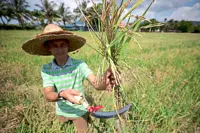
KEPALA BATAS: The new padi variety MR333 has been developed specially for granary areas with a potential yield of up to 9.96 tonnes per ha, said Datuk Seri Mohamad Sabu.
The Agriculture and Food Security Minister said it is in line with the objectives of the National Rice Industry Reform Plan.
“It has the potential to produce impressive yields of up to 9.9 tonnes per ha, as recorded in Jerteh, Terengganu, while farmers in Sekinchan reported harvests reaching around 9.96 tonnes per ha.
“With its high yield and disease-resistant nature, coupled with strict adherence to good farming standard operating procedure, God willing, this new variant will bring lucrative returns for farmers,” he said.

Mardi (Malaysian Agricultural Research and Development Institute) would conduct further studies on the threat of keladi agas and identify the best way to control the invasive weed.
“When we go down to the padi fields, we can see that the plant is becoming more widespread.
“It used to be just an ordinary plant, but now it is affecting rice growth,” he said.
Mohamad Sabu said one reason the weed multiplies easily is because farmers do not follow SOP for fertiliser application.
“When the rice has just begun to sprout, if fertilisers are applied too early or excessively, it would result in the spread of keladi agas.
“That is why it is important to follow the correct sequence: spray the herbicide first, then apply the fertilisers,” he explained.
Mohamad also reminded farmers to comply with SOP for weed control, including herbicide spraying starting from land preparation and again between the 15th and 18th day after the planting of the rice.
Meanwhile, farmer Muhamad Rafirdaus Abu Bakar, 49, who has been in the business for 30 years, said he would usually have a yield of about four to five tonnes of padi per ha each year.
But since adopting the MR333 variety two years ago, his yield has increased by 50%.
“Since I joined the pioneer programme two years ago using the MR333, I could get more than eight tonnes per ha in the last four harvesting seasons,” he said.
Muhamad Rafirdaus, who hails from Megat Dewa, Kodiang, said the new variety should be adopted by all padi farmers as it could boost their income.
Another farmer, Mohd Nazri Murad, 54, said the MR333 variety is more resilient as it allows the padi to mature faster.
“Since adopting to this new variety, I’ve experienced fewer pest problems than usual.
“The shorter maturity cycle also means that I can plan my planting season more efficiently, reducing the cost while increasing the overall productivity,” he added.
Nazri said the improved yield and reduced risks has given him greater confidence to continue with MR333, especially as market demand for higher-quality padi remains strong.
They were among some 100 padi farmers who attended the MR333 launch in Kampung Lahar Minyak yesterday.
Also known as Menora, the new padi variety is the result of intensive research by Mardi, supported by an allocation of RM36.1mil under the 12th Malaysia Plan.