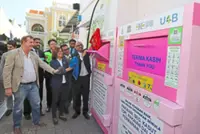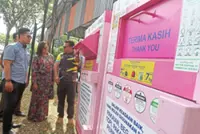
GEORGE TOWN: The next time you want to discard your old clothes, costume jewellery and bags, look out for the bright pink textile recycling bins placed around the island.
As of now, 25 bins have been placed at central locations in Tanjong, Bukit Bendera, Jelutong, Gelugor, Bayan Baru and Balik Pulau for unwanted items.
Other items accepted are shoes, hats, accessories, plush toys, bedsheets, towels and even undergarments which must be in good condition.
The dos and don’ts are pasted on the bins.
The textile waste recovery programme is an initiative by the Penang Island City Council (MBPP) in partnership with the Life Line Clothing Malaysia (LLCM).
MBPP mayor Datuk A. Rajendran said the state generated a daily average of 800 tonnes of waste, with 45% recycled and the rest sent to landfills.
“Every year, tonnes of clothing, fabric and other textiles end up in landfills which take years to decompose and this contributes to environmental pollution.
“This is not just a waste of resources, but a loss of opportunity,” he said.
Earlier, the signing of an MOU between MBPP and LLCM was held at City Hall.
Rajendran said although textile waste made up only 2% of Penang’s total waste composition, separating it from the mainstream waste will ease the environmental and economic burden.
“Based on similar programmes carried out by LLCM in Johor, Selangor and Melaka, Penang is projected to recover 421,200kg of textile waste annually.
“The pink textile recycling bins are to encourage public participation,” he said, adding that collection points will increase with private sector support.
LLCM chief managing director Dale Warren said the programme is aimed at providing a separate and convenient collection system for textiles.
“Rather than letting unwanted clothing and fabrics end up in the landfill, we are creating a pathway for them to be reused, recycled and returned into the circular economy.
“This is about giving textiles a second life, reducing waste and building a sustainable way of living for everyone.
“Circular economy, community responsibility and sustainable living are not just industry terms – they are practices embraced by people of all levels,” he said.
Warren said there is a need for innovative and committed measures to create behavioural change, shifting towards a system where resources are reused and recycled rather than wasted.
“This programme will encourage the community to see textiles not as rubbish, but as a recyclable commodity.
“Textile production has been on a staggering trajectory.
“In the 1900s, it was just 1.5 million tonnes and by 1950, it had grown to five million tonnes,” he said, adding that it hit 124 million tonnes in 2023.