OLD clothes, shoes, handbags and many more fabric recyclables don’t have to end up in landfills.
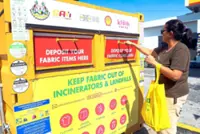
Across Ipoh, Perak, fabric recycling bins are giving residents an easy way to dispose of such unwanted items, thus helping to reduce waste.
Placed at petrol stations, shopping centres and neighbourhood corners, these bins are quietly reshaping how residents think about waste.
The initiative, which began in June last year, is a collaborative effort between Ipoh City Council (MBI) and several private sector partners.
On the bins are clear instructions regarding what can be placed inside, namely clothes, undergarments, scarves, hats, belts, socks, shoes, handbags, schoolbags and accessories.

Growing support
A growing number of Ipoh residents see the fabric recycling facility as a practical and environmentally friendly solution for unwanted clothes.
Marketing manager Sundeep Kaur is glad that the dedicated recycling bins exist for disposing of clothes she no longer wants.
She shared that, like many others, she used to keep unworn garments or discard them without realising there was a more sustainable option available.
“I discovered such a bin at a petrol station near my neighbourhood and have been using it since.

“It provides a practical and environmentally responsible way to manage clothes I no longer want,” Sundeep added.
For administrative executive Noor Ashikin Mustafa Kamal, the facility has changed how she manages clothes her four children have outgrown.
“It is really much more convenient now, as previously I would have cut up the clothes and thrown them away with household rubbish.
“Now I can select items that are still usable and drop them off so others can use them too,” she said.
Another Ipoh resident, Aminudin Saidi, who works in the housekeeping section of a mall, said he disposed of clothing about two or three times a year, comprising mostly traditional attire such as baju Melayu that he no longer wears.
He has also been encouraging friends and family to use the facility.
“It is about doing our part and helping others who may need these items,” he said.
For Nor Daliah Md Daud, an auxiliary policewoman with two children aged five and three, the facility offered an avenue to properly dispose of clothing that they no longer use.
Norsuhada Muhammad, who had learned about the initiative, said her three-year-old would outgrow his clothes quickly yet they were still in good condition.
“It feels wasteful to throw them away.
“The facility means usable items can be separated and shared with people who need them.
“The convenience of the location, especially in malls, is a plus point,” said the marketing senior executive.
Administrative assistant Phang Lai Kham said she regularly cleaned out her closet, putting aside unused stuff in recyclable bags.
“I used to either give the clothes to friends or donate to orphanages or the Salvation Army.
“Now, I have another option to drop off unwanted clothes and bags,” she added.

Low-carbon goals
On Nov 1, Ipoh mayor Datuk Zamakhshari Hanipah told reporters that more than 53,000kg of used fabric were collected for recycling from June to October last year.
The joint initiative is between MBI, the private sector and Life Line Clothing (M) Sdn Bhd (LLCM) which recycles the donated items.
Zamakhshari said the efforts supported the goal of becoming a smart and low-carbon city by 2030, in line with the Ipoh Doughnut Economics framework.
The mayor revealed that 35 clothing recycling bins had been installed within MBI’s jurisdiction, including at several Shell stations, supermarkets, residential areas and schools.
LLCM manager Mohamad Zaki Suratman said the company had implemented a multi-pronged approach to ensure cleanliness at its textile recycling collection points, and prevent bins from overflowing, particularly during peak disposal periods.

He said each LLCM recycling bin was fitted with a QR code, allowing the public to report bins nearing capacity.
“By scanning the code, users can send an alert via WhatsApp, enabling the logistics team to respond promptly.
“In addition, all bins have information to guide the public on proper disposal practices.”
Mohamad Zaki said collection schedules were also based on seasonal and behavioural trends.
Textile disposal, he said, typically increased between December and April, coinciding with major festive and cultural celebrations.
“These periods often prompt households to declutter as part of their spring cleaning.
“A similar spike is observed when recycling programmes are newly introduced in an area, as residents dispose of accumulated clothing and fabric.

“However, this surge is temporary and tends to stabilise once recycling becomes part of regular household habits.
“Our aim is to ensure textile recycling remains convenient and hygienic, while making a positive environmental contribution.”
He said MBI was not collecting payment for the initiative, but incentives were provided to the public who participated in the recycling programme.
These incentives come in the form of shopping vouchers from online fashion platforms or LLCM’s shops.
Waste diversion strategy
Perak housing and local government committee chairman Sandrea Ng Shy Ching said the initiative showed that large-scale textile waste diversion could be effectively carried out at local authority level with the right partnerships and strong community support.
She said the volume of fabric collected reflected growing awareness and participation in recycling efforts among residents.
“This initiative forms part of a broader strategy to strengthen waste diversion programmes and reduce reliance on landfills in Perak.
“The state government was first introduced to LLCM in 2024, and I visited the company’s recycling facility in Selangor to better understand its operations.
“Following the visit, the company was invited to present its recycling model to local authorities in Perak,” she elaborated.
Sandrea said Ipoh was the first local authority in Perak to formalise a collaboration with LLCM and implement a large-scale fabric recycling programme.
Its success, she said, was now viewed as a reference point for other local councils to implement similar initiatives.
“The state government is focusing on strengthening recycling ecosystems, expanding source separation practices and extending landfill lifespans.
“Fabric recycling complements existing waste diversion efforts, including e-waste, food waste and used cooking oil collection.”
She said data showed that Malaysia generated an estimated two million kilogrammes of fabric waste daily.

“Such waste places significant pressure on landfill sites and increases solid waste management costs.
“LLCM sorts the collected fabric materials into as many as 500 categories, before processing them for resale in the secondhand market or upcycling them into new products,” said Sandrea.
Extending lifespans
Perak science, environment and green technology committee chairman Teh Kok Lim said sharing and recycling unwanted clothing was an effective way to reduce household waste and support environmental sustainability.
He said many households tended to store large amounts of unused clothing, even though most items remained in good condition and could still be used.
“With the quality of fabrics today, clothes rarely tear or wear out quickly, which makes recycling and sharing used clothing a practical solution,” he said.
Teh stressed that environmental awareness should begin with simple daily habits.
He encouraged the public to adopt the 5R – refuse, reduce, reuse, recycle and recover – concept in their everyday lives.
He said initiatives to promote recycling of used clothing would be implemented through local councils, focusing on awareness programmes and community- based efforts.
Teh said sharing and reusing clothing was a common practice in the past, particularly during periods when resources were limited.
“Our parents and grandparents shared and reused clothes not only to avoid waste, but also to help one another.
“Reviving this practice would help reduce textile waste while strengthening community bonds and supporting long-term environmental sustainability,” he said.
Aeon Mall northern region manager Badrol Shariff said the used clothing recycling initiative was aimed at raising public awareness on responsible disposal and sustainability.
“The response so far has been very good,” he said.
“Ipoh residents have been very supportive and are willing to participate in this initiative.”
Badrol added that the collection bins were specially designed to ensure ease of use, and so far, the public had adhered to guidelines by depositing only used fabrics at the two recycling bins placed at Aeon Mall Kinta City and Aeon Mall Ipoh Station 18.
Multiple challenges
Ipoh City Watch president Dr Richard Ng said recycling used fabric could help reduce landfill waste, conserve resources and support circular-economy initiatives, but its long-term success depends on proper management.
He revealed challenges faced by similar initiatives implemented in the Klang Valley and other parts of Perak.
He said while several non-governmental organisations (NGOs) in Perak actively collected used clothing for distribution to the needy through free-market concepts, many programmes could not survive long term.
“Among the issues reported were overflowing collection bins, irregular collection schedules, scavenging, vandalism and theft.
“In some cases, bags of donated clothes were torn open and scattered, while hotline numbers provided for assistance were reportedly unresponsive.
“Contamination has also been a major concern, with food waste, broken electrical items and mixed household rubbish found in fabric bins,” he noted.
Richard said low-quality synthetic materials further complicated recycling efforts, resulting in some items ultimately ending up in landfills.
“To address these challenges, stronger public education efforts have been proposed, including clearer signage on bins, wider use of social media and council communication channels as well as collaboration with NGOs and Rukun Tetangga groups.
He suggested MBI prioritise such initiatives by supporting community thrift shops, upcycling workshops and social enterprises, particularly those involving women, youth and B40 communities.
“This can be achieved if MBI provides low-rent spaces,” he said and expressed hope that the latest initiative would be sustainable in the long run.