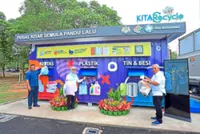
PETALING JAYA: The description is clear. One bin is for recyclable plastics, one for paper, one for aluminium cans, one for glass bottles and one for the rest.
It’s quite simple, right? Wrong.
These recycling bins are being misused, with people not following instructions and mixing up their waste, making it all unusable.
Worse, there are also those who vandalise these bins, taking out the contents to sell on their own while damaging the bins.
Then, there are the special fabric bins found in certain malls, where unwanted clothing can be disposed of.
These too are often vandalised by those who want to steal the clothes and sell them off.
Most of the misuse and vandalism happens in residential areas, says Nik Suzila Hassan, co-founder of social enterprise Kloth Circularity.
Since 2018, Kloth Cares has been committed to promoting sustainable textile recycling practices and has installed more than 500 fabric recycling bins in several key regions.
Some people dump food waste and broken electrical appliances into these fabric recycling bins, she said.
“People mistakenly assume that all recycling bins accept all types of materials, or believe that it is the recyclers who are responsible for sorting out the mixed items.
“There were also cases of scavenging and theft, where people remove items from the bins to sell them off in second-hand markets.
“In one case, CCTV footage showed items being stolen from one of our bins at a petrol station and loaded into a vehicle,” she said.
Nik Suzila said they improved the bin design with narrower and more secure openings to deter unauthorised access.
They are also placing bins in busy areas, where there is high foot traffic and scavengers are likely to be seen.
Najah Onn, the founder of Fashinfidelity, a community, content and consultancy platform, said many people raid fabric recycling bins out of economic necessity – seeing them as low-risk, high-value sources of clothing that can be reused, resold or even worn.
“They believe these bins hold donations meant for redistribution, not materials destined for industrial recycling,” she said.
“If people are raiding because they want clothes, we should design a system that allows this without compromising the recycling stream.
“We can have ‘take first, recycle the rest’ community shelves next to bins.
“Also, if clothes are piling up next to the bins, it invites theft,” she said.
Ardent recycler Leen Abdul, 45, from Kuala Lumpur knows too well about that.
Her condominium’s recycling section became a mini dumping ground for residents and was eventually shut down.
She said residents indiscriminately threw things like furniture, glassware, beds, shoes, photo frames and other items into the recycling area.
“The residents were just throwing all their unwanted stuff without sorting them. It got so bad that the condominium management shut down the recycling section,” the homemaker said.
Leen now separates her garbage at home and then goes to the nearby malls to discard them properly for recycling.
Another avid recycler bank officer Sameerah S., 51, from Ampang said she periodically collects old clothes and glass for recycling.
“I have three growing kids and they tend to grow out of their clothes fast. I pass down some of them to my other sisters and for the rest I usually find a fabric bin,” she said.
Prof Richard Ng, president of Ipoh City Watch, a non-governmental organisation with aims to make Ipoh the most liveable city in Malaysia, said there needs to be proper engagement, education and enforcement.
“Recycling bins will only be effective when people understand how to use them.
“Many cities like Ipoh, Kuala Lumpur, Penang and even Singapore face some common issues.
“These include contamination or mixing food waste with recyclable materials, lack of awareness, inconsistent waste collection and lacking the habit to separate waste at source,” he said.
Asked if more of the recycling bins should be put up, Ng said it would be better to place them at strategic locations.
“Some of the best locations include learning institutions, high-traffic public areas, housing areas and apartments, markets and food courts, community halls and government buildings,” he said.
“It’s also better to start young, teaching children at home or at schools to create long-term behavioural change,” he said, adding that short videos can be made to inform the people on how to use the recycling bins.
“Reward-based recycling programmes can also be held where folks can redeem daily goods or vouchers.”