PETALING JAYA: Making preschool education mandatory for children from age five could help close learning gaps but there needs to be urgent investment in teacher training and rural infrastructure, say education stakeholders.
The move is part of the major shift in the education landscape which includes plans to place preschool to secondary education fully under the Education Ministry (MOE), with pre-university and higher education under the Higher Education Ministry (MOHE).
Parent Action Group for Education Malaysia (Page) chairman Datin Noor Azimah Abdul Rahim said the reform was timely and necessary.
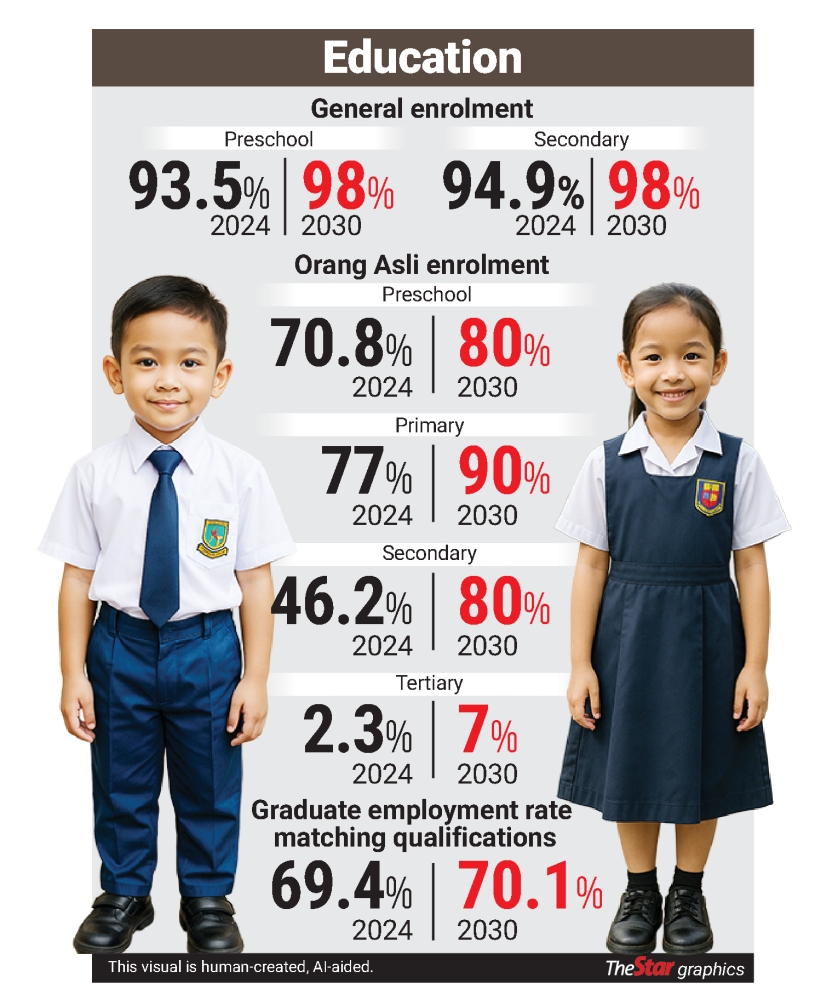
She said the policy could significantly improve a child’s school readiness, particularly in literacy, numeracy, and socio-emotional development.
“It can help narrow the gap between children from different socio-economic backgrounds,” she said.
However, Azimah stressed the importance of accessibility and teacher preparedness.
“Preschool infrastructure is still lacking in many rural, remote and underserved communities,” she said, adding that early childhood educators must be well-trained not only in pedagogy, but also in nurturing holistic development.
She also said the national curriculum must remain adaptable, inclusive, and developmentally appropriate to avoid premature academic pressure in preschool settings.
Azimah was commenting on the educational reforms in the 13th Malaysia Plan (13MP) tabled yesterday.
She said the planned system can better support a seamless learning experience for students, allowing for a more age-appropriate approach to curriculum design, teacher training, assessment practices, and educational support systems.
She stressed that effective coordination between the two ministries will be critical, particularly at transition points like post-secondary education.
“A potential risk is the fragmentation of the education continuum.
“If oversight of this critical stage is moved to the MOHE without strong coordination with the MOE, there could be misalignment in curriculum, assessment standards, or expectations – especially during this critical phase in students’ development,” she said.
Meanwhile, National Autism Society of Malaysia (Nasom) chairman Julian Wong commended the government’s efforts to expand special education facilities and capacity nationwide under 13MP.
This includes building Special Education Integrated Programme (PPKI) blocks in 34 existing schools nationwide, along with the development of new schools equipped with PPKI facilities.
“For a long time, the shortage of appropriate facilities has been a major barrier for children with autism and other learning difficulties to access education.
“The construction of new PPKI blocks and schools will directly increase the capacity for inclusive education, providing more opportunities for children who might otherwise be left behind,” he said.
However, Wong said that infrastructure alone is not enough.
“To ensure these facilities are truly accessible, critical elements such as sensory-friendly design, individualised learning spaces, accessible facilities, and resource allocation for specialised equipment must be prioritised,” he said.
He also highlighted the ongoing shortage of trained special education teachers and support staff as a key issue.
“The government must prioritise special education teacher training, ongoing professional development, and recruit adequate support staff,” he said.