


PETALING JAYA: Every night, Aimy Nadirah tells herself it’ll only take five minutes – a quick scroll through Instagram Reels after putting her daughter to bed.
The five minutes turned into 50, and before she knew it, it was midnight again.
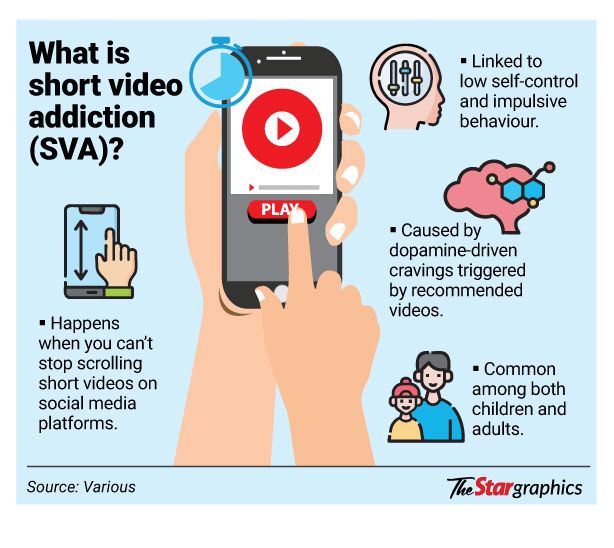
“I lead a healthy lifestyle. I run. I care for my family. I perform at work. But lately, I can’t focus. My brain feels foggy and I can’t even sit through a full movie,” said the 37-year-old civil engineer.
Aimy only realised she was facing short video addiction (SVA) when she stumbled upon a video about it online and recognised herself.
Her seven-year-old daughter had also started sneaking screen time after bedtime and reacting angrily when denied access.
Across Malaysia and beyond, adults are quietly battling compulsive use of short-form content on platforms like TikTok, Instagram and Xiaohongshu – often at the expense of sleep, relationships and productivity.
ALSO READ: Start intervention early to curb SVA, say experts
Lecturer Ezatul Marini Mohd Ghazali noticed the habit forming in her children when they were teenagers, even before the Covid-19 pandemic.
Curious, she began watching videos too and found herself falling into the same loop.
“What started as an observation slowly turned into a habit,” said Ezatul, who now has three adult children.
“It made me realise how easy it is to get caught up in something that feels so harmless.”
She has since made efforts to reduce screen time as a family.
“It’s not perfect, but we’ve seen small, steady changes,” she added.
For Dayana, 41, the consequences were more immediate.
As a copywriter, she used to scroll until 3am, convinced she could cope with just four hours of sleep.
ALSO READ: Hooked on autoplay, infinite scrolling and dopamine hits
However, she began missing client instructions and was eventually let go under a voluntary separation scheme.
“Just one more video – that lie repeated every night. It cost me my full-time job,” she said.
Now freelancing, she’s committed to a 10.30pm bedtime and has replaced night scrolling with books and yoga.
For Paula, 44, an accounts manager in Kota Kemuning, it took nearly losing a major client to realise she must change. She now channels her energy into Tabata classes three times a week.
“The rush from exercise is slowly replacing the dopamine I got from scrolling. It’s not easy, but I remind myself of the cost,” she said.
A 2022 study titled “Addiction on TikTok among Young Adults in Malaysia” found that social, family and lifestyle factors explained 63.4% of addiction levels to short-form video apps.
Another study in the same year revealed that 48% of medical students at Universiti Kebangsaan Malaysia were excessive smartphone users, with links to anxiety and reduced quality of life.
Last year, a research by Universiti Tunku Abdul Rahman’s Tun Tan Cheng Lock Centre found that 34% of respondents aged 16-30 spent over eight hours on screens daily, while 32% used them for five to six hours and 22% for seven to eight hours.
A 2024 US-based survey by Cross River Therapy found around 70% of teens and young adults, and over half of adults aged 30-49 showed signs of social media addiction, spending a daily average of one hour and 40 minutes on these platforms.


