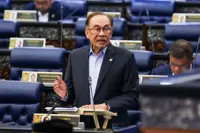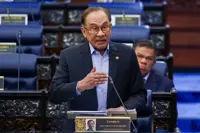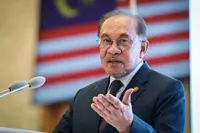
KUALA LUMPUR: Exporters will receive support from the government in light of the ongoing US tariff issues, says Prime Minister Datuk Seri Anwar Ibrahim.
He said that this is especially for small and medium enterprises (SMEs) affected by the tariffs.
"The government is committed to assisting businesses affected by current global developments.
As an initial step, we have announced an increase in Government Guarantees by RM1bil under the Business Financing Guarantee Scheme (SJPP) to help affected SME exporters obtain loans from commercial banks," he said during the special Dewan Rakyat sitting on Monday (May 5).
The government has also agreed to increase soft loan facilities by Development Finance Institutions (DFIs) amounting to RM500mil to support affected SME entrepreneurs, he added.
Anwar said Putrajaya will continue to monitor ongoing developments and remain committed to providing targeted assistance to directly affected SMEs.
Other measures include promoting regional cooperation and new markets.
"With our major trading partners potentially colliding into a trade war, it is important for Malaysia to diversify its trading footprint to new markets in Europe, the Middle East, Central Asia, and South America, among others, as well as strengthen our intra-regional trade, especially with Asean member countries," he said.
To facilitate businesses entering new markets, Anwar said an additional RM50mil will be allocated to Matrade, benefiting SMEs as well.
On strengthening Asean integration and encouraging economic activity between member countries, Malaysia will drive development projects across Asean such as the Asean Power Grid, he added.
Anwar said Malaysia will continue to strengthen economic activities with its Asean neighbours at border regions.
This includes the Johor-Singapore Special Economic Zone (JS-SEZ) and development projects for the southern Thailand border area, including the construction of the second friendship bridge between Rantau Panjang and Sungai Golok in Narathiwat, and a new road route connecting the facilities of the Immigration, Customs, Quarantine and Security Complex (ICQS) in Bukit Kayu Hitam with the Customs, Immigration and Quarantine Complex in Sadao, Thailand.
Negotiations are also ongoing to resolve the reciprocal tariff issue, which includes pursuing strategic purchases or imports from the US.
"For example, the Malaysia Aviation Group (MAG) placed an order for 30 Boeing aircraft, with an option for 30 more, which was finalised last year and recently signed. Efforts to expedite this procurement are expected to strengthen the national tourism industry by expanding MAG’s fleet capacity," he said.
He said trade and investment processes would be further streamlined across key sectors such as agriculture, finance, and digital.
"For instance, a cloud framework agreement involving cloud service providers such as Google, Amazon, and Microsoft forms part of ongoing efforts to advance the public sector’s digital agenda," he said.
Investment-friendly policies will also be formulated to strengthen intellectual property protection in strategic sectors such as high-powered electronic chips, he added.
Aside from that, progress is also being made in the free trade agreement space, he said.
"Following the Comprehensive and Progressive Agreement for Trans-Pacific Partnership (CPTPP), Malaysia made its first tariff-free shipment of sustainable palm oil to the United Kingdom last week," he said.
The Malaysia-EFTA partnership agreement negotiations were completed in April 2025 and are expected to be signed next month. Resuming FTA negotiations with the Republic of Korea and the European Union.
In addition, efforts will also be intensified to strengthen relations at the ASEAN level with regions such as the GCC. Cooperation with GCC countries also emphasises empowerment and innovations in the field of Islamic Finance and trade of halal goods, he added.
"Discussions are progressing meaningfully, particularly with ASEAN member states, as well as China, Japan, and other regional partners.
I am confident that when we convene for the inaugural ASEAN Leaders Summit together with the GCC and China at the end of this month, this matter will be high on the agenda.
Accordingly, we are expected to finalise the negotiations on the enhancement of the ASEAN-China Free Trade Agreement (FTA) in the near future," he said.
"With the resilience and confidence shown by our domestic economy, we will not easily succumb to external pressures and challenges," he added.
He said Malaysia is well-equipped to manage challenges effectively, adding that the structural reforms introduced under the Ekonomi MADANI framework have already strengthened the country’s national resilience and enhanced readiness to face global economic volatility.
He said Malaysia’s macroeconomic performance has been encouraging with the gross domestic product expanding at 5.1% in 2024 compared to 3.6% in 2023, and the fiscal deficit narrowing to 4.1% in 2024.
"The national inflation rate remained benign at 1.8%, against 2.5% in 2023. As of the first quarter of 2025, inflation remained stable at 1.5%," he said.
The unemployment rate continued to remain low at 3.3%, and a record RM378.5bil in approved investments was reported last year.