PUTRAJAYA: Describing the next two weeks as crucial to stem the alarming spread of Covid-19 and to help save lives, the government has imposed movement restrictions once again from Jan 13-26.
However, this time the movement control order will not be nationwide, as the states have been placed under three separate levels.
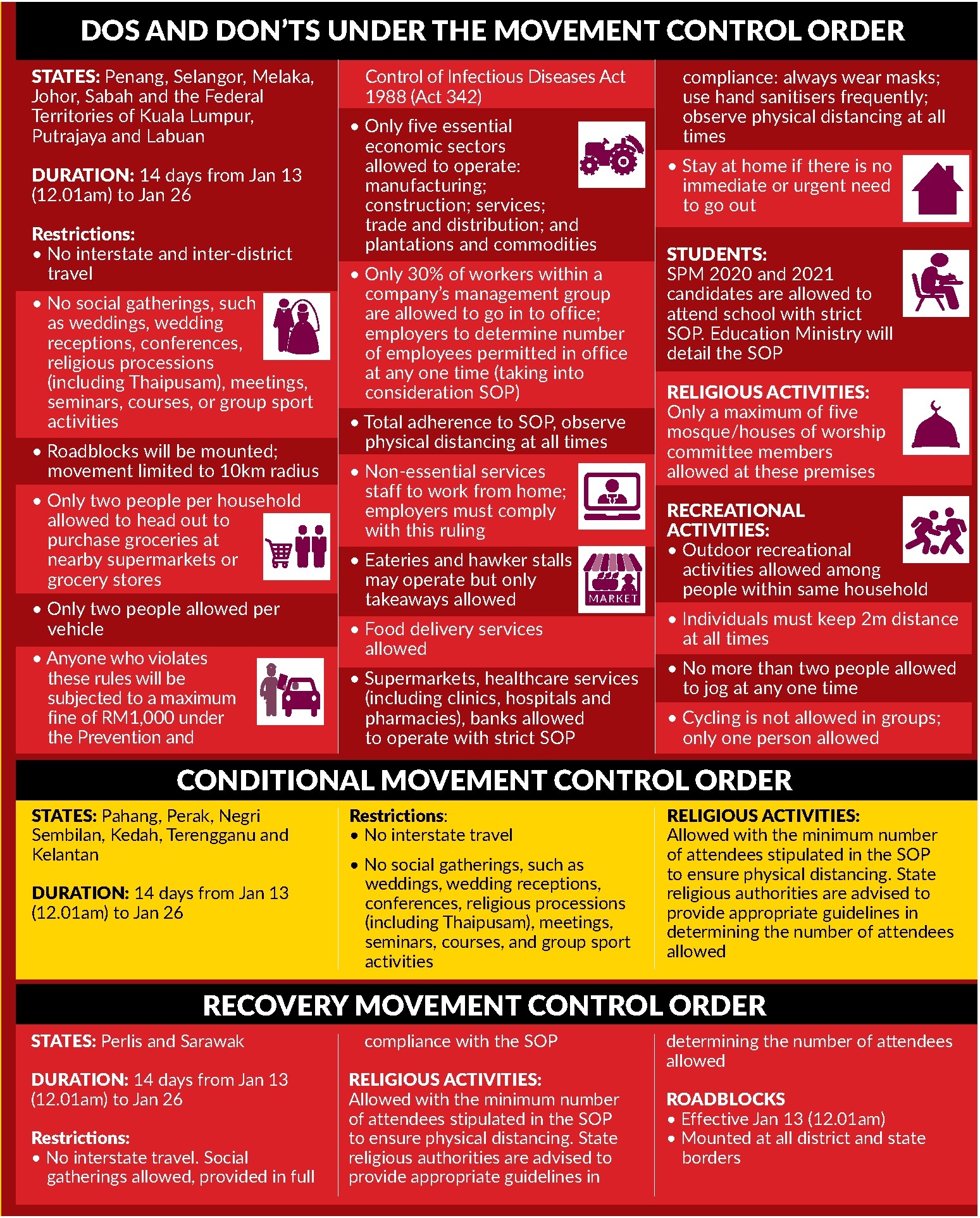
Penang, Selangor, Kuala Lumpur, Putrajaya, Labuan, Melaka, Johor and Sabah have been placed under the MCO while the conditional MCO will be enforced in Pahang, Perak, Negri Sembilan, Kedah, Terengganu and Kelantan.
Only two states – Perlis and Sarawak – will be under the recovery MCO.
In a special televised address to the nation, Prime Minister Tan Sri Muhyiddin Yassin said based on a risk assessment by the Health Ministry, National Security Council and advice from public health experts, the government decided on stricter measures to break the chain of Covid-19 infections in the country.
He said Malaysia first recorded four-digit daily Covid-19 cases on Sept 24 last year with 1,228 cases and since the end of November, the four-digit phenomenon became a daily occurence, with the highest number recorded on Jan 7 with 3,027 cases.
“The situation today is indeed very alarming. Our healthcare system is under tremendous pressure now than at any other time since the start of the pandemic.
“As I have said before, unprecedented situations call for unprecedented measures, ” he said.
Muhyiddin said states where the MCO would be enforced were regarded by the health authorities as “high-risk states” where the ability of health services had almost reached their maximum capacity.
“The ministry will make continuous risk evaluations to determine if the MCO will end or need to be extended before the two weeks end, ” he said.
To reduce the risk of Covid-19 infections, interstate travel will not be allowed nationwide during this period whereas in MCO states, even inter-district movement is banned.
Roadblocks will be set up beginning midnight and in MCO areas, with only two per household allowed to be in a vehicle to get essential items, including food.
“Social activities involving mass gatherings including weddings, conferences, religious processions such as Thaipusam, meetings, seminars, courses and group sports will not be allowed during this period, ” added Muhyiddin.
Social activities subjected to a strict standard operating procedure (SOP) can be carried out in the recovery MCO states of Sarawak and Perlis.
Eateries and restaurants in states under the MCO will be allowed to operate but can only provide takeaway service while areas under conditional and recovery MCO will be allowed to operate as per normal with SOPs in place.
Food delivery services will be allowed while supermarkets, clinics, hospitals, pharmacies and banks in MCO areas will be allowed to operate but with high levels of vigilance.
Muhyiddin assured Malaysians that the food supply would be sufficient and that the Domestic Trade and Consumer Affairs Ministry would monitor the supply of essential items including rice, white bread, hand sanitisers and face masks.
On schools, Muhyiddin said although movement would be restricted especially in MCO states, exemption would be given to examination candidates, who would be allowed to be in school with strict SOPs in place.
“I am aware that isolation for a long period of time can affect mental health. To avoid this, the public are allowed to leave the house for exercise but only with members of their household.
“Physical distancing must be practised and if you want to go for a jog, it should not be more than two persons. If you are to go cycling, avoid doing it in a group, ” reminded Muhyiddin.
He said the next two weeks was crucial as sacrificing one’s freedom, being in isolation and forgoing social activities could help save lives.
He said the coronavirus was now in the community and everyone must not be too comfortable and neglect preventive measures such as using face masks, ensuring social distancing, and washing hands frequently.
“I call upon community leaders to look after and protect their communities from Covid-19. You are all frontliners in your community in the fight against the virus.
“Work together with district health offices, community health clinics and district councils to educate the community so that they know how best to prevent infection, ” he said.
Already a subscriber? Log in
Get 20% OFF The Star Digital Access
Cancel anytime. Ad-free. Unlimited access with perks.