



MELAKA: A sanctuary here has achieved a rare success by breeding one of the world’s most poisonous amphibians – the blue dart frog (Dendrobates tinctorius ‘Oyapok’) which is native to South America.
Melaka Butterfly and Reptile Sanctuary managing director Gerard Wong Woon See took two years of intense research and his own funds to breed the species, which is critically endangered due to heavy poaching in South America and the global pet trade.
Wong, who is also the in-house zoologist, said the species was unable to survive on Malaysian soil and he used his own laboratory at his sanctuary in Ayer Keroh here for the first batch of hatched tadpoles to transform them into froglets.
“We have bred a few using proper techniques, including creating an artificial rainforest ambience for the frogs to multiply,” he said when interviewed here on Saturday.
Wong said he brought a pair of the dart frogs from a captive breeding programme in Germany.
“All documentations were approved by the Department of Wildlife and National Parks (Perhilitan) as dart frogs are a protected species while Perhilitan officers conduct a monthly check on the sanctuary,” he said.
Wong said he had done the breeding with the hope of displaying the frogs in his sanctuary, adding that the research and analysis papers on breeding dart frog would also be used to conserve local frog species.
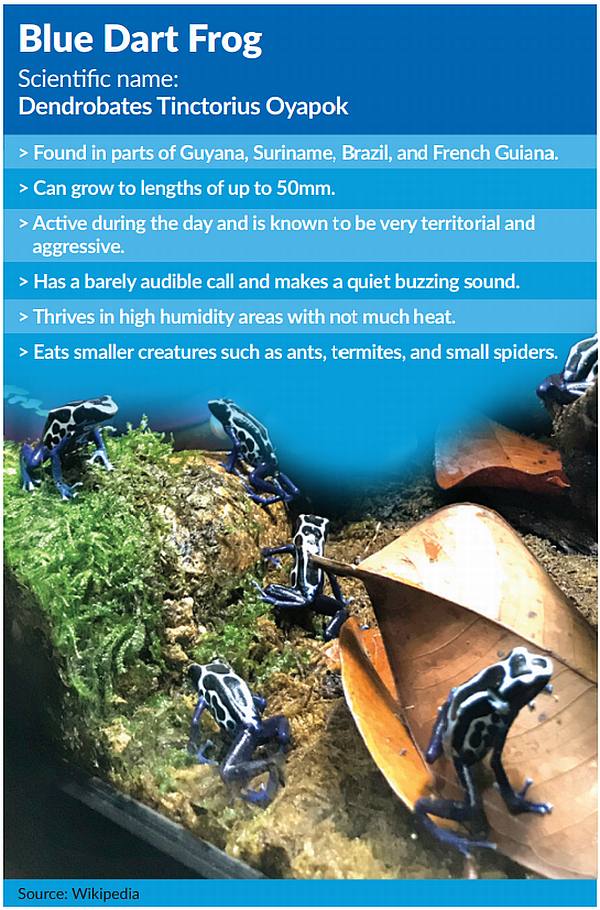
Wong, who is currently breeding various species of dart frogs at his sanctuary, said the research could be used to conserve the Malaysian frog species Hylarana centropeninsularis as well as tree frogs, namely the Malaysian horned frogs (Megophrys nasuta), which are under the threat of extinction.
The biological cycle of dart frogs and the Malaysian species are the same, he said.
He said the powerful skin toxin that the dart frog secretes was used by certain indigenous people in South America on their blow gun darts for hunting.
Scientific research showed that the species loses its toxicity in captivity, he said.
Wong, who is also the Malaysian Association of Zoological Parks and Aquaria vice-chairman said it was his passion to save endangered species and plants but added that he needed support.
State Agriculture, Agro-based, Entrepreneur Development and Cooperative Committee chairman Norhizam Hassan Baktee said he would visit Wong’s sanctuary to look into the potential of using frogs for agricultural purposes.
For instance, certain local frog species could serve as biological pest controllers, he said.
“The state government is willing to come up with research grants for the purpose of flourishing our agricultural lands,” he said.
Already a subscriber? Log in
Get 20% OFF The Star Digital Access
Cancel anytime. Ad-free. Unlimited access with perks.
