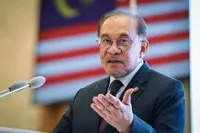
BANDAR SERI BEGAWAN:In a historic move, Brunei has officially dropped its long-standing claim over Sarawak’s Limbang district, Prime Minister Datuk Seri Abdullah Ahmad Badawi said on Monday.
This was the result of the two countries resolving their various land and sea territorial disputes, he said.
"Brunei has decided to drop the Limbang issue and as a result, Limbang is part of Malaysian territory," he told a press conference with the Malaysian media at the Malaysian High Commission here.
"With this resolution, there are no more issues to haunt the close relationship between Brunei and Malaysia," he said.
The resolution was part of several disputes which were settled and sealed with the signing of Letters of Exchange by Abdullah and the Sultan of Brunei Sultan Hasannal Bolkiah at Istana Nurul Iman here on Monday.
The other disputes include questions over where the common maritime boundary of the two countries in the South China Sea should run, the rights to exploit potentially rich oil deposits in the disputed maritime territory, the right of movement by Malaysian vessels over Brunei waters and the demarcation of the common boundary of the two countries.
The dispute over Limbang can be traced back to the cession of the territory by Brunei to Sarawak's White Rajahs in 1890. The cession has been strongly disputed by the Sultanate which regarded the transfer as annexation by Sarawak.
The cession of Limbang resulted in a significant reduction of Bruneian territory and cut the sultanate into two parts.
On Monday, Abdullah thanked the Sultan for the resolution of the various disputes and especially that of Limbang.
He said bilateral relations between the two countries would now enter a new era.
On the points in the Letters of Exchange, Abdullah and the Sultan in a joint statement said they had reached agreement over the final maritime boundaries between the two countries in the South China Sea.
They also agreed to establish a "commercial arrangement area" where oil and gas revenue in the disputed area would be shared between the two countries. How much each country would get was however not disclosed.
The two countries also agreed to the existence of "unsuspendable rights of maritime access" which guaranteed the right of movement by Malaysia vessels through Bruneian territorial waters provided Brunei's laws and regulations are observed.
Lastly, the Letters of Exchange also established the methods to demarcate the land boundary between Brunei and Malaysia.
With the resolution of the maritime boundary delimitation issue, the leaders said the two countries would be able to embark on new developments in their respective areas.
The negotiations, which began in 1995, took 39 rounds of talks to reach resolution.
The dispute over maritime territory arose out of a 1979 map published by Malaysia which indicated that all deep sea territorial waters off the coast of Brunei belonged to Malaysia.
The latest incident related to the dispute over maritime territory occurred in 2003 when Malaysia and Brunei awarded petroleum production-sharing contracts to four exploration blocks in the disputed area, close to where a 440 million-barrel discovery had been made the year before.
Petronas awarded its two blocks to US oild firm Murphy Oil while Brunei awarded one of its blocks to France's Total, BHP Billiton and Hess Corp and the othr to Shell, Mitsubishi and Conoco-Phillips.
Following the dispute, both countries agreed to stop drilling activities in the area.
Earlier, before the signing ceremony, Abdullah had a four-eyed meeting with the Sultan at the Palace.
Sarawak Chief Minister Tan Sri Abdul Taib Mahmud said the resolution of the question over the ownership of Limbang would enable several projects in the Sarawak district, which could benefit Brunei to proceed.
He said one of them was the construction of a hydroelectric dam across the Sungai Limbang where electricity could be supplied to Brunei.
”This will bring Sarawak and Brunei closer together as we can supply electricity to Brunei,” he told a press conference at the Malaysia High Commission.
On whether the resolution of the Limbang question would bring about easier access between that district and the rest of Sarawak, Taib said the problem was more to do with finding a convenient practice for immigration and customs checks.
He said the two countries had already agreed to using indentity cards instead of passports and further fine-tuning of the procedures could enable easier passage of people passing through checkpoints on the Brunei-Malaysia border.
Limbang’s road network is cut off from the rest of Sarawak and those travelling to the district have to pass through two border checkpoints.
Already a subscriber? Log in
Get 20% OFF The Star Digital Access
Cancel anytime. Ad-free. Unlimited access with perks.