



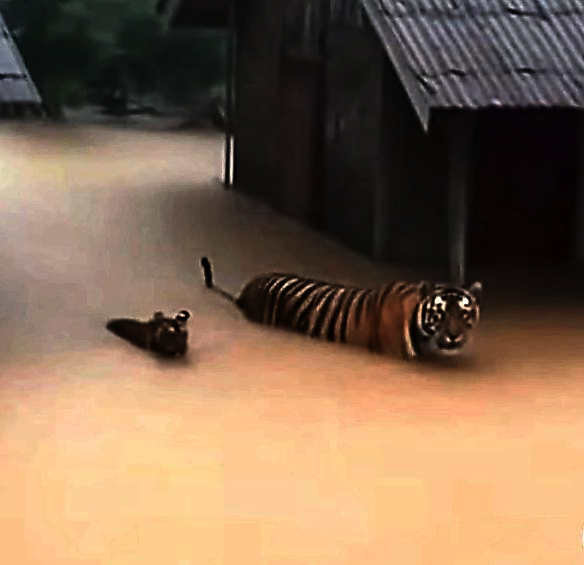
AS floods swept through Terengganu late last year, a video showing two tigers wading through floodwaters in a residential area began circulating on social media, raising fears that the dangerous predators had wandered into a village.
The footage, purportedly filmed near Hulu Terengganu, garnered more than 15 million views on TikTok, with some users expressing concern over the apparent sighting.
But the tigers were not real.
The video was generated using artificial intelligence (AI), as confirmed by the Terengganu Wildlife and National Parks Department, while an AFP fact-check identified several visual inconsistencies in the footage.
More recently, a similar incident in neighbouring Singapore demonstrated how fabricated wildlife sightings could have real-world consequences.
In September, a 30-year-old man was charged after allegedly creating an AI-generated image of a crocodile at the city-state’s largest reservoir, prompting authorities to launch an intensive search and suspend activities in the area.
The man was charged with communicating a false message and obstructing the course of justice.
Such incidents have raised questions about the dangers of increasingly realistic AI-gene-rated content, particularly when fabricated images or videos are presented as genuine threats to public safety.
They have also highlighted the potential legal consequences for those who create and circulate such material, even when no actual danger exists.
Intent matters
Technology and cyber law expert Foong Cheng Leong says individuals who deliberately create and spread fabricated wildlife sightings could face criminal liability under existing Malaysian laws.
The lawyer identifies two provisions that could potentially apply in such cases: Section 233 of the Communications and Multimedia Act 1998 and Section 505(b) of the Penal Code.
Section 233 of the Communications and Multimedia Act applies when a person knowingly creates and transmits false content with the required intent, such as to threaten or harass. Section 505(b) of the Penal Code concerns statements intended or likely to cause public fear or alarm, whereby a person may be induced to commit an offence against the state or public tranquillity.
Foong, a former chairman of the Kuala Lumpur Bar Information Technology Committee, says actual injury or financial loss was not necessarily required for criminal liability under these provisions.
However, he stresses that the creator’s intentions and the circumstances surrounding the content would be important in determining whether an offence had been committed.
“Intent matters. Section 233 expressly excludes satire, parody and clearly fictional content from its explanation of false content.
“But saying ‘it was a joke’ is not conclusive. The court would consider how the video was presented, including whether it carried a fabricated location or warning,” he says.

The distinction also extends to individuals who share or repost such videos, particularly those who may genuinely believe the footage is authentic.
Foong says unknowingly forwarding a fabricated video does not automatically make someone criminally liable, as their knowledge, intentions and the relevant legal provisions must be considered.
Section 505 of the Penal Code also provides an exception for those with reasonable grounds to believe the information was true and who lacked the prohibited intent.
Difficult to trace
However, tracing the source of misleading AI-generated content can be difficult, particularly when it has been repeatedly shared across multiple platforms.
Foong says anonymous accounts, overseas platforms and repeated reposting could obscure the identity of the original creator or uploader.
Investigators would also need to establish the accused person’s knowledge or intentions, relying on original files, platform records and device evidence that meet legal requirements for admissibility.
As for individuals or businesses that suffer losses because of such misinformation, Foong says pursuing civil action could prove challenging.
A claimant would need to establish an applicable cause of action and demonstrate that the conduct caused the damage suffered.
Meanwhile, Generative AI Association of Malaysia president David Woo says misleading AI-generated images and videos are already widespread, and their prevalence will only increase as the technology becomes more accessible.
“It’s common, and it will get more common,” he says.
Woo points to previous cases of deepfake videos impersonating prominent Malaysians, including the prime minister and singer Datuk Seri Siti Nurhaliza, as examples of how the technology has been misused.
He says the Malaysian Communications and Multimedia Commission has removed close to 225,000 pieces of deepfake and scam content since 2022, although this represents only reported material.
According to Woo, three factors make AI-generated imagery particularly effective at misleading audiences: low cost, speed and the minimal technical expertise required.
“Photoshop needed a trained person and hours of work. Now anyone with a phone can generate a photorealistic image in seconds, for free, in unlimited variations,” he says.

Unlike manipulated photographs that may have an identifiable original image, entirely AI-generated visuals may have no original source to trace, making conventional reverse-image searches less useful.
The proliferation of such content has also raised concerns among wildlife conservationists.
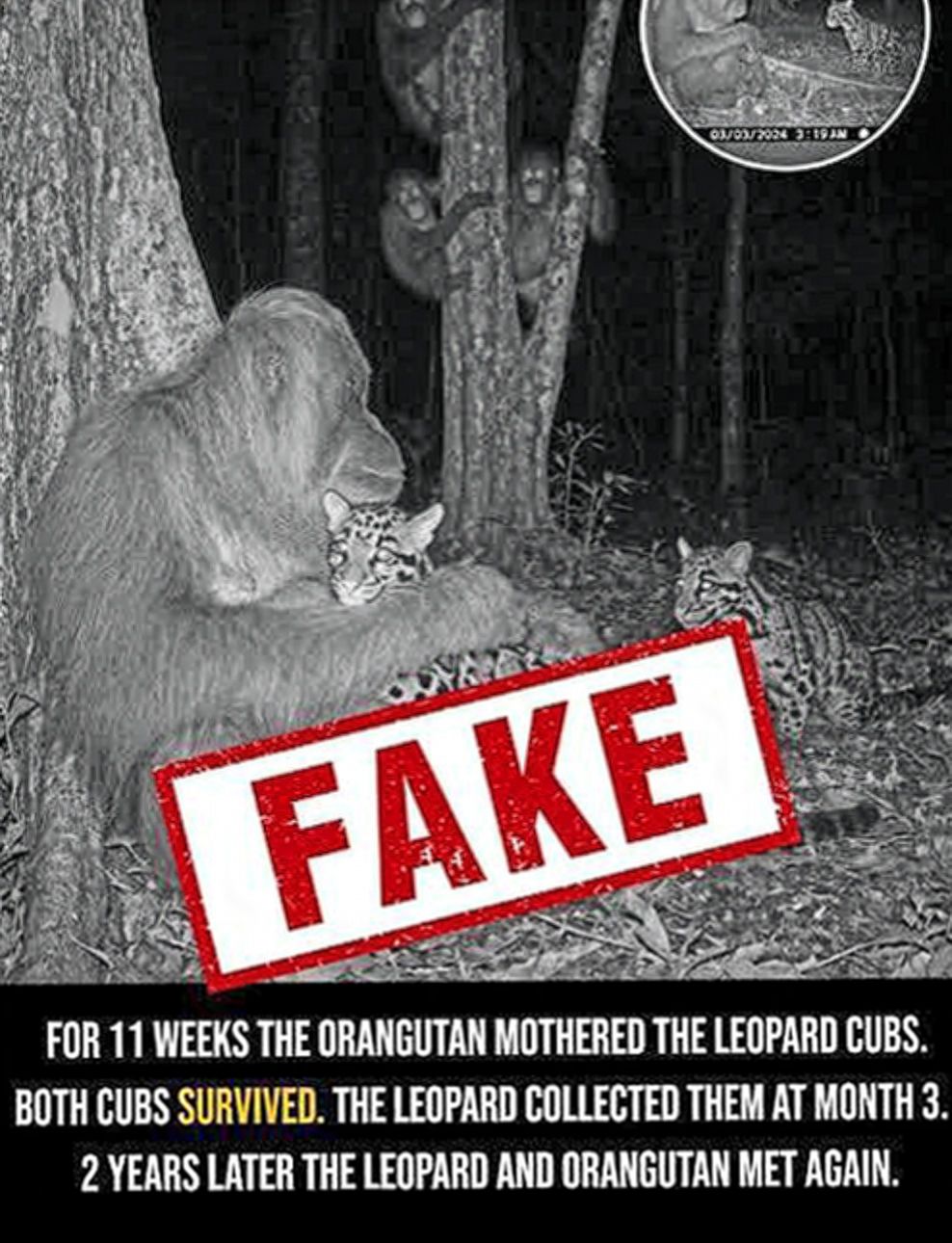
An AFP report in August highlighted a viral AI-generated image purportedly showing an orangutan cradling endangered leopard cubs in Sabah, among numerous fabricated wildlife visuals circulating online.
Conservationists warned that such images could distort public perceptions of wild animals, encourage unsafe interactions and undermine conservation efforts.
‘Where does this come from?’
Woo says the wider problem is the gap between what AI technology can produce and what the public understands about its capabilities.
Rather than relying on how realistic an image appears, he urges people to question its origins.
“Once people understand that anyone can make one in 10 seconds, the image on its own stops being proof, and people start asking the right question – not ‘does this look real?’ but ‘where did this come from?’” he says.
On accountability, Woo argues that responsibility should not depend solely on whether AI was used to produce the misleading content.
“Responsibility doesn’t depend on which tool made the image. It depends on intent and conduct, and that’s something a court decides, not the technology,” he says.
While creators should bear primary responsibility, particularly where deception is deliberate, Woo says social media platforms must also play a greater role in detecting and limiting the spread of misleading material.
He suggests platforms deploy AI-powered detection systems capable of identifying potentially synthetic content before it circulates widely.
Foong similarly calls for stronger cooperation among technology companies, noting that Malaysia’s existing legal framework already addresses certain aspects of AI-generated misinformation.
However, he says enforcement remains too dependent on the willingness and speed of social media platforms to respond.
“In my view, the present system is too slow because we remain dependent on social media platforms to take action,” he says.
He suggests additional safeguards be put in place, including requiring platforms to label AI- generated material, providing tools to verify its origins and improving detection capabilities among messaging service providers.
Woo, however, cautions against excessive regulation that could discourage legitimate use of AI.
“Do not overregulate. Target misuse like fraud and impersonation, not the tools,” he says.
Both experts emphasise the importance of public awareness alongside stronger safeguards, with Woo arguing that education is the most effective long-term defence against misleading AI content.
“Be alert, but don’t be fearful,” he says.
“Fear makes people either distrust everything or stay ignorant and get fooled.
“Curiosity is the better response.”
