THE city does not end where the cemetery begins.
Its presence lingers beyond the trees. Traffic grumbles in the distance. Tower cranes hover over unfinished buildings and glass towers catch the afternoon sun. On the day of the visit, a thick veil of haze hangs over Kuala Lumpur, softening the skyline and shrouding the graveyard in mystery – present but distant.
Beyond the gates of Kwong Tong Cemetery in Bukit Seputeh, time appears to move differently.
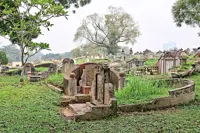
The roads wind uphill through rows of graves stretching across the landscape like stone terraces. Some tombs are grand, their sweeping structures adorned with carvings and inscriptions. Others are modest markers softened by decades of rain, heat and neglect.
Together, they form a silent settlement overlooking Kuala Lumpur.
At first glance, it is simply a burial ground. But Kwong Tong has also attracted interest as a dark tourism site, drawing visitors to a place where history, death and memory intersect.
It sits within a wider landscape of places in and around Kuala Lumpur that offer glimpses into darker chapters of the past, from the former Pudu Prison site to memorials and historic locations associated with war and loss.
But unlike abandoned prisons, battlefields or sites of disaster, Kwong Tong’s darkness is subtle.
There are no dramatic ruins or visible scars of catastrophe.
Instead, it emerges from the accumulated weight of thousands of lives.
Timeless tales
One may ask whether cemeteries are truly eerie in the most stereotypical way. Delving into the realm of the dead, so to speak, tends to elicit reminders of the supernatural which is often followed by imaginations of ghosts awaiting your arrival.
The question of curiosity is also often asked – what warrants such a visit? Is it just to quench an intrusive thought that some apparitions may be lurking here and there?
The Kwong Tong Cemetery lays out a different experience in self-reflection and, to a certain extent, serenity.
Every grave marks a story that has already reached its ending. The cemetery unfolds like an archive without a catalogue.
Names appear along the winding paths, some inscriptions still sharp and legible, others faded beneath moss and weather.
Photographs of the dead stare out from each of the many polished stones, preserving expressions that belonged to another century. A smile. A stern gaze.
A family portrait frozen behind glass.
The faces remain remarkably present despite the years separating them from the living.
Further uphill, the scale of the cemetery becomes apparent. Tombstones rise in every direction, while pathways twist between them before disappearing behind trees and slopes.
Shadows gather beneath overhanging branches. Sunlight filters through leaves in broken patterns that shift with every breeze.
Nothing unusual happens, yet the setting invites questions that everyday life tends to keep at a distance.
Dark tourism is often associated with a fascination with death. But visits to places associated with mortality can also offer a way of understanding history, memory and the passage of time.
What remains after a life ends? How long does memory survive? What happens when there is no one left to remember?
Among the graves, some tombs bear signs of recent visitors. Fresh flowers rest beside headstones, while offerings are carefully arranged.
Others appear abandoned; grass creeps across stone. Roots press through cracks. Names become difficult to decipher.
These forgotten graves carry a different kind of sadness. Their power lies not in anything supernatural, but in the possibility of disappearance.
Families move. Generations pass. Memories fade. Eventually, even those who once carried a name in their hearts are gone.
The stone remains – for a while.
The forefathers
Among the cemetery’s most notable residents is Yap Ah Loy, the Kapitan Cina often credited with helping to rebuild and develop early Kuala Lumpur. His final resting place offers a quiet reminder that even figures closely associated with the city’s growth eventually become part of its history.
But the significance of Kwong Tong extends beyond any single name – the cemetery is, in many ways, also a record of Kuala Lumpur itself.
Founders, merchants, labourers, community leaders and ordinary families share the same landscape. Their lives differed in countless ways, yet the cemetery gathers them into a single story about the passage of time.
Elena Shim, who has been a tour guide to dark tourism sites for a decade, says one question that often comes up is where Kuala Lumpur’s early community leaders were buried when they passed away.
“The answer is Kwong Tong Cemetery. Yap Ah Loy was laid to rest there, as were many of the Kapitans. It is one of the most significant historical cemeteries in Kuala Lumpur,” says Shim, looking out from a higher vantage point.
The contrast becomes starkest from the higher slopes.
Beyond the rows of graves rises the skyline of contemporary Kuala Lumpur – glass, steel and concrete, symbols of progress dominating the horizon.
Below them rests a generation that helped lay the foundations of the modern city.
“The Qingming ritual is closely connected to places like this.
“During Qingming, families return to their ancestors’ graves to pay their respects and offer food. It is an important tradition that keeps the connection between the living and the deceased alive,” says Shim.
Life and death
In the distance, office lights flicker on and headlights stream along the roads.
Life continues. Meetings are held. Trains arrive. Restaurants fill with customers. Beyond the cemetery walls, people move through their daily routines, largely unaware of the hillside overlooking the city.
Yet, Kwong Tong endures as a reminder that every city has two histories.
One belongs to the living, written daily through construction, ambition and movement. The other belongs to those who came before.
Dark tourism sites often invite visitors to witness tragedy. Kwong Tong offers something quieter and perhaps more enduring: a confrontation with impermanence.
“When I bring visitors to Kwong Tong Cemetery, I usually spend quite a bit of time there. Many of them want to take photographs, so we do not simply walk through and leave.
“There is also a cultural belief that after visiting a cemetery, you should rest for about half an hour before returning home. I am not sure how widespread this is across South-East Asia, but it is something many of us believe. The idea is that you should not go directly home immediately after leaving a burial ground.”
Fame survives longer than most things, but not forever. Stone erodes. Photographs blur. Names become difficult to read. Memory itself proves fragile.
Before leaving, Shim hands out a small bag of limau purut (kaffir lime) together with flowers, explaining that they can be used in a traditional cleansing ritual after a cemetery visit.
Regardless of the poignant and tranquil atmosphere, Shim doles out a reminder that a cemetery remains a “gateway” to the supernatural world – if you tread carelessly, “something” may hitch a ride home as well.
“After returning from the cemetery, prepare a floral bath, known as ‘mandi bunga’.
“Whether you are staying in a hotel, homestay or at home, you can place the lime and flowers in a bucket of water and use
it to rinse yourself. It is a cleansing ritual that many people observe after a visit to a cemetery.”
As darkness rests over the cemetery, the living city below grows brighter. The graves retreat into shadow, but they do not disappear.
They remain nestled nearby, preserving thousands of stories that can no longer speak for themselves.
And in that silence lies the cemetery’s enduring mystery: not what happens after death, but how quickly life can become history.