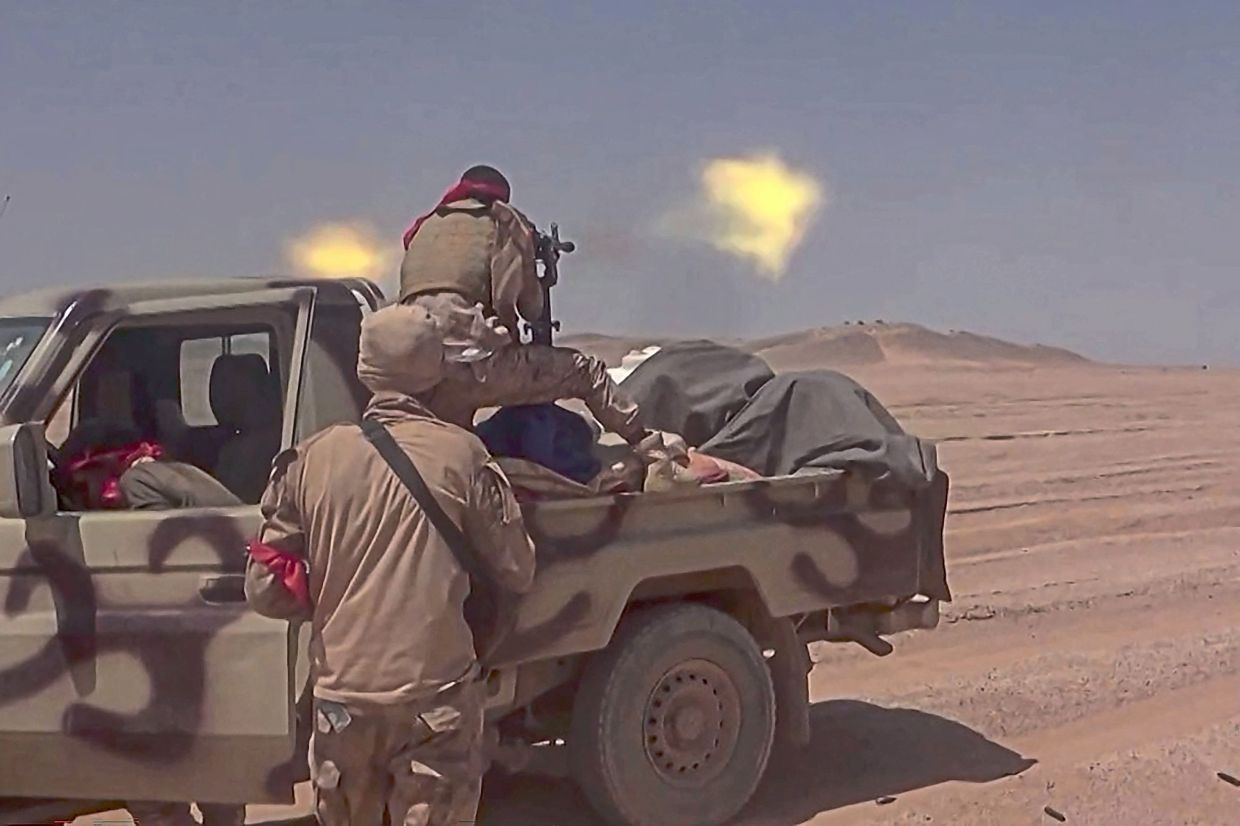
THE popular image of Yemen’s Houthi rebels is of men on the backs of pickup trucks, firing AK-47s into the desert air.
Yet the group has launched long-range missile strikes at Israel, more than 1,600km away. The Houthis prey on ship traffic in the Red Sea with naval drones. The group said recently it had downed a Saudi fighter jet over Yemen using a locally made missile.
Saudi Arabia claimed the Houthis also had sent a drone towards Mecca, which was shot down before reaching the city.
And evidence points to the Houthis’ growing ambition to use artificial intelligence and other means to produce more advanced weaponry themselves, making them less reliant on their sponsors in Iran.
Although they are backed by Iran, for months the Houthis remained on the sidelines of this year’s fighting in the region. That ended in July, when they declared a maritime blockade on Saudi Arabia.
Since then, they have marched south, seizing the historic port city of Mokha while capturing islands near the narrow strait known as the Bab el-Mandeb, tightening the group’s grip on the choke point at the southern end of the Red Sea.
“They use every opportunity to build their capability, to test their capability, such that they are now the most lethal non-state actor in the entire Middle East,” said Timothy Lenderking, the former US special envoy for Yemen, at a Middle East Institute forum.
A report by Anthropic on the misuse of AI said “a cell of threat actors based in northern Yemen”, where the Houthis have their stronghold, used Claude for “a sustained effort to develop guided weapons”.
Despite Anthropic’s safeguards, the company said, the cell proceeded as far as the test firing of a guided rocket.
The Houthis still rely on their Iranian sponsors for the most sophisticated components in their drones and ballistic missiles, but as the Anthropic report suggested, in recent years they have become much more advanced at building their own weapons systems.
This has given the Houthis greater flexibility to maintain their fight against their Yemeni and Saudi adversaries, attack shipping traffic in the Red Sea and threaten Israeli and US targets even with the US Navy enforcing a months-long blockade of the Strait of Hormuz.
Laboratory of war
The Houthis and their Iranian advisers were already experimenting with uncrewed surface vessels a decade ago. The group used a remote-controlled boat loaded with explosives to attack a Saudi frigate all the way back in 2017, killing two people in the process.
At first, Yemen was a laboratory for Iran’s pursuit of warfare. Increasingly, it is a factory, too.
Peter Salisbury, an adjunct professor at Columbia University’s School of International and Public Affairs, who has studied Houthi weapons manufacturing closely, said larger parts like missile chassis are fabricated in Houthi-controlled territory rather than sent from Iran.
“Iran and Hezbollah have invested heavily in continuing to upskill the Houthis in the manufacture and use of weapons,” Salisbury said. “Increasingly they’ve been able to indigenise the production of a lot of things like one-way attack drones.”
According to Farzin Nadimi, a senior fellow with the Washington Institute for Near East Policy, the Iranian defence industry has dedicated design bureaus and factories for weapons systems specifically for proxy forces like the Houthis that are “simple to assemble, simple to move, simple to prepare for launch and simple to use”.
Resilient supply chains
The Iranians have also encouraged the Houthis to develop additional supply chains for components.
“There’s a lot the Houthis don’t need anymore, and the reason they don’t need it anymore is because they’ve been able to use the global black market supply chain to get most of the things they need,” said Kevin Donegan, a former commander of the US 5th Fleet, whose area of responsibility included the Persian Gulf and the Red Sea, and who built the first intelligence fusion cell to study Iranian support for the Houthis.
“They do need key components still, especially for the missiles to make them effective,” Donegan said. “They have the ratlines that still can bring those components because they’re not the big pieces.”
Those might include guidance systems, rocket engines and wing tips and fins that require a higher degree of precision engineering, Salisbury said.
While the US Navy’s blockade focuses on large container ships and tankers, smaller components can be smuggled on medium-size vessels like the traditional dhows ploughing the region’s waters.
Shipments can be sent directly to Houthi-controlled areas of Yemen, transshipped via the Horn of Africa or even transferred ship-to-ship in the waters off the coast of Somalia.
Salisbury calls it a “giant game of three card monte”.
If the Anthropic report is accurate, the group that was using Claude in northern Yemen tried to develop a multi-stage ballistic missile with a range of more than 1,900km and a hypersonic glide vehicle.
The weapons designers were careful to avoid Anthropic’s safeguards, hiding the true purpose of the guidance systems they were designing from the very system helping them design it.
Anthropic said there was no evidence that they were successful in “fielding an operational device”.
The users queried Claude Code about why their field test had failed.
“Nevertheless, we have evidence that the actors had already built an offline simulation tool kit that does not rely on Claude,” the report said.
Recent history suggests they will keep working to improve their capabilities.
“Keep in mind that the Houthis are always on the move,” said Lenderking, the former US envoy. “They’re extremely entrepreneurial.” — ©2026 The New York Times Company
This article originally appeared in The New York Times
Already a subscriber? Log in
Get 20% OFF The Star Digital Access
Cancel anytime. Ad-free. Unlimited access with perks.