THE park was in the centre of China’s richest county. Willow trees clustered around a well-manicured pond. Joggers circled shiny new playgrounds filled with children.
But in a quieter part of the park, Hu Xinbing was resting after another day of trying, unsuccessfully, to win his share of the local prosperity.
After failing to find a job that morning, Hu, 31, lay behind some bushes, using a windbreaker as a pillow, and waited until he could try again the next day.
Around him, about a dozen other out-of-work men had claimed their own corners of the park in Kunshan, about 50km outside Shanghai, dozing on benches or inside tents.
Not long ago, they would have been hard-pressed to find the downtime.
Kunshan, which in the early 2010s produced one-third of the world’s laptops, is at the heart of China’s gargantuan electronics manufacturing industry.
For decades, millions of workers from across the country, including Hu, flocked there for steady work assembling devices for Apple and Dell.
For more than 20 years, Kunshan has been ranked as China’s most economically developed county. But now Hu is one of tens of millions of workers who may be left behind by China’s pivot away from low-end manufacturing towards advanced technology. Kunshan’s government has offered generous support for companies focused on technologies such as artificial intelligence or flying cars.
Meanwhile, traditional electronics makers, facing uncertain demand because of trade frictions, have embraced automation, cutting positions and wages for human workers.
“It’s all robots driving screws. They don’t need people to do it anymore,” said Hu, who is originally from the inland province of Henan.
In previous years, he said, he signed longer-term contracts with manufacturers like Pegatron and Inventec, both major suppliers for Apple.
During peak seasons, he could earn up to 6,000 yuan (about US$885) a month. But he said his previous employers had cut jobs as they introduced robots.
In May, he said he worked only day gigs, mostly security jobs, that paid between 60 and 120 yuan (roughly US$9 to US$18) each.
“It feels like there won’t be any work left in the future, if things keep developing like this,” he added.
The predicament of Hu and his fellow workers highlights the challenge China faces as it tries to transition into a high-tech power.
China leads the world in technologies like solar panels and electric vehicles, and is vying with the United States for AI dominance.
But the manufacturing jobs created by those industries are largely for skilled workers. Those roles cannot make up for job losses among less-skilled workers, who still make up one of the biggest parts of China’s workforce.
Many people have instead been pushed into daily gig work, either in the same factories where they used to work on contract, or in other positions, like as security guards.
There are already around 40 million gig workers in China’s manufacturing sector alone, according to Zhang Dandan, a professor at Peking University who has studied Kunshan’s migrant workers.
Hub for struggling workers
The park in Kunshan, Zhenchuan Good Samaritan Park, has become known across China as a gathering place for the struggling or burned out. It is near major factories and a labour market, where recruiters gather every morning from 4am until they have filled their daily quotas.
It attracts vendors selling cheap haircuts and lunchboxes for less than a dollar, even as middle-class families flock there to enjoy the spotless facilities.
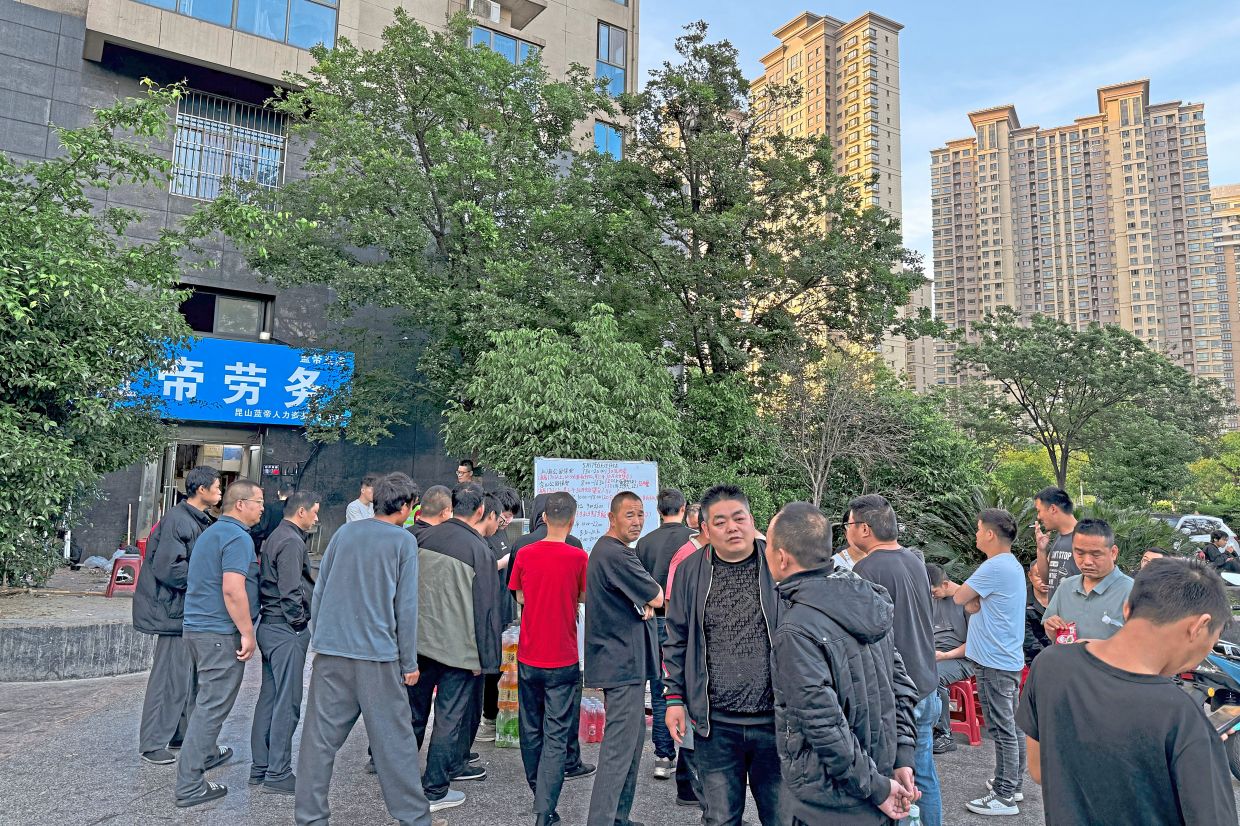
At night, workers sleep in nearby dormitories for about US$3. Some stay in the park itself.
Similar clusters of labourers have sprung up around labour markets in Shenzhen and other manufacturing hubs in recent years, frequented by people like Hu who are looking for daily gig work.
The son of farmers, Hu started working after middle school, assembling circuit boards and smartphones in factories around Kunshan.
The jobs were tedious but they were steady. He was able to save a few thousand dollars each year, he said.
But jobs became scarcer after the Covid-19 pandemic. As geopolitical and trade tensions between China and the West intensified, many manufacturers, including in Kunshan, scaled back or moved overseas.
At the same time, China was pushing to become a technology superpower. That meant, in part, investing in robots.
In 2024, Hu returned to a factory he’d worked at the year before, making gaming laptops. Previously, he said, the workshop had been full of people busily turning screws by hand.
“When I went again, I took a look and, whoa, there weren’t any people anymore,” he said. “It was all robots.”
There was plenty that Hu admired about China’s robotics prowess. He had passed kiosks with robot baristas, and he enjoyed watching dancing humanoid robots on Douyin, China’s version of TikTok.
During the pandemic, he recalled, drones delivered his food when he was in quarantine.
But his admiration was always tinged with anxiety. He was afraid that he didn’t have the energy or the ability to learn new skills that would protect him from being replaced.
“If you don’t have an education, it’s not easy to learn those things,” he said.
The morning after he failed to find work, Hu awoke early as usual.
This time, he secured a job as a security guard for a Pokémon festival in Shanghai.

Around 6am, he climbed aboard a bus with dozens of other workers to the festival, where he set up barriers to keep overeager children from barrelling into a Pikachu parade. He earned about US$18 for the day.
At 8pm, he boarded the bus back to Kunshan. If the weather was nice, he might stay in the park.
The next morning, he would get up and do it all over again. — ©2026 The New York Times Company
This article originally appeared in The New York Times.