




THE deadly Ebola outbreak in eastern Congo is moving faster than efforts to contain it, raising fears about what might happen if it explodes in highly populated areas held by M23, the powerful rebel group that seized vast swaths of territory last year.
Ebola cases have already been reported in the rebel zone, including one infection in the city of Goma, the rebel headquarters.
Transmission for the moment appears to be low there, according to figures released by Congo’s Health Ministry, but hot spots are getting closer and closer to occupied areas, moving south from the epicentre in the province of Ituri.
When M23 seized territory last year, thousands of people were killed, and hundreds of thousands were displaced.
Now, the rebels impose taxes, control public utilities and present themselves as the only legitimate authority in their territory, which includes two provincial capitals – Goma and Bukavu.
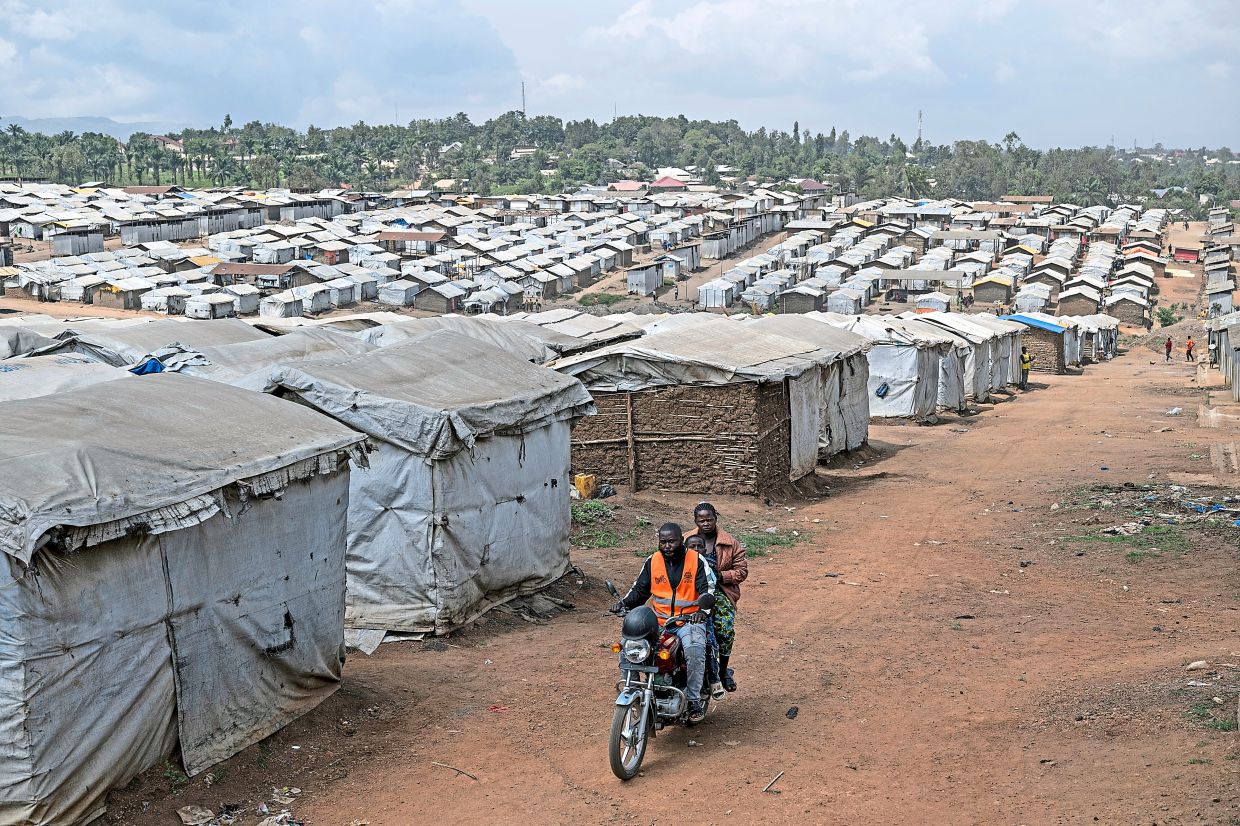
Officials say a full-scale outbreak in M23-controlled areas would be devastating for civilians trapped by fighting and the virus. But it may also present an opportunity for the rebels.
If M23 manages to contain Ebola successfully, it could bolster the image it has cultivated as a legitimate authority, at a time when the government is struggling to get the outbreak under control.
M23 rules over a population that is highly sceptical of Ebola.
Some Congolese have called the virus a hoax meant to line the pockets of government officials and foreigners.
Isolation wards in Ituri have recently been burned and medical workers violently attacked.
During an outbreak in 2018, hundreds of millions of dollars flowed in for the Ebola response, and some funds were misused, leading to the health minister’s imprisonment for embezzlement.
Against this backdrop, M23 has set up an Ebola task force, produced slick videos documenting visits to laboratories and treatment centres, and released cartoons about hand-washing.
It has introduced measures aimed at containing the spread, like limiting the number of passengers allowed on buses, and accused the Congolese government of “indifference” toward those in Ituri.
Congo’s neighbour, the tiny country of Rwanda, has supported and supervised M23 for years and has stationed between 14,000 and 18,000 troops in Congo, according to a UN panel of experts.
But the Congolese government says M23 is in no position to handle the outbreak.
“Both the M23 and Rwanda are ill-equipped to run an emergency response for a threat of this magnitude,” said Therese Kayikwamba Wagner, Congo’s foreign minister.
For health workers to have unfettered access and be able to do their work, she said, “Rwanda must leave the DRC” referring to the Democratic Republic of Congo.
Responding to a request for comment, Rwanda’s government said it was accelerating the withdrawal of Rwandan troops from Congo after a peace agreement brokered in Washington last year.
Rwanda closed its borders to Congo in May, when the outbreak was first detected by the World Health Organisation, but has since partially reopened them.
Many people living under M23’s rule refused to comment for this article, fearing for their safety.
Dieudonne Kazadi, the director of Congo’s National Institute of Public Health, said he had no information about what was happening in rebel-held areas.
“I can’t give you the situation in the territories occupied by M23 because I don’t have access,” he said.
M23 has kept two key airports in the area closed since the rebels seized territory last year, despite calls from the United Nations and the United States to reopen them for humanitarian aid during the outbreak.
Rwanda has gradually eased restrictions, allowing humanitarian supplies and workers, and now some civilians, through.
This Ebola outbreak could become the worst in history, partly because the species of the virus, known as Bundibugyo, was identified so late.
Congo’s Health Ministry said that as of July 5, there were 1,561 confirmed cases in the country and 506 confirmed deaths.
Dr Jean Kaseya, the head of Africa Centres for Disease Control and Prevention, said in an interview that verifying virus reports in rebel territory was currently impossible.
“Independent people don’t get access there,” he said.
M23 has also been accused of treating the crisis as a financial opportunity.
Despite the politics of the outbreak, a degree of technical cooperation exists across the front lines.
Some test samples in rebel areas have been sent to Kinshasa, the capital, and others from Beni, in government-controlled North Kivu province, to the laboratory in Goma.
The Congolese government continues to pay health workers and laboratory technicians in M23-held areas, and it collects data about cases, testing and contact tracing, though health officials cannot independently verify the data.
For the millions of Congolese trapped in rebel-held territory, the risk is “to be contaminated by Ebola, or to die by hunger or by violence”, said Denis Mukwege, a gynaecologist who won the 2018 Nobel Peace Prize for his work treating victims of sexual violence.
He excoriated the United States and others for failing to stop the fighting in eastern Congo.
“The world closes its eyes on this situation,” Mukwege said. — ©2026 The New York Times Company
This article originally appeared in The New York Times
Already a subscriber? Log in
Get 20% OFF The Star Digital Access
Cancel anytime. Ad-free. Unlimited access with perks.

