
THE United States’s relationship with Colombia was fraying.
Just six months ago, President Donald Trump threatened military action against the country.
He called its leftist president “a sick man”, accusing him of “running cocaine factories”.
And the decades-old alliance with Latin America’s third most populous country – a pivotal player in the US anti-drug war – briefly seemed on the verge of unravelling.
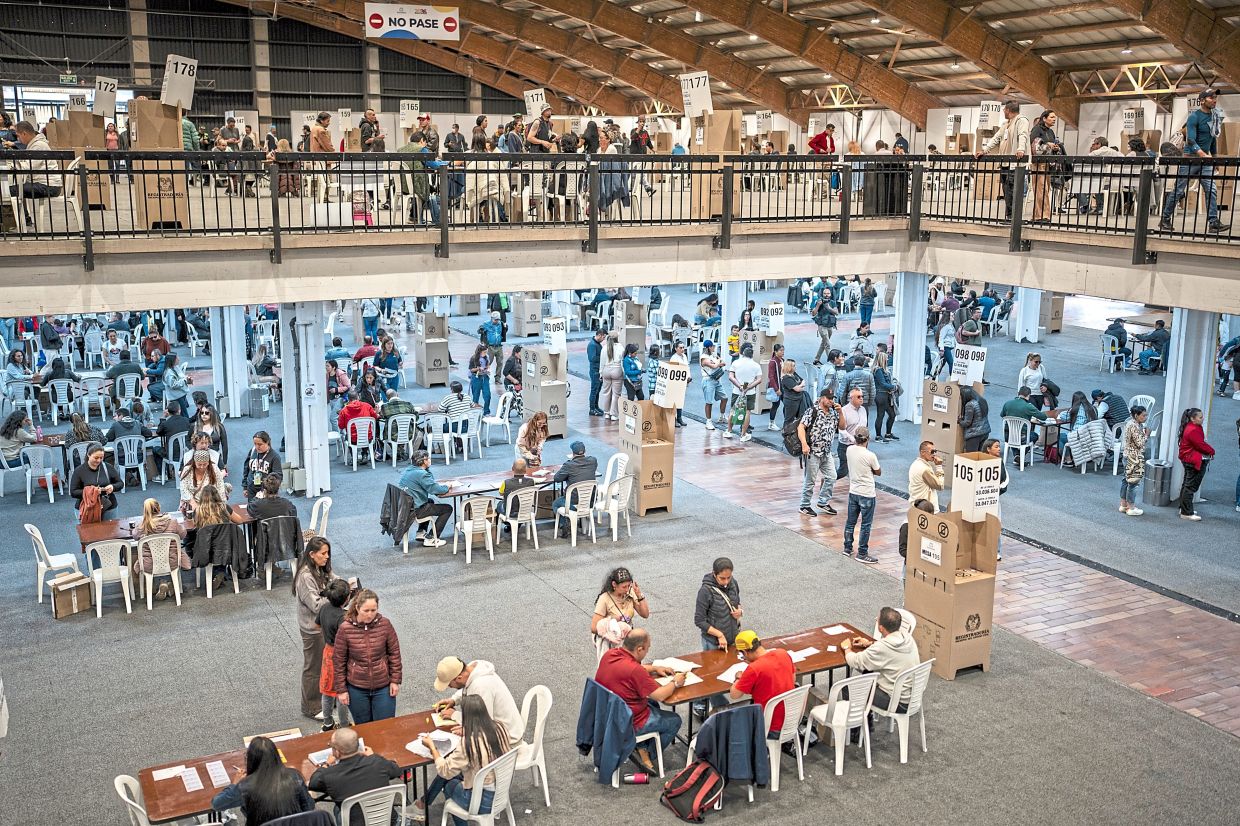
Then came Colombia’s presidential election on June 21.
With the victory of Abelardo De La Espriella, a Trump-endorsed, right-wing outsider who has vowed to destroy narco-traffickers with military might, Colombia is poised to vault solidly back into Trump’s good graces.
De La Espriella’s triumph, the latest in a conservative resurgence and anti-incumbent wave sweeping Latin America, gives Trump a key right-wing ally as he seeks to expand US influence in the Western Hemisphere.

It proved, yet again, that the norm-breaking endorsement of an American president in a Latin American election could help propel a populist wave. This, in a region scarred by decades of intervention from Washington but also fed up with drug-fuelled violence.
Now Trump will have an enthusiastic ally at the helm of Colombia, the world’s largest producer of cocaine and a key player in the US president’s increasingly militarised battle against drug trafficking.
De La Espriella’s presidency raises the possibility that US forces will become more deeply involved in fighting Colombia’s illegal drug organisations as Trump clamours to send US troops to combat cartels in places like Mexico.
Although De La Espriella has spoken out forcefully about preserving Colombia’s sovereignty and has ruled out a US-led “incursion”, he supports increased intelligence sharing and operational support.
The new push has been welcomed by many disillusioned Colombians but has raised concerns among critics who worry that a purely military approach would lead to more bloodshed without making any meaningful dent in drug flows.
Colombia’s former president, leftist Gustavo Petro, openly quarrelled with Trump even as many of his South American neighbours fell in line.
The United States, after deposing former president Nicolas Maduro in January, now holds outsize sway over Venezuela, where it killed the leader of a transnational gang in a joint strike in mid-June.
The Pentagon recently began joint military operations against drug gangs in Ecuador, the world’s largest transit hub for cocaine.
And Bolivia welcomed back US drug agents on its soil for the first time after two decades of leftist government.
Following El Salvador’s lead, De La Espriella has promised to build remote mega-prisons and has called for an all-out military assault against drug-trafficking groups, raising concerns that his iron-fist approach could erode civil liberties and lead to civilian casualties.
“There is no liberty without security,” he said during his victory speech. “There is no democracy without authority.”
De La Espriella has hailed the joint strikes in Ecuador as a potential model.
He wants Colombia to join a recently created coalition between the United States and other Latin American countries to combat cartels.
And he has celebrated the US military strikes against suspected drug smuggling boats that have killed more than 200 people in South American waters, and which a range of legal experts say are illegal, extrajudicial killings.
De La Espriella has said that his own military would shoot down planes and boats carrying drugs off Colombia’s coast.
“The US administration will be looking for an approach which is kinetically focused,” said Kevin Whitaker, the former US ambassador to Colombia from 2014 to 2019. “It is not centred on law enforcement, on achieving judicial outcomes, as had increasingly become US and Colombian policy.”
The United States helped bolster Colombia’s military by investing nearly US$15bil in Colombia over more than 20 years, to purchase attack helicopters, intelligence hardware and help rural regions transition away from coca, the plant mixed with chemicals to make cocaine.
While the funds helped weaken Colombia’s once largest guerilla army, which profited from drugs, it failed to disrupt the global cocaine trade over the long run, experts say.
Cocaine production, driven by global demand, has now reached record highs. Smuggling networks are moving cocaine by speedboats, submarines or cargo containers to Mexico, the United States and Europe.
And the groups that control the drug trade have grown stronger over the past decade.
De La Espriella won over Colombians alarmed by the worsening security situation under Petro.
Petro, whose drug policy focused on seizing cocaine and incentivising farmers to replace coca with legal crops, largely resisted Trump’s pressure to enact more hard-line measures.
That prompted Trump to accuse him of allowing drug trafficking to flourish and to impose economic sanctions on him.
That is expected to change under De La Espriella, a criminal defence lawyer with no previous government experience.
There could also be a shift in Colombia’s extradition policy.
Petro, sceptical of extraditions, mostly sent many low and mid-level traffickers to the United States for questioning, prosecution and to build cases against transnational smuggling.
De La Espriella could please Trump by prioritising the capture of higher-ranking drug traffickers or extraditing those under US indictment who are sitting in Colombian jails, analysts say.
But Whitaker cautions that prioritising drug leaders without tackling the groups’ underlying financial structures is often a quick fix for a more complex problem.
“You take out the senior leadership, and there are people below who are actually pretty capable,” he said.
“The organisation is not degraded.”
Analysts also said the United States is likely to provide intelligence and operational support to the Colombian military, which has suffered high turnover under Petro.
“That is an area where joint work would be absolutely fundamental,” said Carolina Barco, the former Colombian ambassador to the United States from 2006 to 2010. — ©2026 The New York Times Company
This article originally appeared in The New York Times