
WHEN Noor’s six-year-old son came home from preschool crying after being pushed by a schoolmate, she brushed it off as another playground squabble. But the incidents kept happening.
Over the following months, Noor says the same child repeatedly shoved, hit, bit, and intimidated not only her son but other children as well.
Although teachers had raised concerns about the child’s behaviour, she felt the parents did not take the incidents seriously enough.
She was also told the child had transferred from another kindergarten because of behavioural issues.
Then, in May 2025, the situation escalated.
According to Noor, her son was sitting beside a playground slide after declining an invitation to play from the other child. She says the child climbed to the top of the slide and jumped onto her son.
The impact broke her son’s shin-bone, leaving him needing hospitalisation and surgery.
“The incident traumatised both of us. I can still remember seeing my son with his leg turned blue, jutting out, and him crying hysterically,” recalls Noor, an e-hailing driver who asked that neither she nor the children be identified by their full names to protect their privacy.
During his recovery, her son was afraid to let anyone touch his injured leg and often woke crying in pain. Noor also says reporting the incident to both the preschool and the police was challenging.
Looking back, she says what troubles her most is that there had been warning signs long before the injury.
“I support the new anti-bullying law 100%.
“Why wasn’t it introduced sooner?” she says.
Noor’s experience is not an isolated one.
In 2025, the death of Form One student Zara Qairina Mahathir after she was found unconscious on the ground floor of her school dormitory in Sabah sparked a nationwide discussion over school safety and bullying prevention.
The same year, two schoolgirls were charged over an incident in Kedah in which a Form One student was allegedly found bound and gagged in a school toilet.
Also in Kedah only several weeks later, a Form Three schoolboy who had previously complained of bullying sustained internal bleeding in his eye after allegedly being punched by a schoolmate.

The cases have raised difficult questions about where responsibility should lie when one child bullies another, among the child, parents, schools, and the wider community.
Why parents matter
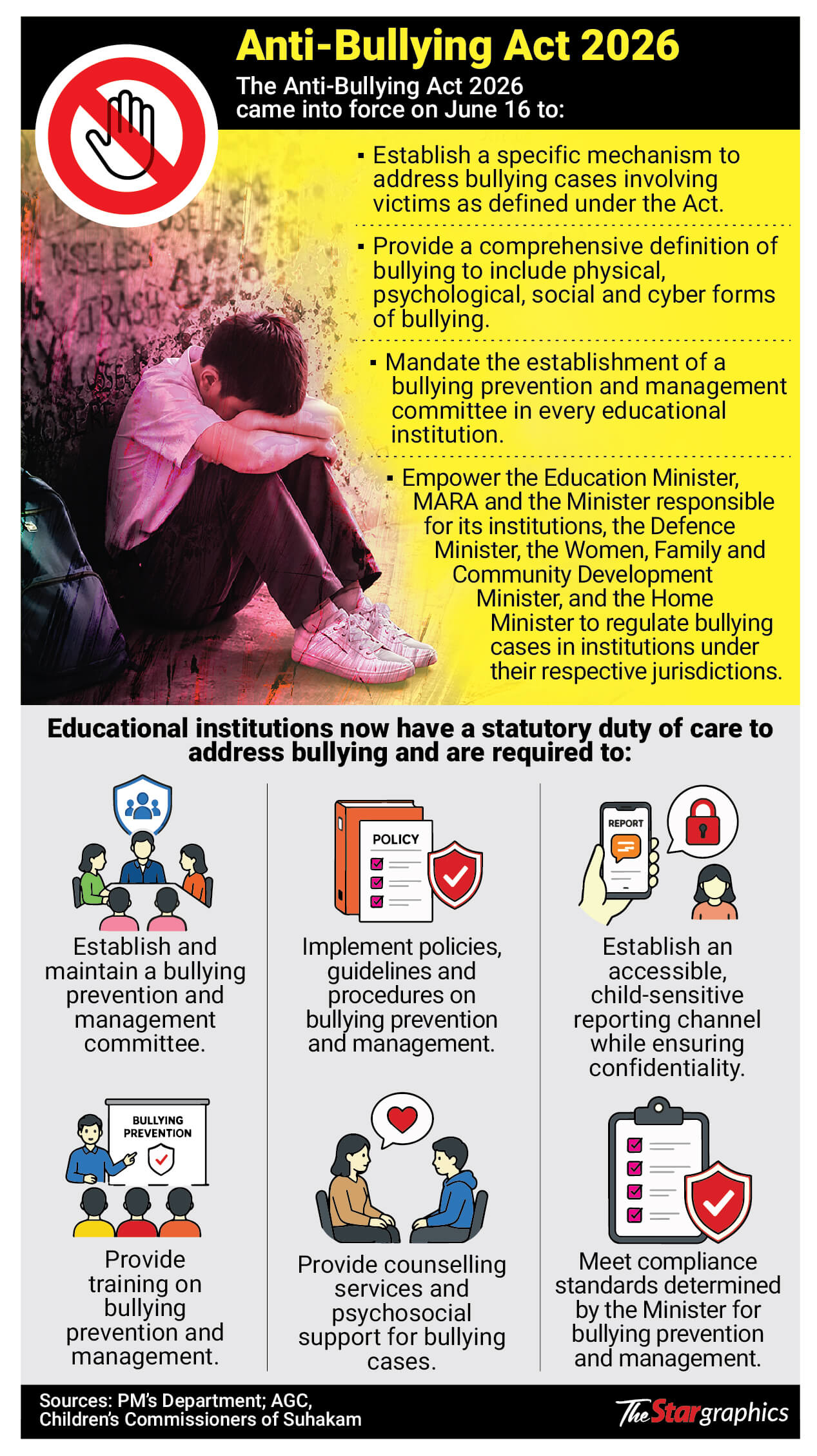
Malaysia’s Anti-Bullying Act 2026 introduces shared family responsibility, allowing parents or guardians to be held accountable in certain circumstances for bullying committed by their children. The Act covers repeated bullying involving minors and the relevant authority, such as schools, now have a statutory duty of care to address bullying.
Parental involvement plays an important role in addressing bullying behaviour because children and teenagers are still developing their ability to regulate emotions, understand consequences, and make decisions.
According to clinical psychologist Dr Joel Low, parental accountability can help reduce bullying by ensuring parents are more aware of their children’s behaviour and can be more actively involved in guiding them.
“There are cases where bullies are allowed to run rampant because of the lack of consequences, or where the consequences applied by schools may not be sufficient,” says Low, who is an executive committee member of the Malaysian Society of Clinical Psychology.
“This accountability would then mandate that parents are also significantly involved in ensuring that their kids are more aware of and in control of their behaviours.”
Low says parental involvement may also address situations where parents do not recognise that certain actions amount to bullying.
“There are certainly cases where some parents may not consider or realise that the behaviours are bullying, so having an external indication that this is so would definitely be good,” he says.
Furthermore, children under 18 are still developing the maturity needed to fully understand the consequences of their actions.
“While it must be said that ultimately we ought to ‘own’ our choices and behaviours, at those young ages, parents would have significant say and influence over what the kids do, and even if not, at the very least, be involved with teaching the child repercussions about their behaviours,” he says.
Low says a child’s under-standing of right and wrong is shaped by their experiences and the people around them, making parents and guardians important in teaching healthy ways to respond to conflict and peer relationships.

Multiple factors behind bullying
Bullying can stem from many factors, including children having a desire for control, having been a victim of bullying themselves, or not fully understanding the impact of their actions, says Low.
Some children may also act without recognising the harm they cause not because they intend to be malicious, but because they have not developed the ability to see another person’s perspective.
In these situations, parents have an important part in helping children understand consequences while also protecting them when needed. The new law helps complete the circuit of accountability by recognising the various people and influences that shape a child’s behaviour, says Low.
This is especially important during a child’s formative years, when parental figures play an integral role in guiding their development, values, and understanding of consequences.
Nevertheless, Low cautions that parental accountability should not be viewed as the only solution.
“Will this make it foolproof? No, clearly, because there are a lot of other elements involved. But I think this allows us to close an important gap.”
Parental accountability on trial
THE concept of shared family responsibility for minors (under age 18) under Section 43 of the Anti-Bullying Act 2026 legally shifts joint liability to the offender’s family – ensuring parents or guardians are directly accountable for a child’s actions, if he or she is found guilty of bullying.
The Anti-Bullying Tribunal can order the parent or guardian of the child offender to:
> Reimburse the victim for any reasonable expenses incurred as a result of the bully.
> Pay any compensation or damages not exceeding RM250,000 for any loss or damage suffered by the victim in respect of the bully, excluding expenses referred to earlier.
> Attend together with the child offender counselling or attend parenting support sessions provided by the relevant government agency.