
WHEN Monica Sanz, 24, first heard the word “mog,” she had a startling realisation: She had reached linguistic obsolescence.
The three-letter word, along with its various permutations – mogging, mogged, getting out-mogged – has become a way to describe one person outshining another, primarily used by Generation Alpha.
“I actually heard it from my boyfriend’s 15-year-old brother, and I was like, ‘Oh, my God, what are they talking about? Like, what does this mean? Am I getting old?’” Sanz said, adding, “I just don’t know the lingo anymore.”
While the term has existed for decades, it has taken on a new life on social media and among the younger generations, who typically use it to describe outdoing oneself or others, usually in a joking manner.
Gold medal Olympic figure skater Alysa Liu once said her main goal at a competition was simply “to mog.” Political commentator Hasan Piker posted on Instagram that he got “absolutely frame mogged by real celebrities” at an Oscars party. Arnold Schwarzenegger even joined in when he posted a compilation of his bodybuilding clips on the social platform X, writing, “Someone just tried to explain this new trend ‘frame-mogging’ to me ...”
As the term has grown more broadly popular, its usage has also widened.
“You can mog absolutely anything,” said Pierre Paul, 28, whose recent video about the roots of the term and its more colourful uses gained traction on TikTok.
“Einstein developed the theory of relativity,” Paul said in the video. “We can effectively say that he mogged physics and mathematics.”
But most often, he said, it was used as a means of insulting someone’s appearance, by comparing one person to another.
That makes sense given the term’s roots in the acronym “AMOG,” or “alpha male of the group,” said Adam Aleksic, a linguist and influencer who posts as @etymologynerd on social media. There’s no precise definition, but the original term was typically deployed to demean another person by way of perceived superior attractiveness.
By the mid-2010s, “mogging” was turning up in forums dedicated to the “black pill” philosophy, Aleksic said. The phrase, a modified metaphor borrowed from The Matrix, describes a nihilistic outlook among incels about their perceived sexual rejection by women.
But in the last decade, it spilled out of the online ecosystem of pickup artists, looksmaxxers and men promoting incel culture and into more mainstream platforms such as X, Instagram and TikTok. Along the way, the meaning has been sanitized.
“It’s sort of been semantically bleached,” Aleksic said, adding, “It’s lost a lot of the overt connotation.”
By the time Julianna Freed, 30, encountered the word at the start of this year, she had a different interpretation of its meaning.
“I understood mogging, as just, like, looking sexy,” Freed said. “And then more correctly understood it as like out-sexying somebody else.”
Her understanding of the term changed after seeing TikTok videos posted by Clavicular, the influencer whose real name is Braden Peters and who has become a de facto face of the term. He is also deeply associated with looksmaxxing, an adjacent concept that holds male attractiveness as the key to success. (“So much of what I know about this is, like, totally against my will,” Freed joked.)
Many now also use it ironically, distancing themselves from its origins.
“It could be used in the context of looks, style – outshining somebody in anything,” said Matthew Klein, 23, who has used the word satirically on TikTok. In February, he posted a video that amassed millions of views in which he described a viral moment during which Clavicular appeared to be mogged by a student at Arizona State University as a “significant historical event.”
The word is perhaps most used by Gen Alpha, Aleksic said, though Gen Z has picked it up, too.
“The people who are most willing to adopt new language are typically middle schoolers who are extremely flexible in their sense of self,” he said, “and they’re trying to build their identities and differentiate themselves from adults and build a shared kind of framework for themselves.” He added that they adopted vocabulary from online streamers.
Paula Simoni, a 25-year-old bartender in Miami, said that she used the phrase with her 9-, 10- and 11-year-old nieces, to mixed reception.
“To them,” she said, “I’m like the cringey aunt.”
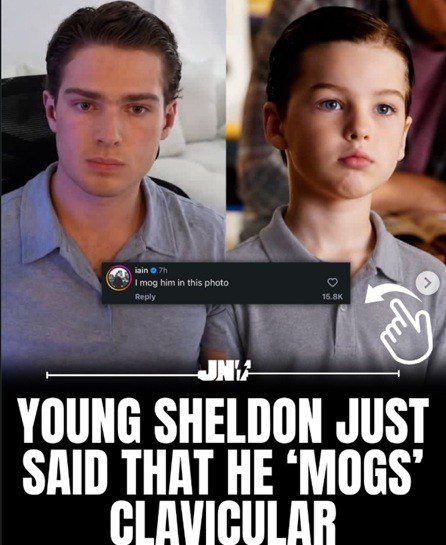
Simoni learned about the term earlier this year, when a trend on TikTok involving users showing pictures of people who are “outmogging” them. She posted a TikTok that zoomed out on a photo of her and her sisters, revealing additional people as the perspective expands.
The video now has more than three million views. And yet, she said, one of the sisters pictured, who is not on TikTok, still doesn’t know what mogging means. — 2026 The New York Times Company