SERENA R.* saw her life upended during the Covid-19 pandemic when her father was diagnosed with bladder cancer and a serious heart condition.
In her mid-30s and the sole breadwinner of her family, she juggled work while caring for her father, then in his late 60s.
“I wasn’t able to find a job I truly loved, as my priority was to earn as much as I could to pay for my dad’s treatment,” she says.
While her younger brothers helped with physical tasks, Serena handled most responsibilities, including hospital visits, and tracking his medication, diet, symptoms, and overall health.
She spent nearly RM200,000 of her own savings after his insurance was exhausted. A full-time professional caregiver was too expensive at nearly RM5,000 a month, so a part-time carer was hired while Serena filled in the gaps.
“I was privileged. I had savings, access to medical advice through extended family, and we could afford private healthcare when public hospitals were overstretched. But even then, it was hard,” she recalls.
Her father’s condition required a range of support, from caregiving and physiotherapy to multiple specialists. At one point, he was seeing seven doctors at once because different functions of his body were affected.
Serena describes navigating care with little guidance, relying on scattered information online.
“It made me realise how complex care really is. There’s a whole ecosystem, but no one explains it.”
The strain took a toll on her. Serena put off career moves and marriage as she balanced work, caregiving, and home responsibilities.
“I was exhausted. It affected my health. I can see how someone could lose themselves under that pressure.”
Serena’s experience reflects a broader reality faced by many families across Malaysia, where caregiving often falls on individuals with limited support, information, or resources. As family structures evolve, these pressures are becoming more widespread and harder to manage.
Malaysia also faces a growing shortage of trained care workers – reflected in relatively low nurse to-population ratios compared with ageing-country benchmarks – limited numbers of certified eldercare professionals, and persistent recruitment challenges in childcare and long-term care services.
Recognising this, policymakers are taking a more coordinated approach.
A framework for care
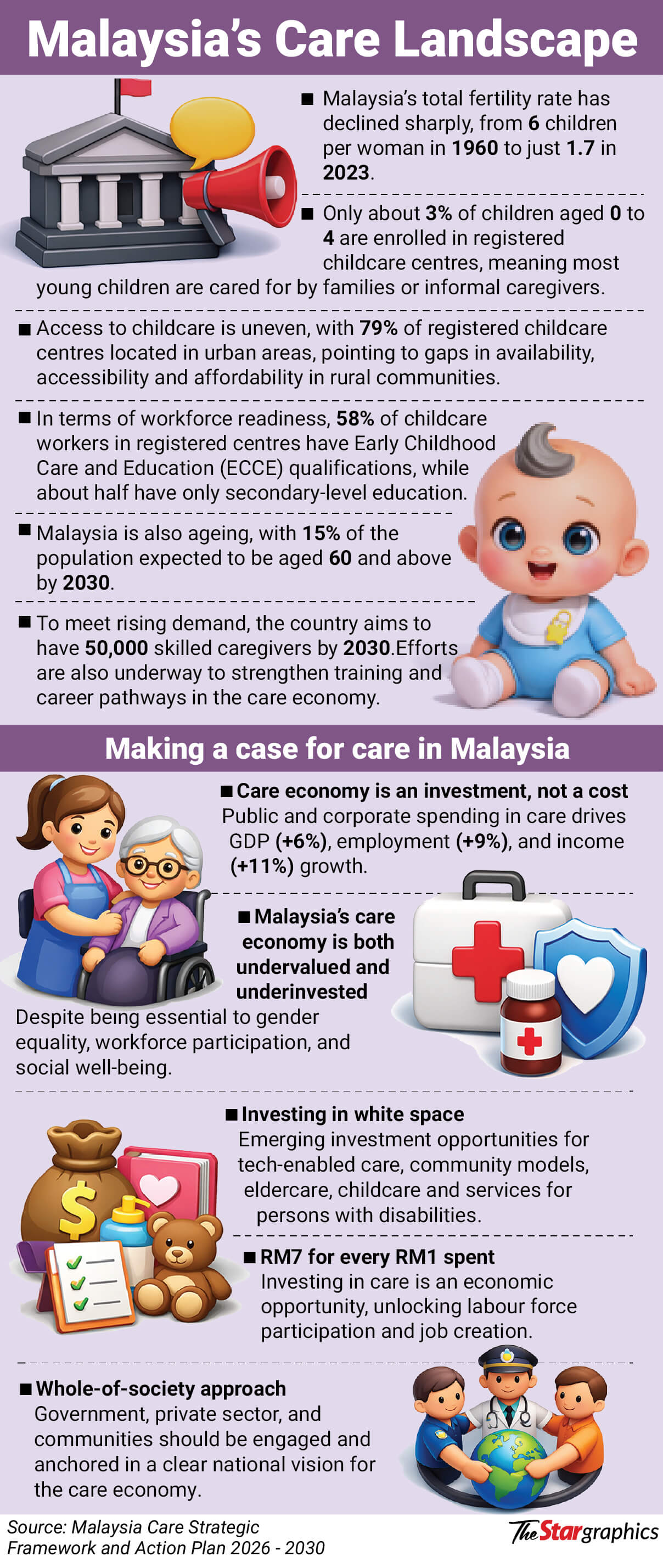
This year, the Malaysia Care Strategic Framework and Action Plan 2026-2030 kicks into gear, aiming to build a more resilient and sustainable care ecosystem in response to an ageing population and declining birth rates.
These demographic shifts are raising dependency ratios and placing growing pressure on care services, social protection systems, and families, particularly on the “sandwich generation”, who are balancing care for children and older relatives. This burden continues to fall disproportionately on women, including single women.
The framework acknowledges that without proactive planning and strategic investment, Malay-sia risks a care crisis that could strain families, communities, and the wider economy.
It therefore serves as a national roadmap to guide the care agenda by strengthening legislation and governance, developing concrete care career pathways, improving advocacy efforts, encouraging strategic partnerships, and integrating research, technology and data in policymaking. It also targets training 50,000 caregivers by 2030 while promoting professional qualifications and structured career pathways to elevate care as a respected profession.
This framework is timely because improving Malaysia’s care system is not merely a necessity, but an opportunity for growth. According to United Nations Development Pro-gramme (UNDP) findings, every RM1 invested in the care economy could generate RM7 in economic returns, with potential gains of up to 6% in GDP, 9% in employment, and 11% in income growth.
A demographic imperative
Malaysia’s care needs are rising sharply.
Despite falling birthrates, there is still a significant population of children under the age of 10, nearing five million in 2025. There are also over 800,000 registered persons with disabilities as of 2025. In terms of ageing, the number of older adults aged 60 and above will rise from 4.13 million (12% in 2025) to 8.79 million (21%) by 2050.
These trends are also accompanied by changing family structures, says Universiti Malaya demographer Dr Tey Nai Peng.
He explains that smaller families, more people remaining single, and emigration abroad increase care pressures, often leaving caregiving responsibilities to single children or leaving older adults without family support.
There is also the impact of gender dynamics on family and workplace. Tey explains that in Malaysia, women remain primary caregivers, often sacrificing careers or childbearing. He says the framework can help improve work-family balance, better support people’s choices around parenthood, and increase female labour force participation to 60%.
He also notes Malaysia’s diverse population and emphasises that this unique demographic situation requires tailored care policies. As such, rural-urban disparities must be considered in implementation, alongside addressing unequal access and diverse cultural and ethnic needs.
The value of care
The value of the framework lies in recognising care as a social and economic issue rather than solely a private family responsibility, says Amalina Annuar, manager of Research for Resilient Democracy and an Inclusive Society at the Institute for Democracy and Economic Affairs (Ideas).
Amalina highlights the framework’s significance in providing a clearer national direction on care policy by linking childcare, eldercare, disability care, workforce development, and social protection under a single strategic framework.
However, she cautions that it should ultimately be judged by whether it delivers practical reforms that reduce the care burden on women, expand access to quality services, and is supported by clear financing, strong implementation and accountability.
“One of the most important shifts is recognising both paid and unpaid care work as economically and socially valuable,” she says.
Care in Malaysia broadly falls into two categories: paid and unpaid. Unpaid care is typically provided by family members (often women), while paid care includes services delivered by trained professionals across homes, centres, and specialised facilities.
The framework also aims to streamline regulation across fragmented care services and strengthen licensing and oversight.
Furthermore, the plan to professionalise care work by developing competency standards, formal qualifications, and training pathways could improve both service quality and the attractiveness of care work as a profession, says Amalina. She adds that greater emphasis on data, research, and coordination will allow for better policy design aligned with demographic realities.
However, Amalina emphasises that efforts to professionalise care work must be matched with decent wages, labour protections, and retention incentives.
Next steps
While the framework is a credible start, Amalina notes that there are potential risks in implementation.
Cross-ministry coordination could dilute accountability if responsibilities are not clearly assigned, while long-term financing mechanisms remain unclear.
“There is also limited focus on redistributing care responsibilities.
“While the framework recognises the disproportionate burden of unpaid care on women, policies that actively redistribute care across men, employers, and the state are less prominent,” Amalina notes, pointing to countries like Sweden that promote shared caregiving through policies such as non-transferable paternity leave that help rebalance care within households.
Other steps that could strengthen the framework include developing better workplace policies for caregivers, such as flexible working arrangements and caregiving leave, along with stronger enforcement of quality assurance and safeguarding mechanisms.
“Expanding care services without robust inspection systems, complaint mechanisms, and regulatory oversight can create risks for children, older persons, and persons with disabilities,” Amalina cautions.
When it comes to care, it is not enough to just ensure accessible and affordable care services; a broader shift in societal attitudes is also needed.
“European countries such as Sweden and Denmark treat early childhood care as a public service with substantial subsidies and capped fees. Evidence shows this improves women’s labour force participation and child development outcomes,” explains Amalina.
“Overall, practical labour policies, accessible services, and better support for caregivers would help ensure the framework translates into real reductions in unpaid care burdens,” she says.
*Not her real name.