JACOB Frey, only days into his third term as mayor of Minneapolis, had to step up to a microphone after an Immigration and Customs Enforcement (ICE) agent fatally shot Renee Nicole Good on the south side of town.
Federal officials were defending the Jan 7 shooting. The mayor was having none of it.
Frey, a Democrat, called the federal government’s self-defence claim “bull***t.” He told ICE to “get the f*** out of Minneapolis.” And he asked residents to stay peaceful, lest the Trump administration send in the military.
His comments made national headlines, winning him praise from unlikely corners of his city while angering top officials in Washington.
On social media, the Trump administration said that Frey was a “scumbag” who “should be ashamed of himself.”
And in a statement, Abigail Jackson, a White House spokesperson, described the mayor as “a disgrace” who had “rushed to publicly lie and incite more violence against law enforcement.”
Though Trump’s allies have portrayed Frey as an example of liberal excess, the mayor has long faced the opposite charge inside his heavily Democratic city, where some residents have complained that he was too moderate and too accommodating of police.
In the days that followed, as ICE has flooded Minneapolis, Frey and other top Democrats had been unified in their criticisms of the president and their calls for agents to leave.
When ICU nurse Alex Pretti was shot by ICE last Saturday, Frey was not as explosive but he was still fiery as he appealed to US president Donald Trump, asking him to “put America first” and remove federal law enforcement officers from the city.
“How many more residents, how many more Americans, need to die or get badly hurt for this operation to end?” he questioned.
It is a far different political landscape from 2020, when Minneapolis Democrats were divided over what to do about policing after an officer murdered George Floyd, and when Frey became a target of left-wing protests.
“Apparently,” said Frey, who has said he is in his last term as mayor, “I’m like a walking Rorschach test.”
‘Villain No. 1’
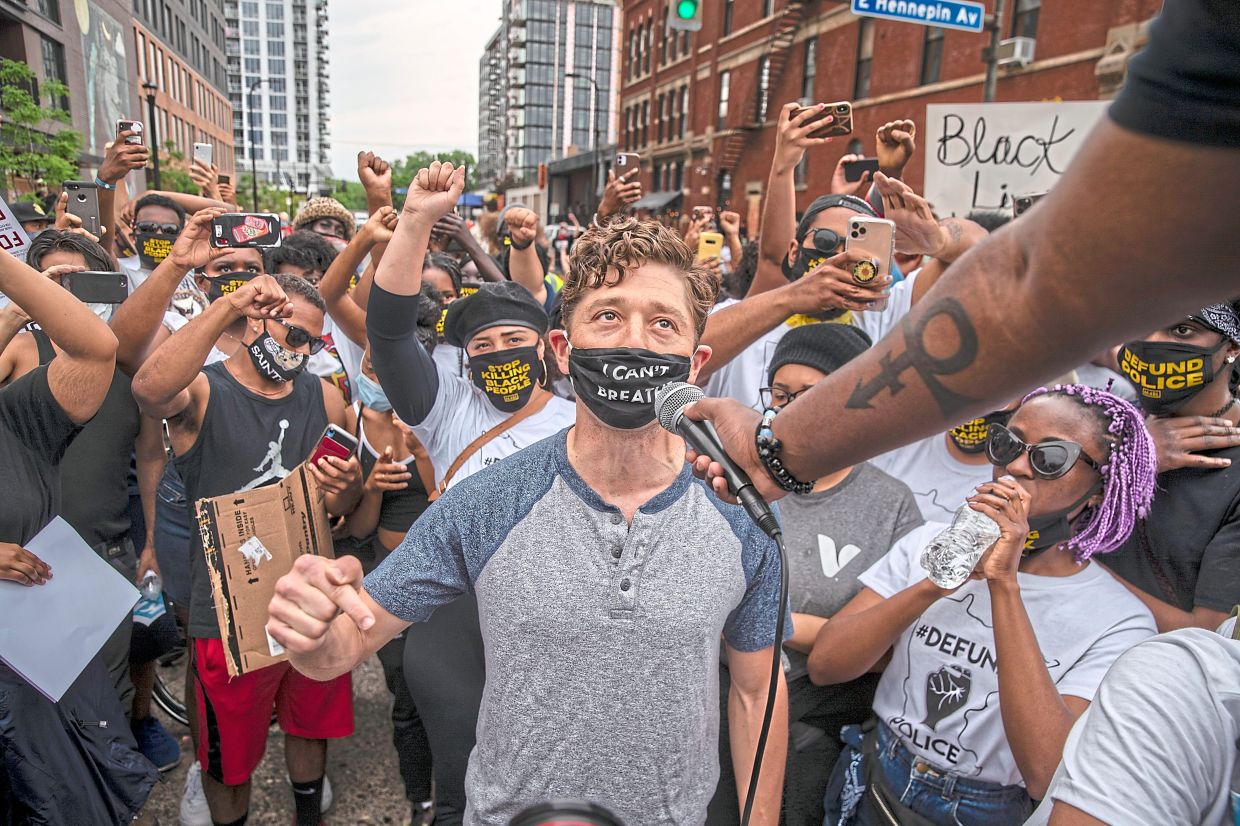
After the murder of Floyd in the spring of 2020, Minneapolis was in chaos and protesters gathered near Frey’s home. A speaker asked about defunding the police and presented the first-term mayor with a microphone.
“I do not support the full abolition of the police,” Frey responded through a face mask, his voice barely audible. The crowd booed. He walked away to chants of “Shame!” and “Go home, Jacob.”
Not long after, when a veto-proof majority of the City Council pledged to dismantle the troubled Minneapolis Police Department, the mayor resisted.
“I thought my political career was probably over,” Frey recalled in an interview recently.
Frey, 44, took an unlikely path to leading Minnesota’s largest city. He grew up in Virginia and represented the United States as a runner in the Pan American Games. As Frey tells it, he fell in love with Minneapolis while competing in the city’s marathon and then decided to make a life there.
He emerged from a large field of candidates in 2017 to unseat a mayor whose handling of two police shootings had been criticised. Frey, a lawyer, was an upbeat, confident speaker who quickly gained traction on the campaign trail.
But from the beginning, some doubted that he was up to the job.
“I told him during the campaign, I just said, ‘I don’t think that you’re equipped to be the mayor of a racially and ethnically diverse city that has all of these significant problems,’” recalled Nekima Levy Armstrong, a civil rights lawyer and activist who was also a candidate for mayor that year.
“I was really concerned that he was under-equipped and way too idealistic and lacked substance in the right areas.”
After Frey won, those questions persisted.
“When he first got elected, I thought he was a little too green,” said Andrea Jenkins, who served two terms on the City Council while Frey was mayor and became his political ally.
“I thought it wasn’t quite time for him yet.”
The mayor was put to the test in 2020, first as Covid-19 shut down the world, and then with the murder of Floyd. Businesses were ransacked. National Guard troops patrolled the streets. A Minneapolis police station was set ablaze.
Frey’s stance – that the Police Department needed an overhaul but should not be abolished – was seen by some as out of step with the moment, but it aged well with voters. The next year, he was elected to a second term. Minneapolis voters rejected a ballot measure that proposed disbanding the Police Department.
“In the progressive movement, he became Villain No. 1,” said Jenkins, who was among the council members who initially called for the department’s disbanding. “But he stood by his guns. He did not capitulate to the political winds, which would have been kind of easy to do.”
Uniting message
Last year also brought excruciating loss to Minneapolis. In June, just outside the city, a Democratic state legislator and her husband were killed in what prosecutors called an act of political violence. And in August, an attacker fired guns into a Catholic church, killing two children and wounding 19 people.
Shortly before the end of 2025, the Trump administration focused on a sweeping social service fraud scheme that prosecutors said was largely perpetrated by members of Minnesota’s Somali diaspora. Soon, immigration agents announced a crackdown in the city.
In the early weeks of the ICE surge, much of the political heat from the administration landed on Tim Walz, Minnesota’s governor. Walz, who clashed with Trump in 2024 as the Democratic nominee for vice president, announced days before Good’s death that he was abandoning his campaign for a third term as governor amid criticism about his administration’s oversight of social services funds.
After Good’s killing, Frey spoke angrily against ICE and seemed to move up the list of political targets for the Trump administration.
“I do think it’s time to use bad language,” said Ben Person, a resident who voted for the mayor. “He’s gone through a lot of events, and I think he really represented exactly how so many Minnesotans and Minneapolitans are feeling.”
Linea Palmisano, an ally of Frey’s on the City Council, said she had wondered at first whether the mayor’s use of expletives in his remarks about the shooting might have been a mistake. As she spoke with others in the city, including her young son, she realised his comments had captured the mood.
“Minneapolis is pretty united around his message right now,” Palmisano said. “Even if they don’t want to like him personally, they don’t have to like him personally.”
A ‘weathered’ mayor
Inside Minneapolis, Democrats have been largely in agreement that the ICE deployment is wrong, a sharp difference from the intra-party fissures in 2020. That has led to some unlikely political scenes for Frey, who won a third term in November by beating a new slate of challengers from his left, including state Senator Omar Fateh, a democratic socialist who is Somali American.
At a news conference after the shooting, Frey stood alongside state Rep. Aisha Gomez, a Minneapolis Democrat who describes her politics as “leftist” and “radical,” as they both called for state agents to rejoin the investigation of the shooting.
Gomez said in an interview that she had been at odds with Frey over the years on issues such as policing, homeless encampments and the role of corporations in politics, but that “I appreciate his clarity in this moment.”
“I’m happy to link arms with Jacob Frey and fight against Trump’s fascist shock troops,” said Gomez, who noted that it would “probably ruin my street cred if you print me saying nice things about Jacob Frey.”
Others remained sceptical of the mayor and questioned whether he was meeting the moment.
Levy Armstrong said Frey needed to “really show” his power and “back up all that tough talk.”
Dan Engelhart, a Democratic member of the Minneapolis Park & Recreation Board, said he had never supported the mayor, and “to be honest, I think he’s the worst politician I’ve ever been around in my whole life.” He called for moving beyond “the lowest possible bar and performative speeches.”
Frey has not talked much publicly about his plans after his term ends in about four years. Asked about higher political aspirations, his spokesperson, Ally Peters, said Frey was focused on being mayor.
But Frey described himself in interviews as a different leader from the one he was in 2020. He said he was now a “weathered and experienced mayor,” someone who had built up “confidence and thickness of skin” and learned to trust in what he knows to be right.
He described the current moment as one in which people who disagree on other issues are “grinning down the bear, and we’re standing with each other.” But it also remained a risky time, he said, with the potential for escalation every day that the ICE deployment continued.
He later announced that Minneapolis was joining the state attorney general and neighboring St Paul in asking a federal judge to order an end to the surge of ICE personnel in Trump's "Operation Metro Surge".
That same day, the Department of Homeland Security released another statement criticising Frey and Walz for policies that limit local law enforcement agencies’ cooperation with immigration agents.
The federal government said that those limitations were dangerous and that immigrants convicted of crimes “should not be released back onto our streets to terrorise more innocent Americans.”
On Jan 31, however, US federal judge Kate Menendez denied Minnesota's motion for the temporary restraining order. The court documents, filed on Saturday, say that Minnesota and its cities of Minneapolis and St. Paul have not met their burden of proof.
Frey said he still has no plans to enforce federal immigration laws in the city, even after being warned by Trump that he was "playing with fire" by failing to do so.
During a conversation with Lulu Garcia-Navarro on The New York Times' "The Interview", Frey was asked what he took away from Trump's previous warning about Minneapolis failing to enforce federal immigration laws.
"We were never going to agree, and we have not agreed, to enforce federal immigration law. Why? First off, it’s not our job," Frey asserted.
"I want our police officers doing their own work, not somebody else’s.
"I want our police officers doing the important work of keeping Minneapolis residents safe, responding to 911 calls, stopping carjackings, preventing murders. The work of a police officer in a major city." — ©2026 The New York Times Company
The article was first published in The New York Times.