
A future without cervical cancer is possible in Malaysia, say experts. This type of cancer is largely preventable through screening and vaccines. But a wider coverage, especially a vaccination programme that includes boys too, is crucial.
CERVICAL cancer is one of the few cancers that can be almost entirely prevented, yet it remains the sixth most common cancer among women in Malaysia and the fourth most common among women worldwide.
Over 99% of cervical cancer cases are linked to persistent infection with high-risk human papillomavirus (HPV). The disease often takes 15 to 20 years to develop, making early prevention and screening critical. In Malaysia, about 47% of cervical cancer cases are detected at stage three or four.
National Cancer Society of Malaysia (NCSM) managing director Prof Dr Murallitharan Munisamy explains that delayed detection often leads to poorer outcomes; longer treatment journeys, higher costs, and greater physical and mental burdens for patients.
As we observe Cervical Cancer Awareness Month in January, it is a timely reminder that the tools to prevent cervical cancer already exist: wide vaccination coverage and regular screening. The challenge is ensuring they reach everyone, early and equitably.
Vaccination: An effective solution
Prevention is key. The HPV vaccination is widely recognised as the most effective measure, capable of preventing over 90% of cancers caused by the virus, including cervical cancer.
The Malaysian HPV Immunisation Programme, launched in 2010, uses a school-based approach and initially focused on girls aged 13 in secondary schools. It achieved coverage of over 95% up to 2020, but was impacted by Covid-19 school closures which resulted in missed doses.
To close gaps, the Health Ministry carried out catch-up vaccination efforts and introduced HPV vaccination appointments at primary healthcare facilities via the MySejahtera app, targeting girls in private schools, home-schooled students, and those who missed school-based vaccination.
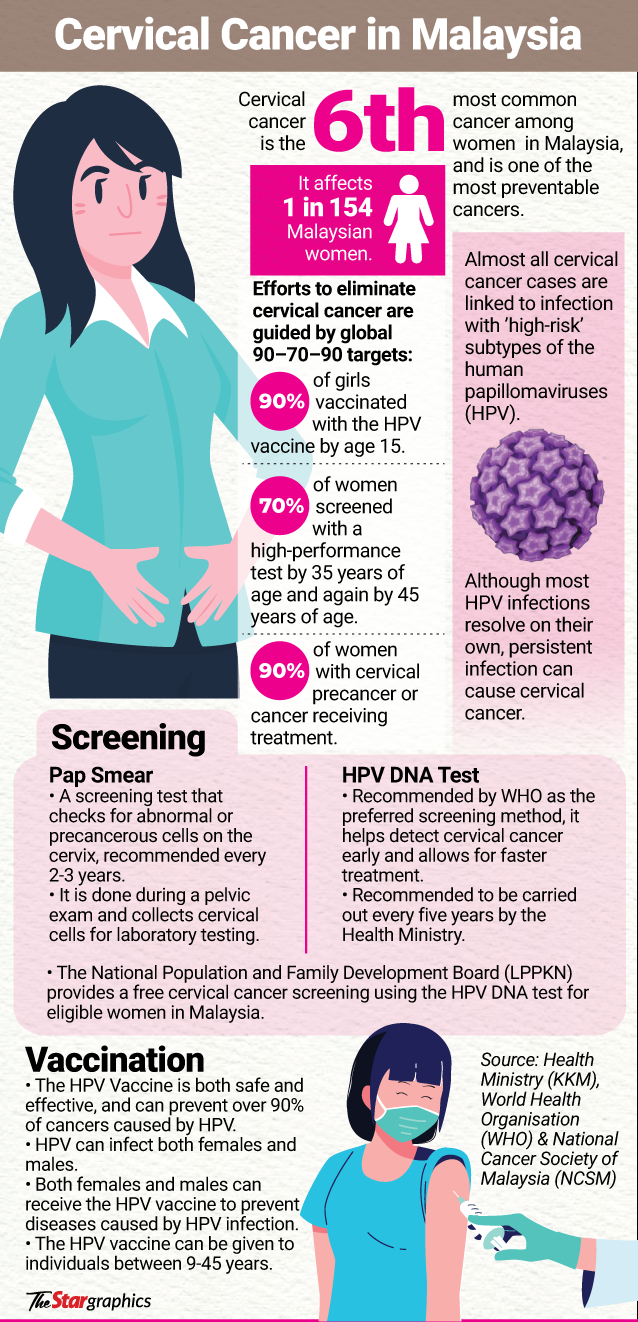
This year, the national immunisation programme shifts to primary schools, vaccinating girls in year six. NCSM praised the move, noting it reduces missed doses due to school transitions or dropouts, and strengthens overall HPV vaccination uptake.
The Ministry has also outlined a national strategy in the Action Plan Towards the Elimination of Cervical Cancer in Malaysia 2021-2030, with elimination defined as an incidence rate of less than four per 100,000 women.
In a written interview with Sunday Star, the Health Ministry says that the HPV Immunisation Programme has consistently achieved high HPV vaccination coverage, exceeding 90% of the target population from 2010 to 2024, indicating that cohorts whose vaccination programme were disrupted during the pandemic years have since received their doses.
And we are beginning to see results from these efforts: Data from the National Cancer Registry show that the age-standardised incidence rate (ASR) of cervical cancer in Malaysia fell from 8.3 per 100,000 women in 2007 to 5.4 per 100,000 in 2021, indicating a gradual but sustained decline following expanded prevention and screening initiatives.
The case for gender-neutral vaccination
In addition to these measures, Dr Murallitharan argues that another, critical step is needed.
“Currently the government policy is to vaccinate only girls but this is not enough, because boys can still catch HPV. Only if you vaccinate boys as well will you actually be able to eradicate cervical cancer entirely and stop HPV from spreading once and for all,” he said.
He points to Australia as an example, which vaccinates both girls and boys through its National HPV Vaccination Programme and is on track to eliminate cervical cancer by 2035.
HPV, a common sexually transmitted infection, includes over 200 types. While most are harmless, persistent infection with carcinogenic strains can cause cervical cancer and is linked to cancers of the mouth, throat, vulva, vagina, penis, and anus, affecting both sexes. In 2019, HPV caused an estimated 620,000 cancer cases in women and 70 000 cancer cases in men globally.
Dr Murallitharan explained that Malaysia recently shifted its national HPV vaccination programme to a single-dose schedule from the initial two-doses following updated World Health Organisation (WHO) recommendations in 2022, which indicate that a single dose of HPV vaccine confers protection comparable to a two-dose schedule for most adolescents. Dr Murallitharan notes that this change frees up resources to vaccinate boys at no additional cost.

Expanding coverage
Three HPV vaccines are approved by WHO globally.
The first is bivalent, covering the strains of HPV 16 and 18; later quadrivalent (HPV 6/11/16/18) and a nanovalent vaccine (HPV 6/11/16/18/31/33/45/52/58) followed. Currently, Malaysian schools use the bivalent vaccine, which protects against strains responsible for about 70% of cervical cancer cases worldwide.
Dr Murallitharan urges switching to the nanovalent vaccine, which protects against 99% of cancer-causing HPV strains. “In Southeast Asia, the dominant cancer-causing strains are not just HPV 16 and 18. The HPV strains 52 and 58 are also common. The nanovalent vaccine covers all strains prevalent in our region,” he explains.
The good news is that generic, lower-cost nanovalent vaccines are entering the market, improving accessibility.
Despite the challenges in combating cervical cancer, Dr Murallitharan is optimistic about the future.
“Malaysia is on the right track. Eliminating cervical cancer is a gift that we want to give our children,” he says.
To complement the national vaccination plan, NCSM launched the “Leaving No One Behind” campaign in 2024, bringing in 300,000 doses of HPV vaccines costing RM90mil, and administered the doses for free across the country to rural and underprivileged communities.
This year, in addition to NCSM’s free vaccination for underserved communities, “Leaving No One Behind 2” is opening up a subsidised programme where HPV vaccines are available for RM290, significantly lower compared to RM500 typically charged at private clinics. It is available for boys and girls aged 9-14 in partner clinics across Malaysia.
For more information, visit: https://hpv.cancer.org.my/