
THE ocean liner that once carried presidents, celebrities and hopeful immigrants across the Atlantic is making its final journey – not to a grand restoration, but to the bottom of the sea.
The SS United States, which set records and captured imaginations in the mid-20th century, departed Philadelphia last month after decades of rusting in place. It is now bound for the Florida Panhandle, where it will become the world’s largest artificial reef.
The 302m-long ship, known as the Big U, first heads to Mobile, Alabama, where hazardous materials, including remaining fuel, will be removed before it is sunk safely.
Since it can no longer move under its own power, a fleet of tugboats pulled it down the Delaware River before a single tug continued the slow tow southward into open waters.
A ship of superlatives
Built in the early 1950s, the SS United States remains the largest passenger ship ever constructed in America, over 30m longer than the Titanic.
Designed by naval architect William Francis Gibbs, it served as a luxury liner in peacetime but could be swiftly converted to transport 14,000 troops if needed.
The ship made history on its maiden voyage, setting a transatlantic speed record by reaching Europe in just over three days at an average of more than 65kph.
Over the years, it made 800 Atlantic crossings, hosting the famous and the ordinary alike.
However, as air travel became dominant, the ship was withdrawn from service in 1969.
A bittersweet farewell
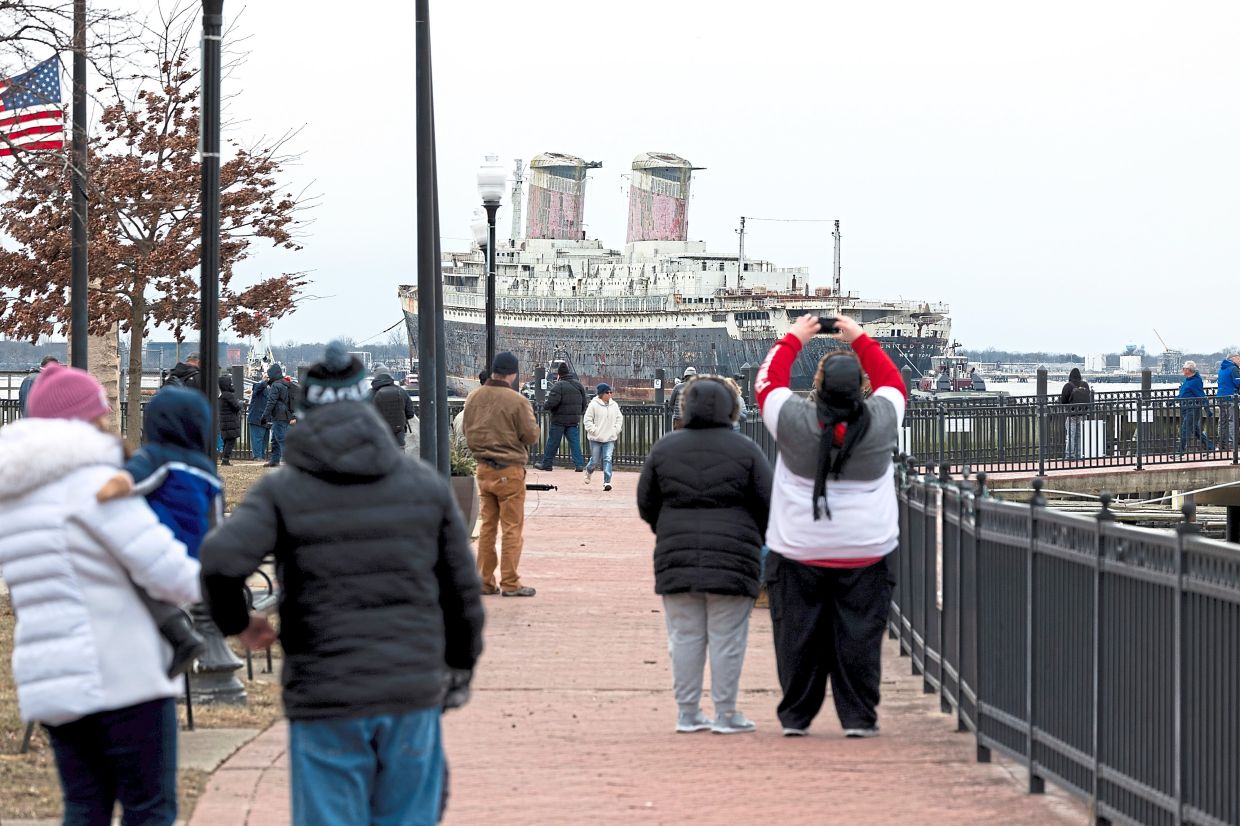
On Feb 19, tugboats guided the ship under the Walt Whitman Bridge, where traffic was briefly halted as its towering funnels cleared the roadway by less than 3m.
Spectators gathered to watch history move once more.
Garfield Harper Jr, a New Jersey resident, had been there when the ship arrived in Philadelphia in 1996. Seeing it depart again stirred memories.
“My life is just about gone – I’m in my 70s,” he reflected. “It’s kind of sad, but I just wanted to see it leave.”
Five days earlier, a small crowd had watched as the ship was carefully moved from its longtime berth to another pier in South Philadelphia.
The peeling black hull loomed over the industrial waterfront as tugboats nudged it across the slip – a short but symbolic step in its final voyage.
For some, the departure was deeply personal.
Stephen Kosciesza, 70, from Maryland, recalled how his parents immigrated aboard the SS United States in 1954.
His father, a stateless Polish refugee, was seasick for much of the journey.
“The famous family story is that all the way over, he was saying, ‘Commodore, stop the ship! I’m getting out,’” Kosciesza chuckled.
The end of an era
Many had long hoped to see the ship preserved as a museum or attraction.
Devin Harrison, a maritime enthusiast from Pennsylvania, lamented its fate. “I think it should be a national treasure,” he said.
The SS United States Conservancy, which purchased the ship in 2011, had fought for years to secure a future for it.
However, after a federal court ordered its eviction from the Philadelphia pier last summer, the group raced to find a new home.
Efforts to secure a berth at major ports across the United States all failed due to the ship’s immense size.
As Susan Gibbs, head of the conservancy and granddaughter of the ship’s designer, put it, “She’s just so darn big.”
In the end, the best available option was to transform the ship into an artificial reef.
Once sunk in about 55m of water off the Gulf Coast, its highest points will still sit 18m below the surface.
Plans are also in place for a land-based museum in Florida, which will incorporate preserved elements of the vessel, including at least one of its funnels.
Alex Fogg, a marine resources expert involved in the project, said the reef would provide a thriving habitat for fish, crabs and other sea life. He believes it will also become a major destination for divers worldwide.
A magnificent journey
For many admirers of the SS United States, its final resting place is a painful but dignified compromise.
Linda Silva, 80, sailed aboard the ship as a young woman on a life-changing voyage to Paris.
“No one in my family had ever done anything like that,” she recalled.
While saddened by its fate, she accepts the inevitability.
“It’s not that life is a decline,” she mused.
“Sometimes your usefulness kind of terminates abruptly, as hers did. But it doesn’t overshadow the magnificent journey you took to get there.” — ©2025 The New York Times Company
This article originally appeared in The New York Times.