



SHE was beautiful and charming, and he fell in love with her even though she was a married woman.
The two started an affair until one day, her husband found out.
The husband then got his justice under the law when his wife’s boyfriend was punished in court for the consensual relationship.
This is possible under Section 498 of the Penal Code, which currently makes it a crime to “entice away” a married woman in Malaysia. If found guilty, the man can be punished with jail time of up to two years, a fine or both.
Now, switch the roles around: what if it was the husband who was enticed away by another woman? The answer is it’s not a crime under Malaysian law.
Such inequality is one of the reasons why various groups are urging for Section 498 of the Penal Code to be abolished completely.
Another reason is because the law itself is irrelevant today, as many view it as treating a spouse like “property” that can easily be taken away.
These calls have been made before, but enticement cases are still being pursued in court today.
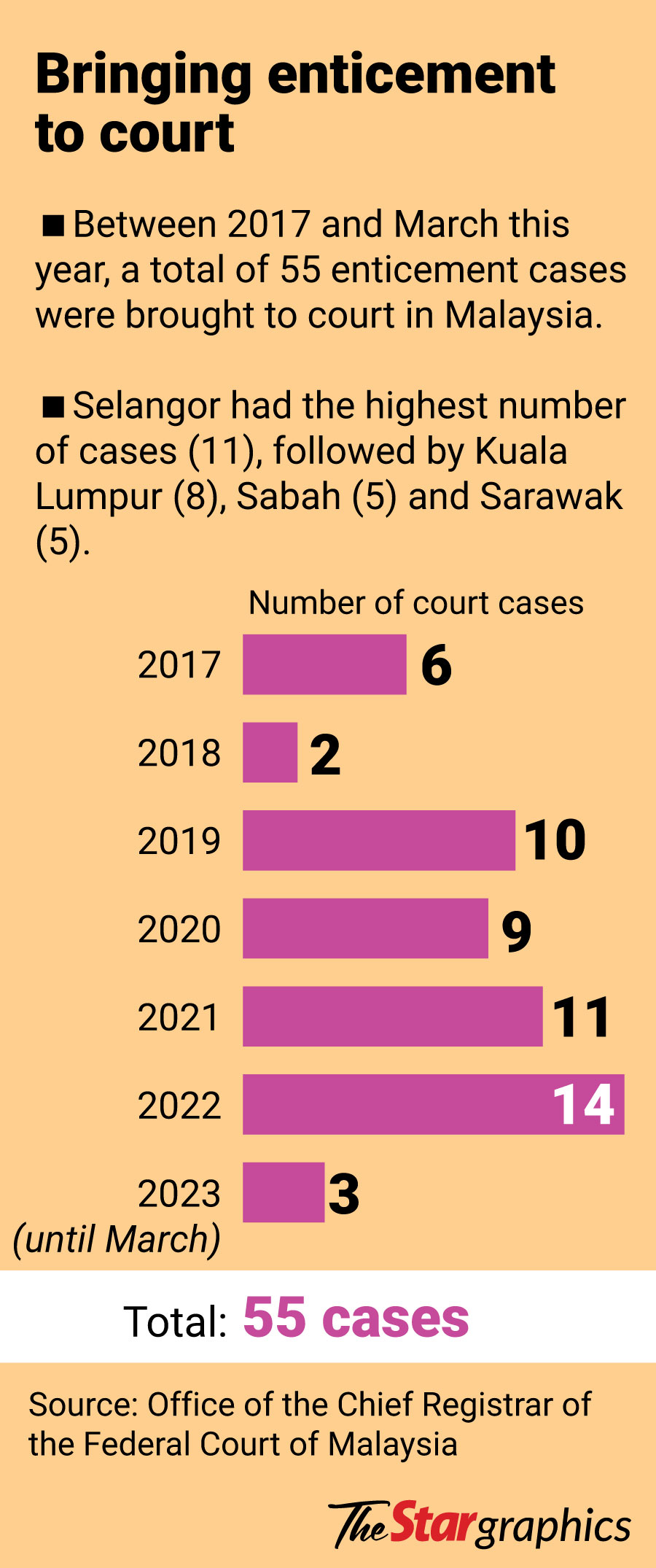
A total of 55 cases were brought to court between 2017 and this year so far, based on data made available to Sunday Star.
Selangor had the most cases with 11, followed by Kuala Lumpur with eight, according to the Office of the Chief Registrar of the Federal Court of Malaysia.
Overall, such enticement cases in courts nationwide increased from nine in 2020, to 11 in 2021 and 14 in 2022.
As of March this year, three enticement cases had been taken to court.
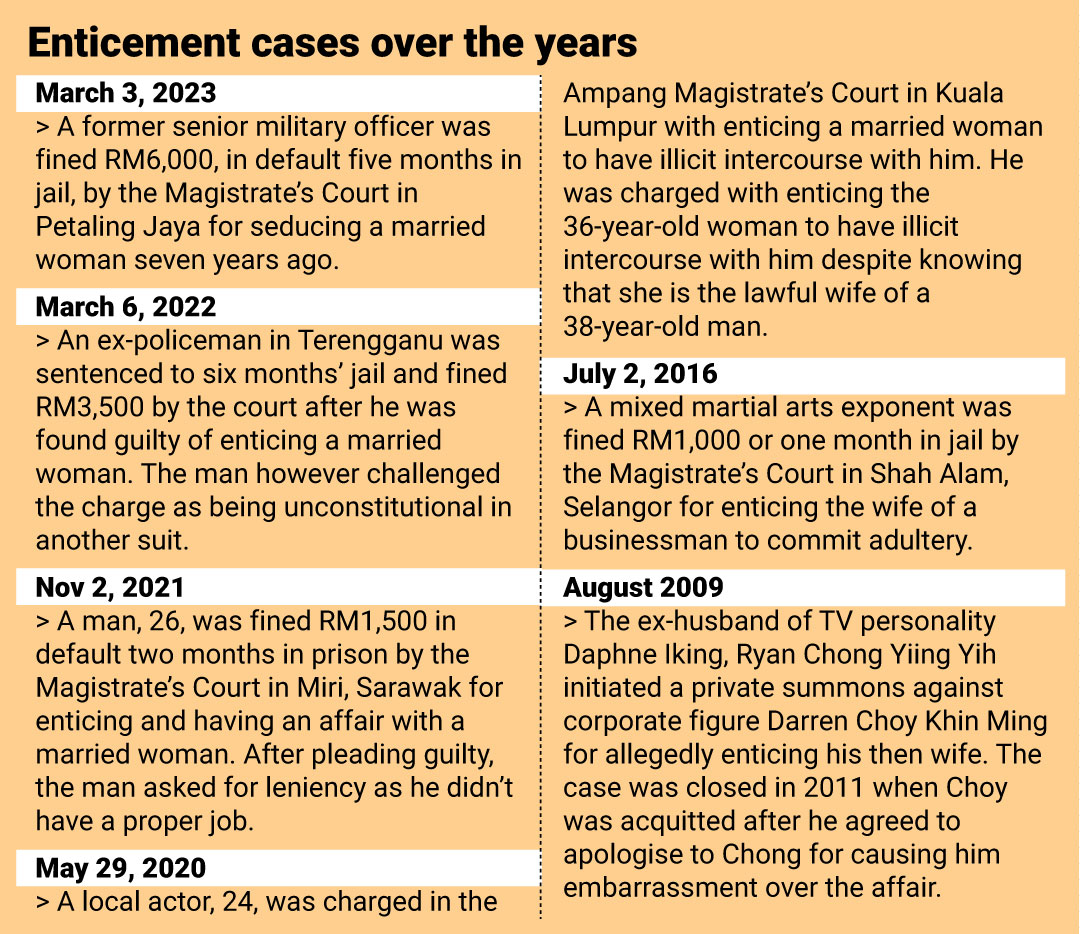
A more high profile case is that of TV personality Daphne Iking – ex-husband Ryan Chong Yiing Yih initiated a private summons against corporate figure Darren Choy Khin Ming for enticement in 2009.
Malaysia has yet to make changes to address the weaknesses in this law.
When contacted, Deputy Minister in the Prime Minister’s Department (Law and Institutional Reform) Ramkarpal Singh says Section 498 of the Penal Code is not on its list of laws to be reformed for now.
“At this moment, we have not engaged or commenced any discussion on it yet,” he said, adding that the government is currently focusing on introducing other law reforms first.
‘Outdated and discriminatory’
Until then, the calls to abolish the law will continue to echo.
Malaysian Bar president Karen Cheah says the law should be repealed in its entirety, as it suggests that women are gullible and easily seduced.
“This law has no place in the 21st century. Women are no longer passive agents in a marriage,” she says.
Not only that, Cheah says Section 498 appears to protect the rights of the husband instead of the wife, as the husband is the one who is seen to have been deprived of his “property” when his wife is enticed away from him.
“It’s also pertinent to note that consent by the wife is wholly immaterial.
“The accused will still be guilty if the simplistic requirements of Section 498 are fulfilled: a woman is enticed and she is married,” she points out.
While Section 498 may appear trivial, its implications are manifold, says Cheah.
“It is discriminatory against women and implies that they are fragile and naïve.
“It wrongly reinforces the view women are chattel, and provides an avenue for disgruntled husbands to take their frustrations out into the open by pressing charges against the man they accuse of enticing their wives in court.
“The existence of Section 498 is less about safeguarding the institution of marriage and more about defending a man’s ego and reinforcing the condescending view that women are the property of their husbands,” she says.
There’s also the double standard that women cannot be charged for “enticing” a married man. However, leveling the playing field by creating a law to criminalise a woman for “enticing” a married man is not the answer either.
“Criminal law should not be wading into waters involving extramarital affairs. It can be dealt with sufficiently in civil proceedings under the Law Reform (Divorce and Marriages) Act 1976.
“There are times, of course, when the state should intervene, however this should only be permitted in certain situations, such as when there is physical and mental abuse.
“The inclusion of the law of enticement in the Penal Code is unnecessary. The state should only interfere to protect the defenseless,” Cheah says.
The past and present
The origins of Section 498 lie in Britain’s Victorian era when such laws were drafted more than 100 years ago.
Other countries that were colonised by the British, like India, then inherited similar laws.
For Malaysia, Section 498 comes from the Indian Penal Code, enacted by the British in 1860.
However, many nations have since done away with the law.
“At the time it was written, Section 498 did not envisage women as having equal rights with men,” says senior criminal lawyer Salim Bashir.
“But now, the penal provision is regarded to be outdated and it no longer reflects the values of modern society in conferring respect and equality to women,” he says.
In Malaysia, Salim says the concept of women as possessions is obsolete, “repugnant to anyone’s intelligence, and discriminative on the basis of gender”.
“We hope that the government will repeal Section 498, in the spirit of equality, to protect the rights of women and bring [that part of the Penal Code] in harmony with our Federal Consti-tution,” Salim says.
Selangor Bar representative Kokila Vaani Vadiveloo urges the government to consider the fact that Section 498 does not fulfil its purpose of protecting the institution of marriage and families as a whole.
“Laws on enticement have been long abandoned in other Commonwealth countries like Australia, Canada, New Zealand, Singapore, and Hong Kong.
“The country from which the enticement law originated, namely Britain, has also repealed it.
“In Britain, Section 5 of the United Kingdom Law Reform (Miscellaneous Provisions) Act 1970 provides that no person can be held liable for enticing married individuals,” she points out.
As such, laws must be reviewed to ensure they are timely and current.
“It’s highly irrelevant for society today to stand with Section 498 as it is legally and morally unsustainable as it promotes the oppression of married women,” says Kokila, who is also Bar Council child rights chairman.
The law also seems to go against the United Nations’ Convention on the Elimination of All Forms of Discrimination against Women, which Malaysia has ratified.
Women’s rights lawyer Honey Tan also believes that Section 498 should be struck from statute books as it is an archaic law.
“It infantilises women, as if they cannot decide on what to do with their bodies,” she says.
Also, making the provision gender neutral does not improve the state of rights between husbands and wives, Tan adds.
“Spouses may divorce each other and adultery is one of the proofs of the marriage irretrievably breaking down.
“Damages and costs may be ordered against the third party in divorce proceedings,” she says.
Already a subscriber? Log in
Get 20% OFF The Star Digital Access
Cancel anytime. Ad-free. Unlimited access with perks.
