
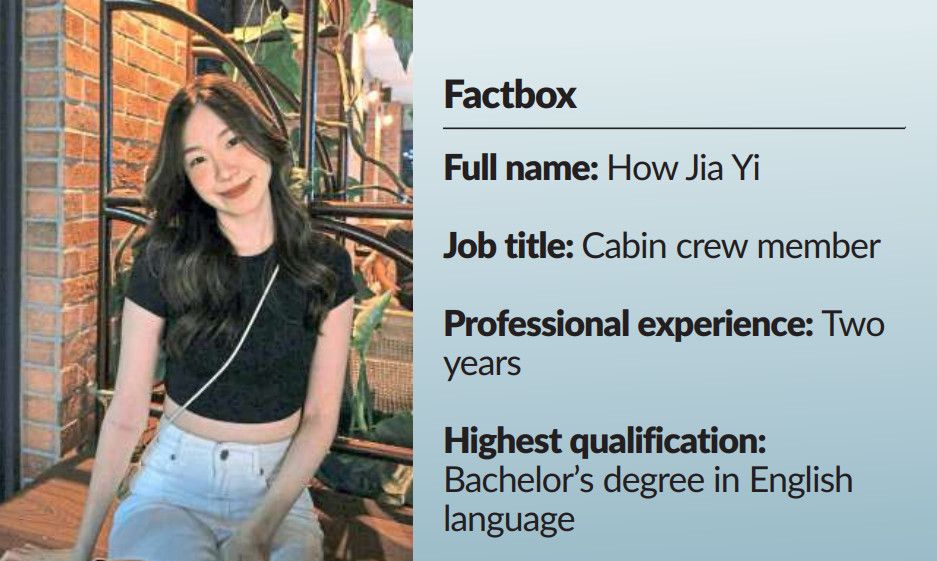
Cabin crew member reveals the skills and resilience required behind the glamour of the job
A CAREER change can be daunting, especially when it means stepping into unfamiliar territory.
But How Jia Yi (pic) took the leap, leaving her marketing job to pursue a career as a cabin crew member.
“I saw the recruitment advertisement on social media one day and decided to give it a shot,” she said.
Although the decision meant entering an entirely different industry, she embraced the challenge with confidence and excitement.
Two years into her job, the 25-year-old speaks passionately about her experience and is determined to continue growing in the aviation industry.
“No matter how bad the day is, every day is a new day, and that is what motivates me,” she said.

What does a typical workday really look like?
How: A typical workday begins with arriving at the airport early to prepare for the flight. We first get ourselves ready through makeup and grooming before heading to the office for our pre-flight briefing.
The briefing covers crucial information about the flight, including the destination, flight number, departure and arrival times, transit time, customs and immigration requirements, weather conditions, time zone differences along the route, and the in-flight services we will be providing.
After the briefing, we proceed to the aircraft to prepare for boarding and take-off.
What skills or mindset matter more than grades?
How: Communication skills play a big role. Effective communication allows us to de-escalate conflicts on board and prevent misunderstandings among cabin crew members.
Interpersonal skills are equally important, as they are closely linked to problem-solving and the ability to empathise with passengers.
On some days, it is not uncommon to encounter rude passengers who act out of emotion when problems arise. However, as cabin crew members, choosing the right words is important, as passengers may misinterpret what we say or take our words out of context.
What is one common misconception about this job?
How: Most people tend to view cabin crew members as high-end waitresses who only serve food and drinks on board while looking good.
While providing service is part of our job, it is not our main responsibility. We also undergo first-aid training and are trained to handle various in-flight emergencies to ensure a safe and smooth journey for every passenger.
While glamorous portrayals of flight attendants are often used on social media for marketing purposes, the reality is that our responsibilities extend far beyond that.
What is the most challenging and most rewarding part of the work?
How: The most challenging part of this job is the working hours. Although we have fewer working days than most white-collar workers, our shifts can last 10 to 12 hours a day.
We also often work at odd hours, which can disrupt our body clocks and make it difficult to get enough rest. If not managed properly, this could affect our health in the long run.
The most rewarding part, however, is the heartwarming interactions with friendly passengers. Sometimes, we meet kind passengers who give us snacks, chocolates, handwritten letters of appreciation or even hand-drawn portraits of us. Some also share their travel adventures and life experiences with us.
These wholesome interactions truly make my day and remind me of why I enjoy serving passengers on board.
What advice would you give to students considering this path?
How: Confidence is key. Being confident helps prevent passengers from taking advantage of you when conflicts arise.
Having a positive mindset also helps, especially when there are flight delays. Not only are passengers affected, but cabin crew members are too, as delays can mean working extra hours. Be ready to let go of a bad day and start afresh the next day.
To those who dream of becoming cabin crew members but hold themselves back because of their appearance,
just give it a shot. What truly matters is not your looks, but your confidence and communication skills. Do not overthink it because you will never know unless you try.
*Individuals are featured in their personal capacity. Views expressed do not represent any organisation.
Evangelene, 18, a student in Selangor, is a participant of the BRATs Young Journalist Programme run by The Star’s Newspaper-in-Education (Star-NiE) team. This feature is part of a series highlighting young working adults who share insights into their jobs and offer practical tips on thriving in the workplace. For updates on the BRATs programme, follow @starbrats on Instagram.

With the theme of the article in mind, carry out the following English language activities.
1 Imagine you are at an interview for your dream job. You have 60 seconds to convince the interviewer to hire you. Include: the career you want to pursue, two personal strengths that make you suitable for the role, one challenge you expect to face, and why you should be hired. Present your pitch in your group.
2 In pairs, take turns describing an occupation without naming it. Can you and your partner guess the job? Have fun!
The Star’s Newspaper-in-Education (Star-NiE) programme promotes English language learning in primary and secondary schools nationwide. For Star-NiE enquiries, email starnie@thestar.com.my.