




KUALA LUMPUR: Amid glitz and glamour, The Majestic Hotel Kuala Lumpur hosted the 21st Malaysian Construction Industry Excellence Awards (MCIEA) 2026, honouring outstanding individuals, landmark projects and organisations shaping the nation’s construction landscape.
Organised by the Construction Industry Development Board (CIDB) Malaysia, the event was held on Oct 29 and attended by industry leaders, innovators and key stakeholders.
Established in 2000, this year’s awards received 276 submissions across three main categories of contractors, projects and individuals, while 20 awards were presented to 55 recipients.
The submission period ran from March 31 to April 30, while eligible projects were required to have been completed between Jan 1, 2021 and Dec 31, 2025.
Visionary leadership
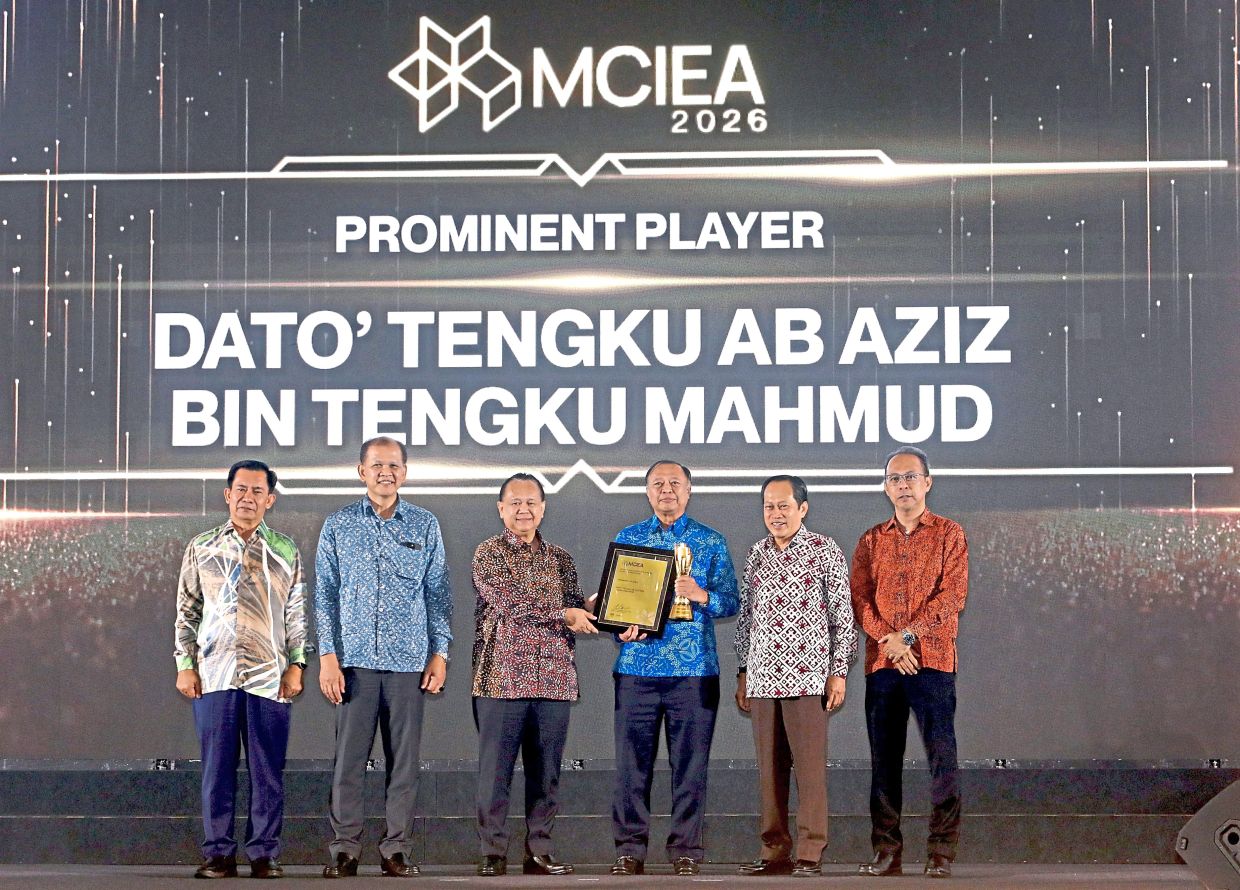
A major highlight was the presentation of the Prominent Player Award, which was accorded to PNB Merdeka Ventures Sdn Bhd adviser Datuk Tengku Ab Aziz Tengku Mahmud.
Tengku Ab Aziz was chosen based on direct recommendations from the CIDB MCIEA Secretariat, in recognition of his involvement in the development of Merdeka 118 - one of the country’s most prominent landmarks that reflects the planning, technical expertise and collaboration required to deliver a project of such scale.
He pointed out that securing financing was of utmost priority before construction could begin.
“We had to have 100% financing in place before we could go ahead,” he explained.
Assembling the right team was another key consideration, with local and international expertise brought together to meet the project’s goals and demands.
“That was another deliberate strategy, which was for us to make sure that our local (talent) were not being left behind,” he said, referring to the decision to include Malaysian professionals alongside international talent.
The project also required engineering solutions to improve building performance and operational efficiency.
At 678.9m in height, Merdeka 118 is one of four mega-tall buildings globally and has adopted an underfloor air-conditioning (UFAD) system across its 83 office floors.
Where chilled air naturally rises as it warms up, it effectively pushes stale air upwards and the system is said to consume less power.
“Normally, the air-conditioning system comes from the top. We did the reverse and now the air comes from the floor because we have raised it by 100mm,” he shared before adding that the 8,000-vehicle car park facility also has a special ventilation system that helps remove warm air generated by vehicles.
Construction logistics presented another challenge, in particular, moving workers around the site efficiently which was why a jump lift was implemented.
The lift is a temporary, self-climbing construction elevator that moves upwards inside a building’s permanent elevator shaft as the structure grows in height.
“At peak, we have about 3,000 workers coming to the site and (without a jump lift), it can take about an hour just to get up there, so there’s quite a substantial loss of productivity,” said Tengku Ab Aziz.
“By using a jump lift, this reduces time wastage and that same lift, upon completion, can be converted into a permanent lift,” he explained.
Sustainability was also a priority and rather than simply seeking a ‘green’ rating, Tengku Ab Aziz opted to aim higher by going platinum right from the start.
“We have four platinum ratings tied to the building and this is something others can perhaps follow since we have shown that it can be done,” he said.
Within the winner’s circle, major award recipients included IJM Construction Sdn Bhd, which won Builder of the Year and Gamuda Bhd’s Singapore branch, which received the International Achievement Award.
Meanwhile, Sunway Square won Best Project Award (Building – Major), while the Gemas-Johor Bahru Electrified Double Track Project received Best Project Award (Infrastructure – Major).
Lasting impact
For individuals, the Changemaker Award went to Extraordinary People Impacting Communities (EPIC) Homes Sdn Bhd founder and chief executive officer John-Son Oei, recognising his work in building homes in partnership with underserved communities, including Orang Asli families.
The award, which is open to all Malaysian citizens and permanent residents with at least 10 years of experience in their field (including stakeholders and academia), acknowledges individuals driving meaningful innovation and change to the construction industry with a focus on leadership and vision, innovation and transformation, industry impact, as well as influence and inspiration.
“When we built our first home alongside an Orang Asli family, we weren’t construction experts. We were just ordinary people who believe that everyone deserves a safe space to call home,” he said.
EPIC Homes developed a modular building system using lightweight, standardised components that can be transported to remote villages.
“A complete durable home can be assembled on site in three days and this system is designed so that anyone, regardless of background, can be trained to build safely,” Oei said.
The organisation also trains community members and works with suppliers to redirect surplus construction materials away from landfills and towards families in need.
Oei said that safe housing could improve health, education, security and economic stability, while community participation could develop construction skills and encourage younger people to enter the trade.
“My aspiration is to see the mainstream construction industry fully embrace inclusive, impact-driven practices. We have the technology, the resources and the talent to ensure that no Malaysian is left behind without adequate shelter,” said Oei.
YTL Construction executive director Yeoh Keong Yuan was given the Outstanding Young Contractor award, which recognises emerging leadership, aged 40 and below with at least five years of industry experience and a leadership position in a CIDB-registered company, who can contribute to the construction industry’s continued development and competitiveness.
Evaluation considerations include professional achievement, leadership and initiative, innovation, industry contribution, future potential and industry impact.
Yeoh highlighted the importance of the 192km Gemas-Johor Baru rail project in improving connectivity between the north and south of Peninsular Malaysia.
“With the completion of this project, Malaysians can now travel by Electric Train Service (ETS) operated by Keretapi Tanah Melayu Bhd (KTMB) from Padang Besar all the way to Johor Baru, making journeys between the north and south of Peninsular Malaysia easier and more convenient,” he said.
Yeoh added that the project managed to create more than 35,000 job opportunities and helped Malaysian engineers and technical specialists to further develop their skills.
“Most importantly, it shows that Malaysian companies and Malaysian talent have what it takes to deliver major infrastructure projects at this scale,” said Yeoh before adding that construction success should be measured by a project’s lasting value, not simply by its completion and stressed that technology should be used to improve efficiency and safety while supporting workers.
The Excellence in Facilities Management award, which recognises excellence in maintaining, managing and optimising the long-term sustainability of built assets, went to Medivest Sdn Bhd and receiving it on behalf of the company was chief executive officer Abdullah Hashim.
This award’s evaluation criteria cover service excellence and operational performance, asset management and maintenance strategy, innovation and technology adoption, sustainability and environmental practices, as well as client satisfaction and value creation.
Abdullah said that the company faced the challenge of maintaining public hospitals around the clock, including facilities with ageing assets.
“The challenges for Medivest are that we have to maintain the facilities 24 hours a day, 365 days a year and it covers everything under the sky,” he said.
Medivest currently maintains 23 government hospitals across Johor, Melaka and Negri Sembilan under its contract with the Health Ministry (KKM).
Abdullah said that it was technology which helped the company monitor facilities and identify problems that could affect hospital operations.
“When people go to the government hospital, they mainly interact with doctors and nurses, but the ones who maintain the facilities, namely the assets, are Medivest,” he said.
He also highlighted Jasin Hospital’s reported achievement in receiving Leadership in Energy and Environmental Design (LEED) Platinum certification (the highest tier of green building certification awarded by the US Green Building Council) for an existing hospital.
The facilities management award recognised the importance of maintaining buildings and infrastructure so that they may continue to provide safe and reliable services long after construction is completed.
CIDB chief executive officer Ahmad Farrin Mokhtar said MCIEA aims to encourage higher standards and the sharing of good practices across the industry.
“For CIDB, MCIEA is more than recognising achievements – it is about encouraging the industry to continually raise its standards, learn from good practices, and recognise the people and organisations that are making a meaningful difference,” he said.
He added that excellence extended beyond completing projects to include delivery quality, innovation, workforce capabilities and long-term value.
MCIEA 2026 celebrated achievements across the industry, highlighting the people, technical innovations and long-term commitment needed to advance Malaysia’s built environment.
To know more, visit www.mciea.my.


