Experts say investing in infrastructure must go hand in hand with proper maintenance and better living conditions
PUBLIC universities need to do more than simply provide accommodation, say experts.
Amid efforts by the Higher Education Ministry to expand student accommodation capacity and upgrade infrastructure, they stress that universities must not lose sight of problems in existing facilities, ranging from unreliable Internet connections and inadequate study spaces to pest infestations.
Such concerns have surfaced on social media recently, with netizens commenting on a post highlighting outdated toilets, run-down rooms and potential safety hazards in Malaysian public university hostels.
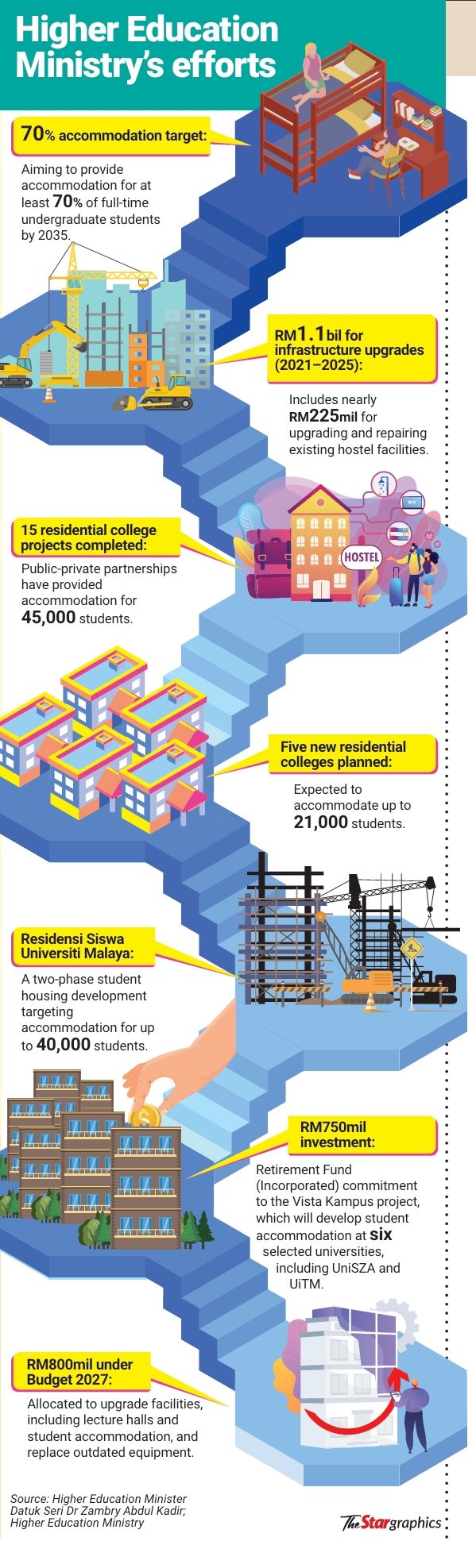
On Oct 26, Higher Education Minister Datuk Seri Dr Zambry Abdul Kadir, in a Facebook post, said the ministry is working towards ensuring at least 70% of full-time undergraduate students have access to accommodation by 2035 (see infographic).
He added that between 2021 and 2025, the government allocated RM1.1bil to upgrade and rehabilitate infrastructure at public higher education institutions, including nearly RM225mil specifically for upgrading and repairing existing hostel facilities.
Earlier, on Oct 9, when tabling Budget 2027, Prime Minister Datuk Seri Anwar Ibrahim, who is also Finance Minister, said RM800mil would be allocated to the Higher Education Ministry to upgrade facilities such as lecture halls and student accommodation, as well as replace outdated equipment.
While welcoming the investments, the experts stress that efforts to expand accommodation capacity must go hand in hand with ensuring that both existing and new hostels provide safe, comfortable and conducive living environments.

The priority, said Universiti Kebangsaan Malaysia psychology programme head Dr Daniella Maryam Mohamed Mokhtar, should be to create living environments that minimise unnecessary stress while allowing students to rest, learn and function effectively.
“Universities should prioritise basic safety, sanitation, ventilation, adequate lighting and facilities that support restful sleep.
“Practical measures such as maintaining functional bathrooms, addressing maintenance concerns promptly and establishing reasonable quiet hours can make a meaningful difference to students’ daily well-being,” she told StarEdu.
Daniella Maryam added that factors such as cleanliness, adequate ventilation, comfortable temperatures, personal space and a sense of safety contribute to psychological comfort and emotional stability.
“Students with physical disabilities, sensory sensitivities or neurodevelopmental conditions may require specific environmental accommodations to support their comfort, accessibility and independence,” she noted.
Maintenance matters
Universiti Putra Malaysia Department of Environmental and Occupational Health Assoc Prof Dr Ng Yee Guan said a key concern is the lack of a sufficiently prescriptive and consistent framework governing the inspection and maintenance of student accommodation.
Although requirements such as the Uniform Building By-Laws 1984 (UBBL 1984) are in place, he said a more comprehensive operational standard should be established to ensure regular inspections, preventive maintenance and timely rectification of defects.
The UBBL 1984 is a set of building regulations in Malaysia that establishes requirements for building design, construction and safety.
He suggested that high-use areas such as toilets, stairways and common spaces undergo daily checks, supported by periodic inspections to identify potential problems before they escalate.
“Poorly maintained facilities can expose students to various hazards, including slips and falls caused by wet toilet floors, damaged stairways and inadequate lighting,” he said, adding that such issues often go unreported.

Ng noted that Malaysia’s hot and humid climate also makes indoor air quality an important consideration, particularly as damp conditions can encourage mould growth.
More importantly, he said, inspections must be followed by corrective action, with clear responsibilities and proper verification to ensure that reported defects have been addressed.
“Without proper maintenance, even the best infrastructure will eventually deteriorate, making the initial investment almost meaningless,” he said.
With resources often limited, Ng recommended that universities prioritise maintenance issues based on the potential severity of harm, particularly those involving faulty electrical systems, defective fire protection equipment, obstructed emergency exits and structural defects.
“Where immediate rectification is not possible, appropriate temporary control measures should be introduced to minimise exposure,” he said.
However, he also cautioned against overlooking less immediately visible problems, such as poor ventilation, excessive heat, inadequate water supply and persistent dampness, which could affect larger groups of students over time.
“In making these decisions, prioritisation should be guided by risk assessment, taking into account the likelihood and severity of harm, the number of students exposed, their vulnerability and the effectiveness of control measures,” he explained.
This, he said, would allow universities to make more informed decisions about allocating limited resources while ensuring that critical safety and maintenance concerns are not neglected.
Ng also stressed that students have a role to play in identifying potential hazards through early reporting.
However, this should complement, rather than replace, universities’ responsibility to carry out preventive maintenance.
“There should also be a straightforward and user-friendly reporting mechanism, proper acknowledgement and timely follow-up. Otherwise, students may eventually lose confidence in the system,” he said.
Students call for better upkeep

Our residential facilities are generally well-equipped and satisfactory. However, students have raised concerns about wild monkeys entering hostel rooms. These intrusions disrupt students’ ability to rest, as they frequently have to clean up the mess left behind in their rooms.
We also hope to see more well-equipped study rooms in residential colleges to provide a quieter and more conducive learning environment. Additionally, improvements to campus transportation, including increased bus capacity, more efficient routes to reduce waiting times and additional covered bus stops, would benefit students.
Universiti Malaya
Association of New Youth
president Lee Wen Qua

Hostel facilities at Universiti Sains Malaysia (USM) are generally in good condition, with regular maintenance and upgrades, particularly to the toilets. However, some complaints take longer than expected to resolve.
While students can report maintenance and safety concerns through the varsity’s online platform, greater transparency on complaint status and expected resolution timelines would help them keep track of their reports.
Among the concerns frequently raised by students are weak Internet connectivity in some residential college areas and waste management issues, with accumulated rubbish attracting stray dogs to campus and posing safety risks.
Priority should be given to basic facilities, cleanliness and safety, including the upkeep of toilets, water supply systems, lighting, ventilation, furniture and common areas. At the same time, maintenance should not be purely reactive, with action taken only after complaints arise.
We need to move towards a preventive maintenance approach.
National Student Consultative Council deputy president and former USM Student Representative Council president Azfar Al Hafiz Azman