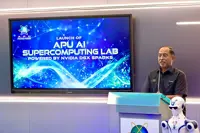
One of the most interesting questions in education today is not whether artificial intelligence (AI) will replace lecturers. We have spent enough time debating that.
On Sept 22, the University Research and Innovation Investment Summit 2026 will bring together universities, researchers, companies, investors and more than 200 investible technologies, ranging from AI and robotics to semiconductors, smart systems, healthtech, sustainable energy, advanced manufacturing and edtech.
What caught my attention, however, is not the number of technologies to be showcased. It is the thinking behind them.
On the agenda are university-industry investment dialogues, pitches to venture capital and corporations, conversations between CEOs and university leaders, and sessions built around the idea of “investing in campus”.
In other words, industry is not being invited to merely recruit students. It is being invited to come onto campus, which could fundamentally change the student experience.
Consider an AI student who spends a semester working with a company on a real automation problem. She quickly discovers that building an algorithm is only part of the challenge. Someone must understand the customer. Another must consider cybersecurity and ethics. Engineers have to integrate it into existing systems. The business team must determine whether anyone will pay for it.
Suddenly, computer science meets engineering, design, finance and human behaviour. That is education which is difficult to reproduce through lectures alone. It also raises an uncomfortable question about our favourite phrase: job-ready graduates. Ready for which job?
AI is already changing how software is written, information is analysed, content is produced, and decisions are made. By the time today’s first-year students graduate, some entry-level tasks they are currently being trained to perform may be partially automated.
Universities therefore cannot simply chase today’s job descriptions. We need graduates who can walk into situations where the job description has not been written yet. This is where closer industry involvement could become powerful.
Instead of waiting until the final year to discover how companies operate, students could encounter real problems much earlier. They could learn to work with AI rather than submit assignments about it. They could experience failure when the stakes are still educational, and learn that an idea in a laboratory can become surprisingly complicated in the real world.
Perhaps this will also change what a successful graduate looks like. A transcript tells us what someone studied. The graduate of the future may increasingly need a portfolio showing what he or she actually did: the problem solved, the prototype built, the research commercialised, the AI tool developed, or even the start-up that failed and what was learnt from it. That does not make degrees obsolete. It makes education richer.
But there is another side to this future. Universities should never become inexpensive R&D departments for corporations. Some research deserves to exist without a business model. Curiosity-driven discovery, fundamental science, humanities and research addressing social needs may not attract investors, but they remain essential.
So the goal should not be to turn every lecturer into an entrepreneur or every student project into a start-up. It is to make the walls more porous.
Companies should be able to bring genuine problems into universities. Researchers should have clearer pathways to take promising ideas beyond publication. Students should be able to move between theory and application. Investors should be able to discover university technologies that might otherwise remain invisible.
Perhaps that is where the future classroom becomes most interesting. It may still have four walls. It may still have lecturers and examinations. But increasingly, the assignment might be a problem brought in by an actual company, with no model answer at the back of a textbook.
And if the idea works, it may not end with a grade. It could become a prototype, a patent, a start-up or an investment.
Prof Dr Mohammad Falahat is the director of the Strategic Research Institute at the Asia Pacific University of Technology & Innovation. He brings over two decades of experience in higher education. A recipient of the Universiti Sains Malaysia Gold Medal Award, he was further honoured in 2025 with the ERA Asian Research Excellence Award and named National Outstanding Researcher at the Private Education Excellence Awards.
The views expressed here are the writer’s own.