MALAYSIA wants a workforce that not only uses artificial intelligence (AI) but can also create it.
However, the high cost of computing power needed to run large language models (LLMs) has been a stumbling block for students wanting to do more.
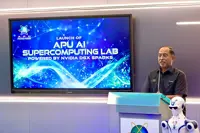
For students at Asia Pacific University of Technology & Innovation (APU), that is set to change as they now have access to Malaysia’s first AI supercomputing lab powered by 20 Nvidia DGX Spark supercomputers.
APU vice-chancellor Prof Dr Ho Chin Kuan said the lab is much needed to grow Malaysia’s AI talent pipeline, especially for jobs that do not exist yet.
“Prime Minister Datuk Seri Anwar Ibrahim has spoken before about sovereign AI, and this lab is one of the ways we can build it,” he said after the launch of the lab on Sept 4.
Plans for the APU AI Supercomputing Lab began last December, with an investment of around RM1.2mil.
As a strategic academic infrastructure initiative to elevate AI education and research at the university, it will enable state-of-the-art coursework, capstone projects and research that would otherwise be computationally infeasible.
Prof Ho said the lab will allow students and researchers to utilise the supercomputing facilities freely.
“Without this infrastructure, you have to spend a lot of money using public clouds to train these models,” he added.
While it will initially be used by students in computer science programmes, Prof Ho said it will soon be expanded and made available to the entire APU student body and teaching and research staff, irrespective of their school.
He also said it will support both undergraduate and postgraduate students, with faculty members able to use the hardware to advance research programmes and enhance teaching delivery.
APU chief executive officer and co-founder Datuk Parmjit Singh said the new lab will give students the capability, confidence and computing power to contribute meaningfully to the AI-driven economy.
“This level of computing power gives students the ability to experiment with larger AI models, tackle more complex problems and turn ideas into working solutions,” he added.
Previously, computing power was locked away in remote data centres or metered cloud services. Now, however, the facility provides students, academics and researchers with hands-on access to advanced computing infrastructure for developing and experimenting with LLMs, generative AI, machine learning, data science, intelligent engineering and emerging agentic AI applications.
This enables learners to experiment in real time, iterate freely and take an idea from concept to working prototype in a single session.
The DGX Spark architecture enables students and researchers to work locally with AI models of up to 200 billion parameters, supporting the development, testing and fine-tuning of sophisticated AI applications within the university environment.
During the launch, Higher Education Minister Datuk Seri Dr Zambry Abd Kadir said AI is an important tool in many fields across higher education and that there is a need to review curricula and pedagogies to include it.
“AI is already reshaping our universities and workplaces. It is also influencing how knowledge is produced and how increasingly complex problems are approached,” he noted.
At the same time, he said the Malaysia Higher Education Blueprint 2026–2035 also emphasises producing graduates who are “human-centric”.
He cautioned that embracing AI within universities should not come at the expense of students’ critical thinking and humanity.