
THERE needs to be a balance between traditional learning methods and the use of digital technology in the classroom, even as studies point to the latter’s adverse effects on children.
This is especially important as digital technology is widely used in higher education and the workplace, say experts.
Consultant paediatrician Datuk Dr Amar Singh HSS said that while research leans towards the total removal of digital devices from classrooms (see infographic), a hybrid approach may be more suitable to ensure students are equipped to use technology, particularly artificial intelligence (AI), when they graduate and enter the workforce.
“We cannot leave our children unaware of AI, as it will affect them in everyday life and at work. Hence, we need to give them the tools to use digital devices and AI wisely,” he stressed.
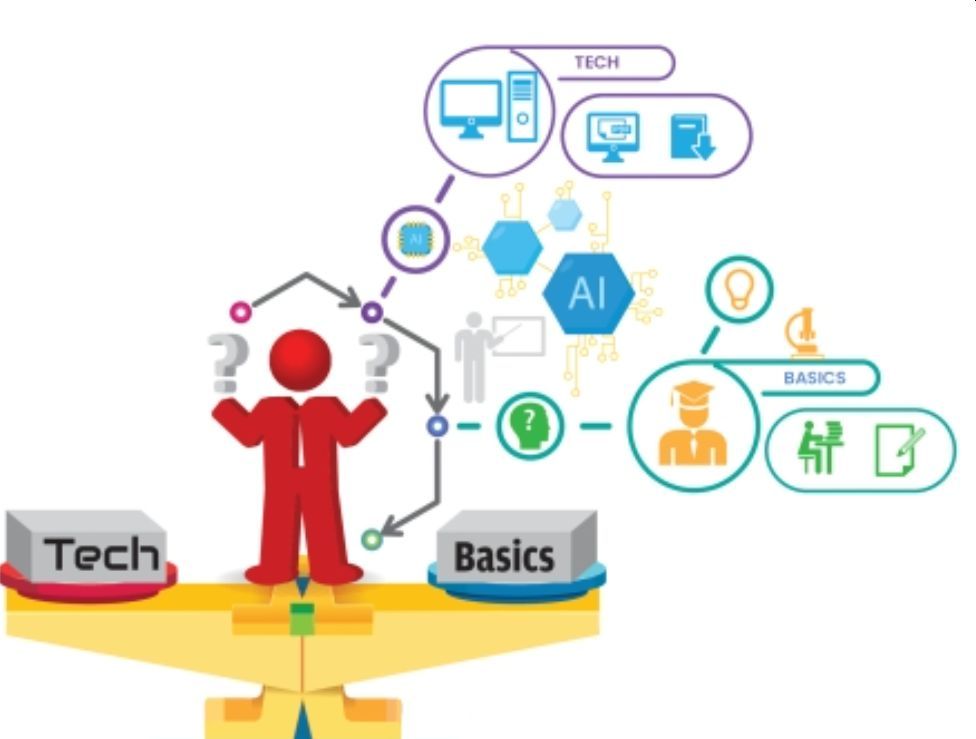
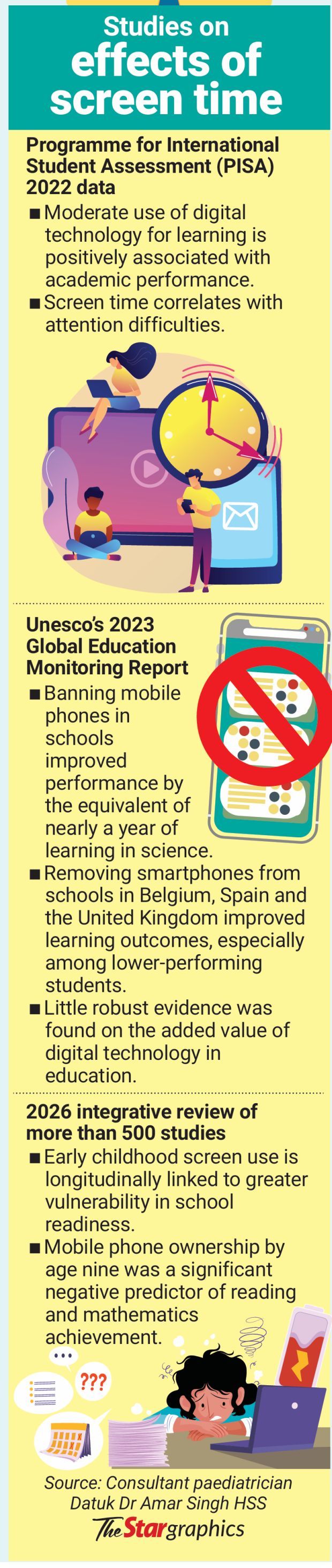
Underscoring the need for a balanced approach, he said digital and AI tools are beneficial when used moderately, purposefully and with adult guidance, but overuse may affect children’s attention, comprehension and independent thinking.

According to the initial findings of a study by Universiti Kebangsaan Malaysia Assoc Prof Dr Kalaivani Chellappan, Malaysian students might grow up proficient in various digital tools but still lack strong critical thinking and analytical skills.
The senior lecturer from the varsity’s Department of Electrical, Electronic and Systems Engineering said her initial observations from the ongoing study involving 12 suburban primary schools in the Sepang district of Selangor showed that pupils had a weak command of mathematics.
The first phase of the study, conducted between March 2024 and February 2026, found that more than 80% of nine- to 12-year-olds struggled to solve mathematical problems requiring basic logic and reasoning skills.

“Malaysia is facing a challenge that rarely makes headlines but affects nearly every household in the country.
“It is a gradual decline in the everyday use of numbers, mental computation and practical reasoning among our children,” she said.
While many children can easily navigate smartphones, she said they struggle with simple mental calculations.
“They can search for answers instantly, but often find it difficult to estimate costs, calculate discounts, remember important numbers, or interpret numerical information without digital assistance,” she noted.
Despite her observations, Kalaivani does not believe limiting or removing digital tools from classrooms is the solution. Limiting their use of these tools could put them at a disadvantage in global competition.
Instead, the Education Ministry should focus on providing guidance and training to help teachers effectively guide students in using these tools in the classroom,” she said.
Foundations first

“Students must first master foundational skills such as mental arithmetic, problem-solving, reading and writing before AI even enters the picture.
“The goal is not to reject technology but to rebalance learning. Schools should continue emphasising handwritten work, mental mathematics, reading, classroom discussion, project-based learning and teacher-led instruction.
“Technology should be introduced more meaningfully only after students have demonstrated competence in the fundamentals,” she said.
More importantly, Noor Azimah said, teachers should use their professional judgement to decide when technology genuinely adds value and when traditional methods are more effective.
“We hope children will still be able to write clearly by hand, read critically, calculate confidently without always depending on devices, and think independently.
“Technology will continue to evolve, but the ability to reason, communicate and solve problems should remain at the heart of education. AI should produce learners who think better – not learners who think less,” she stressed.
Home support
Beyond the classroom, Queen Elizabeth Hospital, Sabah, senior speech and language therapist Dr Amelia Inbam Neelagandan highlighted the need for parents and caregivers to do their part at home.
They must carve out time to spend with their children to reduce the latter’s dependence on screens to fill time, which has led to developmental issues, she stressed.
Parents, Kalaivani suggested, should encourage their children to play outside and involve them in day-to-day activities.
This, she said, would indirectly teach them life skills, including risk assessment and communication.
“It is this informal learning that actually contributes to their development. Children need real-life exposure because right now, many are getting stimulation mainly from digital devices, not from real-world experiences,” she said.
Petaling Utama district education office chief officer Haniza Mohd Jabar @ Ibrahim urged parents to help their children use technology positively and ethically.
She said that since students today are exposed to various forms of digital information and content, education cannot focus on technological skills alone.
“It must shape students with strong digital ethics, integrity and identity,” she said, adding that the successful use of digital technology in schools requires close collaboration among schools, parents, the community and the entire education ecosystem.
“The technological revolution, AI, automation and the use of big data have changed the way we learn, work and interact. In the context of education, this change demands a more flexible, responsive and far-sighted education system,” she said during the launch of SK Taman Megah’s Digitalisation and Safe Content Programme on June 22.
Parents back gradual approach
I feel that digital devices are not for primary schoolchildren, especially if they are going to be used as the main teaching tool. Staring at a screen all day can strain their eyes and also cause brain overstimulation. Even for us as adults, prolonged screen exposure can cause eye strain and brain fog.
The use of digital devices in schools should be introduced gradually. For example, when students enter Form One, they could start using laptops to create presentations and work on small projects as homework, with usage gradually increasing over the years.
Stopping my daughter from using devices is not possible, as they have become the norm in today’s teaching world. The only thing I can do is guide her as she uses them and be involved in her lessons.
The next thing we can do is educate children from a young age about the dangers of the cyber world and equip them with the knowledge and wisdom to avoid falling victim to scams, cyberbullying or even grooming by online predators.
Jaclyn Dass, 32
I would rather not have my child use digital devices in primary school, especially during Years One to Four. It is just not necessary, as this is the fundamental time to be building their core skills – reading, writing and counting. There will be plenty of time for them to use technology later on, and being part of Gen Alpha, there is no doubt they will master these tools quickly.
If it were up to me, I would prefer my child to start using mobile tablets and the Internet when they enter Year Five, and even then, it would be just for exposure. Their brains are still developing, and research has shown that starting screen use at a later age correlates with lower regular usage.
Ronald Tan, 35