
HEALTHCARE, as well as environmental, social and governance (ESG), are two areas that the nation’s oldest varsity is looking to strengthen over the next five years.
Universiti Malaya (UM) vice-chancellor Prof Datuk Seri Dr Noor Azuan Abu Osman said the university’s soon-to-be-launched UM Strategic Plan (UMSP) 2026-2030 – a blueprint built around eight main thrusts – will include these areas as two new thrusts.
“The new ‘Championing Healthcare’ thrust will strategically elevate the role of Universiti Malaya Medical Centre (UMMC) within the university’s master plan.
“UMMC continues to serve as the main pillar of UM’s academic and healthcare ecosystem, integrating clinical excellence, professional training and medical research holistically,” he said during his New Year’s address at UM on Feb 13.
He added that the new “ESG-Driven Ecosystem” thrust seeks to strengthen UM’s commitment to the highest standards of governance and environmental sustainability.
“Every progress achieved should not come at the expense of our responsibility towards the environment.
“UM has set the aspiration of achieving carbon neutrality by 2030 and net zero emissions by 2050,” he said.
Prof Noor Azuan noted that the strategic plan aspires to create a resilient future shaped by learning, research and healthcare, underpinned by digital excellence, sustainability and a commitment to global impact.
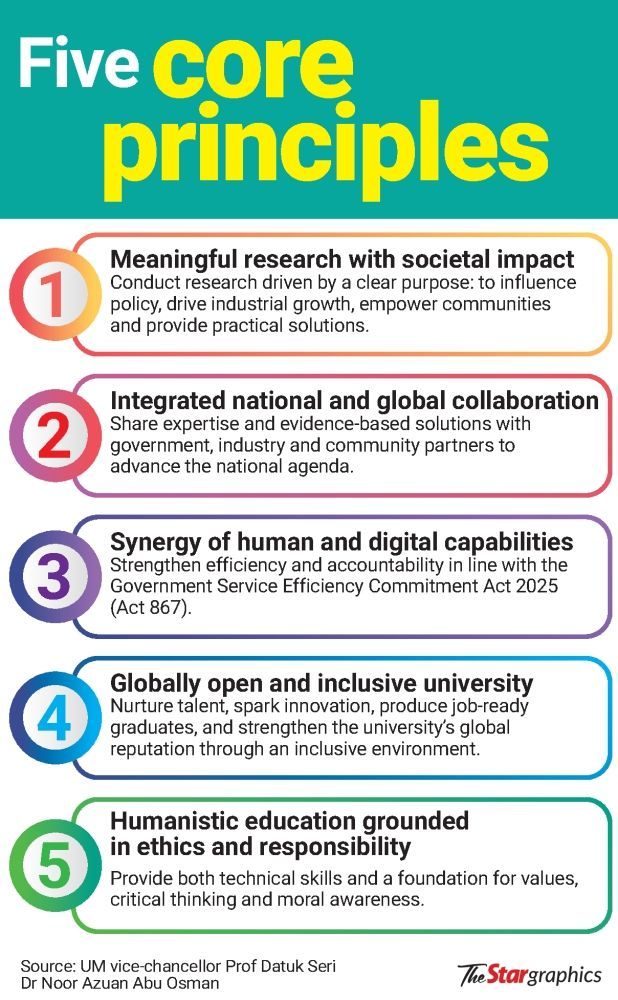
He also said that UM has introduced five guiding principles (see infographic) that will function as institutional guardrails.
“These principles will serve as a compass in shaping strategy, determining priorities and guiding every decision we make.
“They are intended to ensure alignment in planning, implementation and governance across the entire university,” he said.
He emphasised that 2026 should be the year to instil trust in decision-making, uphold integrity in actions and maintain discipline in execution.
“With these values embedded within us, UM will be respected not merely because of rankings, but because of dignity, honour and the blessings of knowledge that truly bring meaning to the nation and humanity,” he added.
Financial autonomy
Prof Noor Azuan also said that UM is accelerating its shift towards financial autonomy to reduce its reliance on government funding.
The university, he explained, aims to build a more sustainable institutional model by generating a larger portion of its own revenue.
“UM’s dependence on government funds fell from 61% in 2025 to 57% in 2026,” he said, noting that 43% of the university’s financial needs are now met through its own internal efforts.
“We will continue to move gradually, systematically and boldly towards more balanced and sustainable financing,” he added.
To broaden its financial base, UM is utilising public-private partnerships and alternative instruments such as sukuk, as well as strengthening strategic engagement with government-linked companies and government-linked investment companies to support long-term development.
Prof Noor Azuan shared that UM reported consolidated revenue of approximately RM2.4bil in 2025 and expects this to rise to RM2.6bil for the 2026 financial year.
Endowment contributions have also risen significantly, from RM17.6mil in 2024 to RM31.6mil in 2025 – surpassing the target by 109%.