WHEN Chayenne Tan, 47, learned that her employment contract would not be renewed, her dread went beyond not having a salary – it was losing a sense of who she was.
“For many people, our job is a huge part of our identity,” she said.
“It’s how we introduce ourselves to family and friends, it’s the lens via which we relate to the world.
“I remember thinking: without a job, who am I? Am I contributing to society?”
A mother of two from Petaling Jaya, Selangor, Tan had spent 14 years in the banking sector before moving to a government-linked company, where she took on a senior communications and marketing role under a two-year contract.
“Perhaps it was due to the economic climate, but the company ultimately decided my role was no longer necessary.”
Two months have passed since her last day of employment and Tan is now working on her own project.
Her experience reflects that of hundreds of thousands of Malaysians navigating an increasingly uncertain labour market.
Data released by the Department of Statistics Malaysia (DOSM) early this year revealed that more than 500,000 people were jobless as of February.

Recent figures suggested that people like Tan would have to compete in an increasingly crowded job market.
According to news reports, more than 7,000 workers lost their jobs in April, a 21% increase from 5,800 in March.
Economy Minister Datuk Seri Akmal Nasrullah Mohd Nasir noted that these figures were lower than the 10,600 job losses recorded in January and 7,500 in February.
“Every single figure represents a family that has lost its source of income.
“The government will ensure that the Employment Insurance System (EIS) or Lindung Kerjaya, under Social Security Organisation (PERKESO) functions swiftly to assist them,” he was quoted as saying.
Selangor and Kuala Lumpur made up the highest number of job losses in March, according to a Hong Leong Investment Bank report.
Citing PERKESO data, the bank said Selangor accounted for 29.3% of total job losses, followed by Kuala Lumpur at 25.6%, even as the national unemployment rate held steady at around 2.9%.
At press time, total employment at national level stood at roughly 16.8 million people.
To better understand the human toll behind these figures, StarMetro spoke to several individuals about navigating unemployment.
A new chapter
Though the experience initially left her questioning her future, Tan soon began to see unemployment as an opportunity to reinvent herself.
While polishing her resume, she also started working on a side project, hoping to earn supplementary income.
“During his time as an industrial psychologist, my father developed a behavioural profiling framework to assess workplace personalities and strengths.
“I hope to streamline his findings and market it as a solution for companies.”
Looking back, Tan said the experience transformed the way she viewed employment, self-esteem and identity.

“There is often a stigma that losing your job means you were not good enough, but that’s simply not true.
“A role can become redundant for any number of reasons, and you may never know why it happened.”
Tan also advised against burning bridges with former employers and colleagues.
“Use the downtime to reflect, recharge and rediscover your long-term career goals.
“It’s also an opportunity to learn new skills and reconnect with people who matter in your life.”
Tan recently took charge of organising her secondary school’s reunion, an experience she found fulfilling.
“I would not have been able to take on that responsibility had I still been working,” she said, adding that the gathering was also a chance to network.
Emotional rollercoaster
For some, the loss of a regular pay cheque brought emotional strain as bills and family commitments continued to mount.
Raja Noor Shima Raja Hishan Shah, 57, opted for a mutual separation scheme (MSS) after her employer faced severe cash flow challenges during the Covid-19 pandemic.
She had spent three decades working at an airline catering and food services company.
“I was among hundreds who accepted the MSS.

“We were promised compensation equivalent to 20 months of our last drawn salary, to be paid in instalments.
“Initially, payments were made on schedule, but they became increasingly irregular before stopping altogether.”
With loan and credit card repayments piling up, the mother of three was forced to withdraw from her Employees Provident Fund (EPF) savings.
“I was reluctant to dip into my retirement savings, but I had little choice,” she said, adding that she also took a six-month loan moratorium.
Between 2020 and 2022, the government allowed a series of partial withdrawals from EPF to help contributors stay financially afloat.
It also introduced a moratorium allowing those hit by the Covid-19 pandemic to defer loan repayments.
Desperate to earn an income, Raja Noor Shima began selling kuih before working part-time as a cashier at a restaurant.
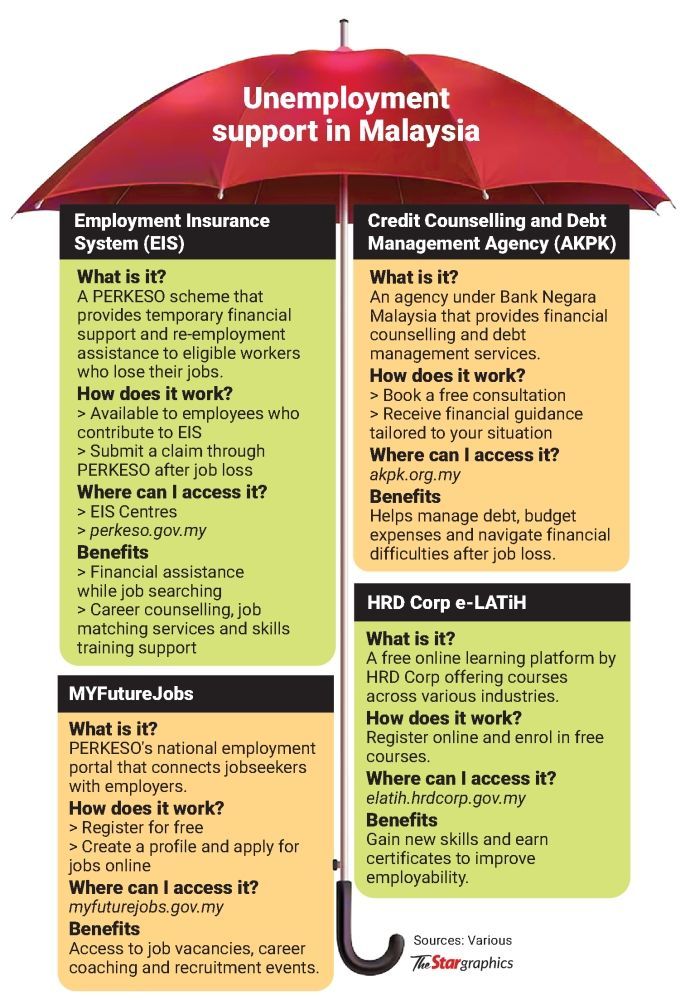
She also applied for financial assistance under EIS, through which she received a monthly allowance for six months while searching for work via the MYFutureJobs portal. (see chart)
But job-hunting in her 50s was not easy as many companies were not keen on hiring older workers, she said.
Last year, Raja Noor Shima found work with an airline cleaning company, but it was short-lived as she was laid off in March this year.
“Fortunately, I had withdrawn my EPF savings when I turned 55, which provided a financial cushion,” she said.
However, she considers herself lucky to be able to service her loans without having to turn to the Credit Counselling and Debt Management Agency (AKPK) for help.
On reflection, Raja Noor Shima wished she had been more prepared.
“Though I had served for decades, that didn’t stop the company from letting me go.
“Without an alternative source of income, I was particularly vulnerable to financial shocks.
“Losing a job also meant that I lost the insurance coverage provided by my previous employer,” she said.
Blessing in disguise
While job loss left some grappling with financial hardship and uncertainty, others emerged from the experience with a renewed sense of direction.
N. Renganathan, 36, who used to work at a call centre in Cyberjaya, Selangor, lost his job during a retrenchment exercise a few years ago.
“I was among dozens of employees who were let go as part of cost-cutting measures.
“The company applied a last-in, first-out policy, and we were given 24-hour notice along with compensation equivalent to three months salary.”
Living away from his parents in Ipoh, Perak, Renganathan said his first priority was reducing unnecessary spending.
“On the drive home after my last day at work, I began to mentally map out what expenses I could cut.
“Within days, I had cancelled my gym membership, downgraded my mobile data plan and paused my subscriptions to streaming services.”
Rather than dwelling on setbacks, Renganathan immediately updated his resume and began applying for jobs.
“To be honest, I had already been thinking about exploring new opportunities outside the call centre industry.
“So while I continued applying for similar roles as a backup, I also started looking at positions in other sectors.
“Within two months, I secured two job offers – one from another call centre and another in marketing.
“I chose the latter,” he said, stressing that he was happy to accept a lower pay in exchange for flexible working hours.
While he was job-hunting, he also browsed through the free courses available on HRD Corp e-LATiH to upskill himself.
In hindsight, Renganathan said he was fortunate to have been younger with relatively few financial obligations when he lost his job.
“I know others who struggled because they had huge financial commitments and families to support,” he said.
Despite the initial hardship, Renganathan said what happened ultimately opened new doors for him.
“Looking back, I lacked the courage and retrenchment was the push I needed to make the career leap.
“Now, I get to do what I love and find meaning in my work. The experience was actually a blessing in disguise.”