ONE entrepreneur in Kedah has made a thriving business out of selling her own version of ketupat.
Sarah Hussain, 43, wraps the glutinous rice speciality in bamboo leaf and shapes it like a pyramid instead of the traditional diamond-shape.
She uses ash water to give the ketupat its yellow hue.
Demand for her bamboo-leaf ketupat surged this year with orders reaching around 16,000 pieces, or roughly 1,000kg.
Sarah, from Kampung Bukit Murai in Pendang (about 30km from Kedah capital Alor Setar), began making this speciality in 2017 after inheriting the recipe and preparation method from her mother and sister.
And what started as a family tradition has since grown into a successful enterprise.
“At first, I didn’t know how to make the ketupat, but I gradually learned from my mother and sister until I became proficient.
“After I shared photos online, many people started asking about it and placing orders,” Sarah told Bernama.
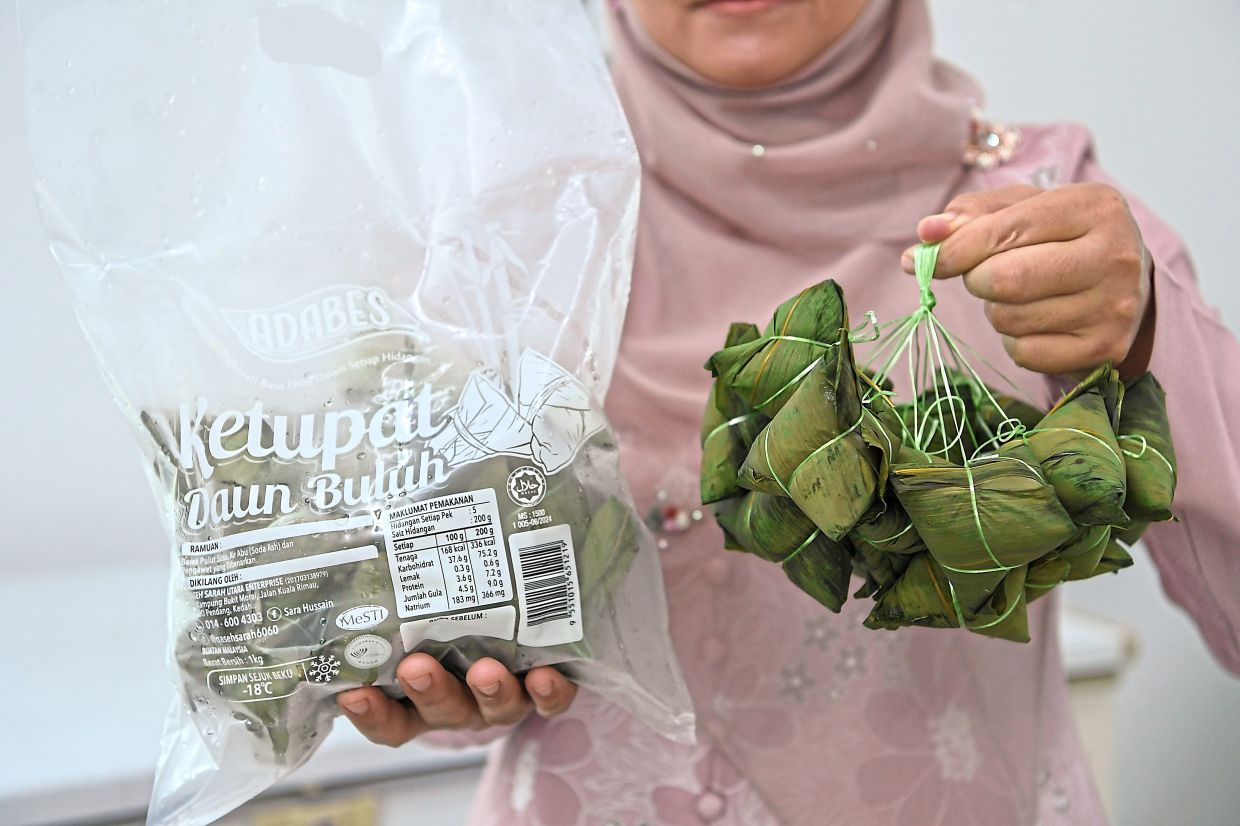
Despite its simple ingredients – glutinous rice and filtered ash water – the preparation is painstakingly long.
The process begins with sourcing bamboo leaves from local villagers.
The leaves are cleaned and steamed before they are used to hold the glutinous rice that has been washed and mixed with ash water.
The bundles of ketupat will then be boiled for seven to eight hours before being steamed and subsequently frozen to preserve their quality.
Sarah explained that freezing allowed the ketupat to last between six and 12 months.
It enables her to prepare the stock in advance to meet festive demand.
Nicknamed elephant ketupat, the speciality is prized for its distinctive aroma and chewy texture.
Unlike ketupat palas or ketupat nasi, it does not use coconut milk.
“It can be enjoyed with various types of serunding, or eaten with condensed milk, gula melaka or even chocolate,” said Sarah.
Priced at RM28 per kilogramme, Sarah gets orders for the bamboo leaf ketupat from not just statewide but also beyond Kedah.