THE Cantonese from China who came to Ipoh in the 1880s brought with them community-specific practices and traditions.
While some of these are still practised, however, many have faded away.
Richard Ng, who is the main researcher involved in developing Ipoh’s Cantonese Heritage Trail, said when tin was discovered in the 1880s, it was first mined by the Malays before the British took over.
He said the British brought in coolies, mostly from China, to help in the industry.
The immigrants brought in were Hakkas as they had expertise in tin mining.
Over time, some of the Hakkas eventually saved enough money to start their own tin mines.
“The rich tin miners then brought in the Cantonese from Guangzhou because of their abilities and skills in many sectors,” Ng added.
These sectors included entertainment, lion-head making, carpentry, culinary, craftsmanship, construction and Chinese traditional medicine.
Today, the three main Cantonese associations in Ipoh are the Perak Nam Hoi, Perak Pun Yue and Perak Shun Tak, and they have existed since the time the Cantonese migrated to Ipoh.
Ng, who is also a Perak Nam Hoi steering committee member, said in the 1880s, there were wooden plates inscribed with prescriptions for Chinese traditional medicine.
He said there are 10 plates engraved with 50 prescriptions that are stored at the Paloh Koo Miu Temple.
He said the 150-year-old Hakka temple is the oldest in Ipoh set up in 1872 but Cantonese artisans were later brought in to refurbish the interior and exterior.
Ng said, back then, in the event of illness, a spiritual ritual would be performed at the temple, after which a number would be drawn from a bamboo holder.
Based on the number drawn, the patient would refer to the wooden plates to find the prescription and seek medication from a Chinese medical hall.
“Now, those wishing to obtain traditional medicine only need to go to a medical hall to get their medication after getting a prescription from a practitioner," he said.
Ng, who is also an Ipoh city councillor, said during that era, Chinese women from poor families who wanted to earn a living often worked as maids referred to as ma jie.
However, he said this job came with heavy responsibilities and required sacrifices.
He explained that those wanting to become housekeepers needed to take a vow of celibacy in front of an altar to signify their commitment and dedication to their masters.
“They were often married off to a dead person as part of the vow and had to vow to remain single until their last breath.
“The ma jie were known for keeping their hair in a long plait and wearing white blouses and black pants on their work days.
“I am in talks with Ipoh City Council to set up a museum at a building where the ma jie used to occupy and try to gather as much of their belongings as possible to put on display,” Ng added.
The association’s secretary, Mak Chen Choong, said one tradition that had faded away was a ritual performed on the eve of a wedding day.
He said on the night before the wedding, the bride would wake up at a certain hour and take a shower before an elderly person combed her hair from the top to the roots three times.
“The first act of combing signifies a long-lasting marriage, the second one is for the couple to live and die together, while the third one signifies a generation to come.
“In those days, Cantonese couples who did not perform this ritual were not considered as married,” he added.
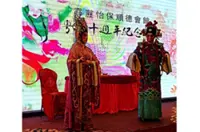
Besides that, Mak also explained that the lion dance and Chinese opera were traditional elements the Cantonese community brought with them.
Ng added that Yuan Xiao was another festival celebrated by the Cantonese and equivalent to Chap Goh Meh that’s commemorated by the Hokkiens.
He said the lesser-known festival in Malaysia, which means “the night of the first full moon”, was celebrated on a grand scale in China.
Because the Hokkien population was the biggest in Malaysia, Chap Goh Meh was more popular, Ng said.
During Chap Goh Meh, young people gather to toss mandarin oranges into lakes or rivers, hoping to find partners.
In comparison, Ng said, that during Yuan Xiao, pinwheels with inscribed images of the God of Prosperity and God of Health were carried over a bridge during a procession to bring good luck, prosperity and good health as well as ward off bad luck.
He said the celebration held on the 15th day of the lunar new year also welcomed the latest addition to the family, so the names of newborns were written on lanterns.
As the majority of the Chinese population in Ipoh are Cantonese, Yuan Xiao is slowly gaining popularity again, so he hopes to incorporate the festival into the Perak Tourism Calendar.
Ng said the 8km Cantonese Heritage Trail, expected to be launched sometime next month, with 32 stops at both the old and new parts of town, would have informative signs containing details about historical buildings, their founders and the purposes of their establishment.
“The Hakka people may have been the ones who opened up Ipoh back in the day, but it became vibrant and prosperous through the skills and economic activities of the Cantonese.
“Thus the idea of the trail, besides keeping the heritage alive, is to attract more tourists from China who would like to learn about their descendants and what they did for a living here,” he added.
Already a subscriber? Log in
Get 20% OFF The Star Digital Access
Cancel anytime. Ad-free. Unlimited access with perks.
More photos


Mak showing spears made by the Cantonese at the Paloh Koo Miu temple.
Mak (right) and Ng hold up wooden plates inscribed with prescriptions that were used in the 1880s.
Cantonese migrants at a reunion feast held at the Perak Nam Hoi Association in the 1930s. — Courtesy photo
A lion dance performance during the recent Yuan Xiao festival.
Cantonese artisans refurbished the Paloh Koo Miu Temple in Ipoh. – Photos: RONNIE CHIN/The Star
The elaborate altar at Paloh Koo Miu temple engraved by Cantonese artisans.