THE iconic Ipoh tree at the Ipoh Railway Station Square, which toppled during a thunderstorm last April, has been replanted.
The new tree, which was nurtured in a nursery in Buntong is three years old and about 2m high now, was planted by Perak Mentri Besar Datuk Seri Dr Zambry Abd Kadir during a ceremony on Wednesday.
Among those present at the event were state executive councillors Datuk Dr Mah Hang Soon, Datuk Rusnah Kassim and Ipoh mayor Datuk Zamri Man.
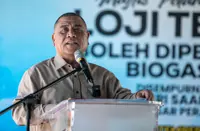
In his speech, Zambry said the tree planting ceremony was an important event for the city.
“The original Ipoh tree was an icon of the city. With the new tree planted, I hope it will flourish to become a symbol of Ipoh again,” he said.
Zambry said the Ipoh City Council (MBI), as the lead agency for the social business city initiative, will also collect fallen trees, leaves or branches to be turned into compost and sold.
“The revenue will then be channelled back to the city council’s funds and be used to preserve the environment,” he said, adding that the initiative serves as an example of an effort that generated revenue for the good of the community
In Asia, the Ipoh tree, or Antiaris toxicaria, can be found from southern India to southern China and throughout South-East Asia to Northern Australia, Fiji and Tonga. In Africa it occurs south of the Sahara from Congo to Madagascar.
It takes 20 years to mature and is capable of reaching a height of 40m. The sap from the tree is highly toxic. In traditional Javan medicine, it is said that its leaves and roots can be used to cure mental illnesses while its seeds are said to be a remedy for diarrhoea.
Apart from the one at the square, another Ipoh tree is found at the D.R. Seenivasagam Park.
On another matter, Zambry said the state hopes that the people would continue to cultivate the habit of keeping the environment clean.
“The people need to raise civic awareness about keeping their surroundings clean. We always talk about how the world is amazed by the Japanese, who keep their cities clean by not littering and even keeping trash in their pockets until they find a rubbish bin,” he said, adding he hopes Malaysians can emulate this.
Zambry said being recognised as the cleanest city or the best local council in the country was not enough as the cooperation of the public was crucial.
“These accolades are not enough, if the public does not contribute to cleanliness.
“People need to take up responsibility and not solely rely on the city council to pick up rubbish and keep the city clean,” he said.
“The First Garden Flats are an example of peole needing to have the right attitude.
“Despite having been cleaned up, I was told that the area is dirty again,” he added.
Retiree PC Low, in his 70s, said he is happy and proud that the Ipoh tree has been replanted.
“It was just a shame that it was uprooted in a thunderstorm last year.
“No one could have imagined seeing such a big tree being toppled.
“Now that a new tree has been replanted, I hope that it can grow up big and tall like the former,” he said.
“The tree is what gave the city its name. It is an icon that should have been replaced earlier,” he added.
Perak Tourism Association chairman Datuk Mohammad Odzman Abdul Kadir hopes that the younger generation will appreciate and learn more about the tree and its significance.
Mohammad Odzman said the leaves shed by the tree in D.R. Seenivasagam Park could be turned into souvenirs.
“The leaves can be preserved, turned into bookmarks or framed and be given to others as gifts,” he said.
After the ceremony, Zambry visited the Dato Sagor food court to have their breakfast and speak to members of the public.
Already a subscriber? Log in
Get 20% OFF The Star Digital Access
Cancel anytime. Ad-free. Unlimited access with perks.