




To escape the recent haze in Kuala Lumpur, four of us – two mothers and two daughters – flew to Tanzania to check out the annual wildebeest migration across the Serengeti.
For 10 days, the four of us travelled from Arusha to Ngorongoro in Tanzania, eventually arriving at the Serengeti.
One of the first Swahili phrases we learnt was “pole pole”, meaning “slowly, slowly”. And in Tanzania, that’s exactly what you need to do. For example, while having lunch at a cafe in Arusha, we wondered why it took a long time for the food to be served. Then we realised that perhaps the problem was not the service, but ourselves, expecting everything to happen according to our schedule.
Arusha is known for its safaris, so our days always start extra early in order to catch more animals in action. Game drives can also last between six and seven hours at a time.
We watched zebras going about their day. One was rolling happily in a “dust bath” while two others chased each other playfully. There was something strangely sentimental about seeing animals in the open and free.
One of the most striking sights we saw was a massive eland, weighing close to a tonne (according to our guide), being taken down by lions.
Tanzania has plenty to offer beyond its wildlife. At a banana plantation, we learnt that the country is home to around 35 varieties of banana, with 16 grown in one particular village.
We were introduced to mbege, a sweet, cloudy brew made from bananas, and sprouted finger millet. In a small local pub, a communal cup of mbege was passed around. Our guide took a sip and passed the cup to me. I looked at it, then at him. Then at the cup again.
I took a sip.
At the Ubuntu Migration Camp in Serengeti, if we wanted to shower, we had to call our room butler Husain on the walkie- talkie. “Hello, are you ready to shower?” he asked. Shortly after, he arrived at our room with two buckets of hot water.
He poured the water into another big bucket. “Your water is ready. Forty litres for two people,” he said.
The Serengeti showed us just how much life the plains hold. Over several game drives, we saw antelope in all shapes and sizes, wildebeest, gazelle, impala and topi, alongside zebras, elephants, giraffes and buffalo. We watched a leopard climb a tree, animals courting and sparring, the young learning from their mothers and, on the other end of the cycle, bones scattered across the plains.
We came across lionesses with two cubs beside a warthog kill. The lionesses tore into the carcass, while the cubs wandered over to lick and nibble at whatever soft morsels they could find, returning to their mothers to suckle.
When one strayed too far, the lioness called it back. Watching this, I wondered, “who was watching whom?”.
This scene also made me think about our own mother-daughter journey. We were four women travelling across Tanzania, two adult daughters and two mothers, both in their 80s. All around us, wildlife was raising its own next generation, too. Elephant calves stayed close to their mothers, while zebra foals and wildebeest calves stayed close to theirs.
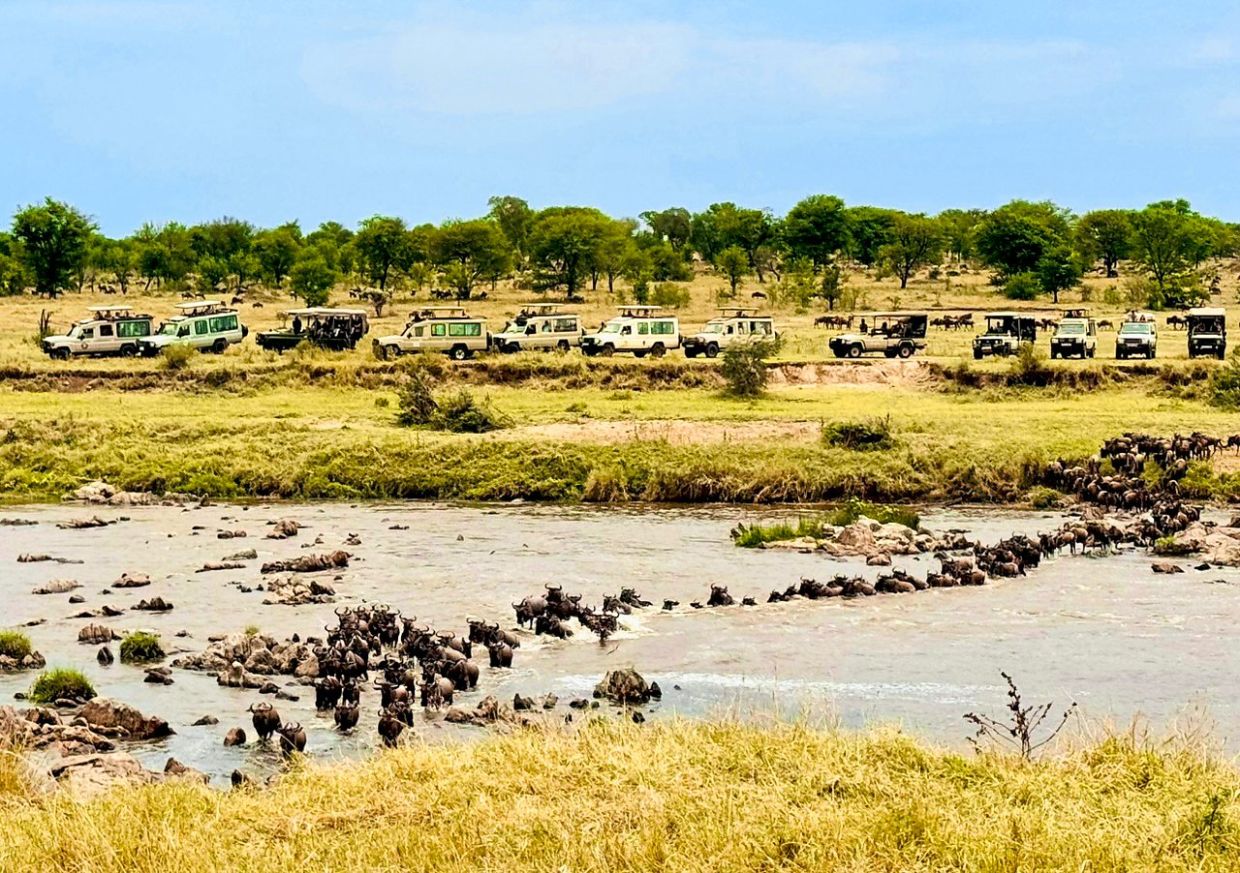
For us, the wildebeest crossing was the ultimate exercise in patience. Thousands waited for the right moment to cross the Mara River, while tourists waited to capture the best picture.
Along the riverbank, vehicles form long lines, sometimes narrowing the animals’ passage. We had come to witness nature, but at what point does watching become interference?
Our journey out of the Serengeti brought one final dose of adventure. We boarded a 12-seater aircraft, with luggage loaded manually onto trolley carts. At our transit stop, we were asked to de-plane, and to take our luggage.
Then came the words that sent us into mild panic: “Welcome to Zanzibar!”
Zanzibar? We were supposed to be transiting in Arusha before heading to Dar es Salaam! Shortly, we were ushered back onto the same aircraft. The air stewardess greeted us with a cheerful, “Hello again.”
Nature does not follow our schedules, and perhaps we do not always need to make one. Tanzania taught me to slow down, take less, expect less, observe more and leave room for nature to be nature.
For the four of us, the joy was in sharing the animals, landscapes, laughter and occasional confusion. And when plans go stray, well, hakuna matata.
The views expressed are entirely the writer’s own.

