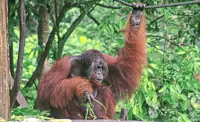
There are only three recognised species of orang utan in the world. Two of these – the Sumatran and Tapanuli orang utan – are endemic to Indonesia’s Sumatra island, while the Bornean orang utan is largely found in Malaysia’s Sabah and Sarawak.
Bornean orang utan can be further divided into three subspecies: Northwest Bornean orang utan, found mostly in Sarawak; Northeast Bornean orang utan, typically found in Sabah; and Southwest/Central Bornean orang utan, which is found only in Indonesia’s Kalimantan wilderness.
Alarmingly, all orang utan species are classified as Critically Endangered on the International Union for Conservation of Nature (IUCN) Red List.
Their population continues to dwindle, with World Wildlife Fund (WWF) estimating there are only approximately 119,000 orang utans left in the wild. Deforestation and poaching are among their biggest threats.
Several rehabilitation and conservation centres work actively to protect these intelligent animals, preventing them from becoming extinct.
Here are three such centres that can be found in Malaysia.
Bukit Merah Orang Utan Island Foundation (Perak)
Photos taken from behind the steel mesh fences here may make the orang utans appear to be living in captivity, but that is far from the truth.
At Bukit Merah Orang Utan Island Foundation (BMOUIF) in Semanggol, Perak, it is the human visitors that are “caged”, in a way.
Also known as “Pulau Orang Utan”, visitors to this island never make any contact with the hirsute residents. After disembarking at the jetty, they walk through a 200m-long semi-circle steel-fence tunnel enclosure, from where they can observe the orang utans roaming freely around the approximately 6ha island.
Serving as an out-and-back path, the tunnel was introduced in 2001, a year after the place publicly opened as an ex-situ conservation and rehabilitation sanctuary.
Recently, Marriott Bonvoy has collaborated with BMOUIF to support the conservation and protection of orang utans.
Through this collaboration, guests at Marriott properties can contribute directly to the conservation efforts via QR code donation touchpoints.
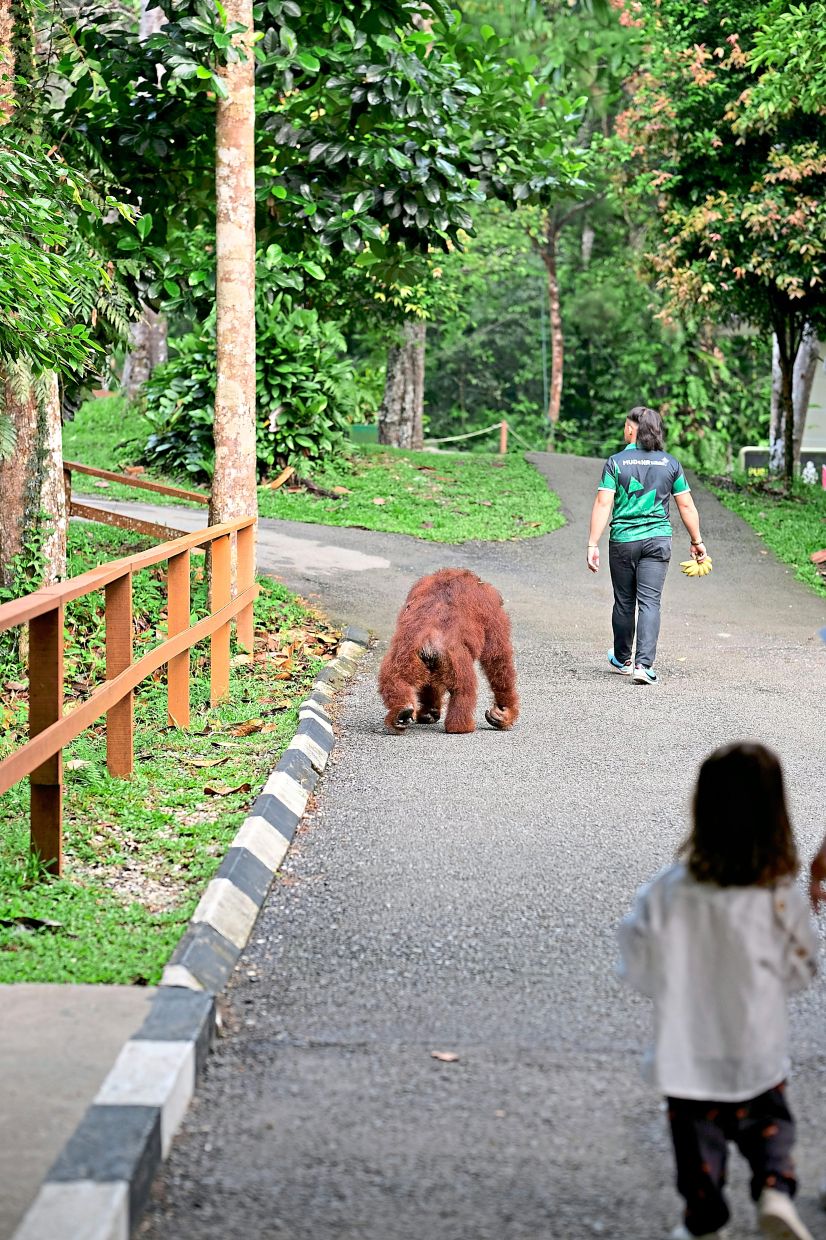
Semenggoh Wildlife Centre (Sarawak)
Set within the Semenggoh Nature Reserve, which is located about 40 minutes away by car from Sarawak’s capital city, Kuching, is the Semenggoh Wildlife Centre.
Here, semi-wild, rehabilitated orang utans are taught to be independent and not accept food from visitors (visitors are also not allowed to offer any food). Instead, during feeding time, they will head to designated platforms where fruits are left for them.
As they eat, visitors can quietly observe them from afar.
Since it was established in 1975, the Semenggoh centre has helped rehabilitate animals that have been in captivity or injured. It also conducts research and breeding programmes to help repopulate the endangered species.
Another notable sanctuary is the Matang Wildlife Centre, set within the Kubah National Park in Kuching. Aside from orang utans, it also rescues and rehabilitates other animals like sun bears, crocodiles and civet cats.
Sepilok Orangutan Rehabilitation Centre (Sabah)
Founded by conservationist Barbara Harrisson with the Sabah government in 1964, Sepilok Orangutan Rehabilitation Centre was the first of its kind in the world at the time.
Located within Kabili-Sepilok Forest Reserve, it had a progressive vision that ensured orang utans brought to the centre weren’t just given somewhere to stay – it was also a place for them to learn.
Essentially, it was a “school”, where rescued orang utans can learn to take care of themselves and be returned to the wild once they are independent enough. This remains the centre’s core principle to this day.
Visitors can observe the orang utans during feeding times, where monkeys and other small animals might also make an appearance on the platforms.
Visits to Sepilok are usually paired with a stop at the nearby Bornean Sun Bear Conservation Centre, which protects the world’s smallest bear species, and a cruise down Kinabatangan River, where lucky visitors may spot orang utans – as well as Sabah’s other “popular” animals like the pygmy elephant, proboscis monkey and crocodiles – in the wild.