
Some might think: Did you really visit Bhutan if you did not conquer its Tiger’s Nest?
Well, climbing Paro Taktsang, or Tiger’s Nest monastery, is certainly no walk in the park. Especially for those of us who are already getting on in years, as it is a big test of our physical strength and determination. Plus, we have to think about our knees!
Perched dramatically on a sheer cliff some 3,120m above sea level in Paro Valley, Tiger’s Nest is one of Bhutan’s most extraordinary landmarks.
Starting from an elevation of approximately 2,500m, the uphill trek stretches about 5.5km one way. The trail climbs steadily, and just when you think you are almost there, hundreds of stone steps still await you.
No vehicle road leads to the monastery – the only way to get there is with your own two feet.
My advice? Use two trekking poles, one in each hand. They help you climb more comfortably and, more importantly, reduce the strain on your knees during the descent.
There are horses that can take visitors halfway up the mountain, but there are risks involved in doing this. Also, the remaining journey after the cafeteria must still be completed on foot.
I would recommend that you leave the horse alone and do the trek yourself. Just know your limits and walk at your own pace.
My travel buddies and I covered approximately 11km, clocked up some 16,000 steps and spent a full seven hours on the trail and mountain.
Hey, not bad at all.
For this Bhutan adventure we stayed at the Amankora, part of the internationally renowned luxury hospitality brand, Aman.
Amankora operates five intimate lodges across five valleys in Bhutan, with 76 suites to choose from. Its Paro property alone has 24 suites.
To ensure our safety and comfort during the climb, Amankora arranged trekking guides at almost a one-to-one ratio, allowing each guest to receive personal attention according to individual fitness levels and walking pace.
To me, Aman’s service philosophy goes far beyond simply getting guests safely from one destination to another. It is about encouraging travellers to slow down, appreciate the scenery and truly experience the beauty of nature and local culture.
At 7.30am, fully equipped and ready for action, we began our adventure. I would have preferred starting at 6am as the morning light would be softer, the air fresher, and the pine forests would still be filled with that lovely, subtle fragrance of mountain greenery.
But 7.30am was good, too.
We started off a little too enthusiastically. After walking only a short distance, several of my travel companions and I were already huffing and puffing.
This is because we were already standing at a pretty high altitude. At this elevation (2,500m), the lower oxygen pressure means that walking too quickly can easily leave you breathless.
Our chief guide, Tzewang, kept reminding us: “Slowly, slowly!”
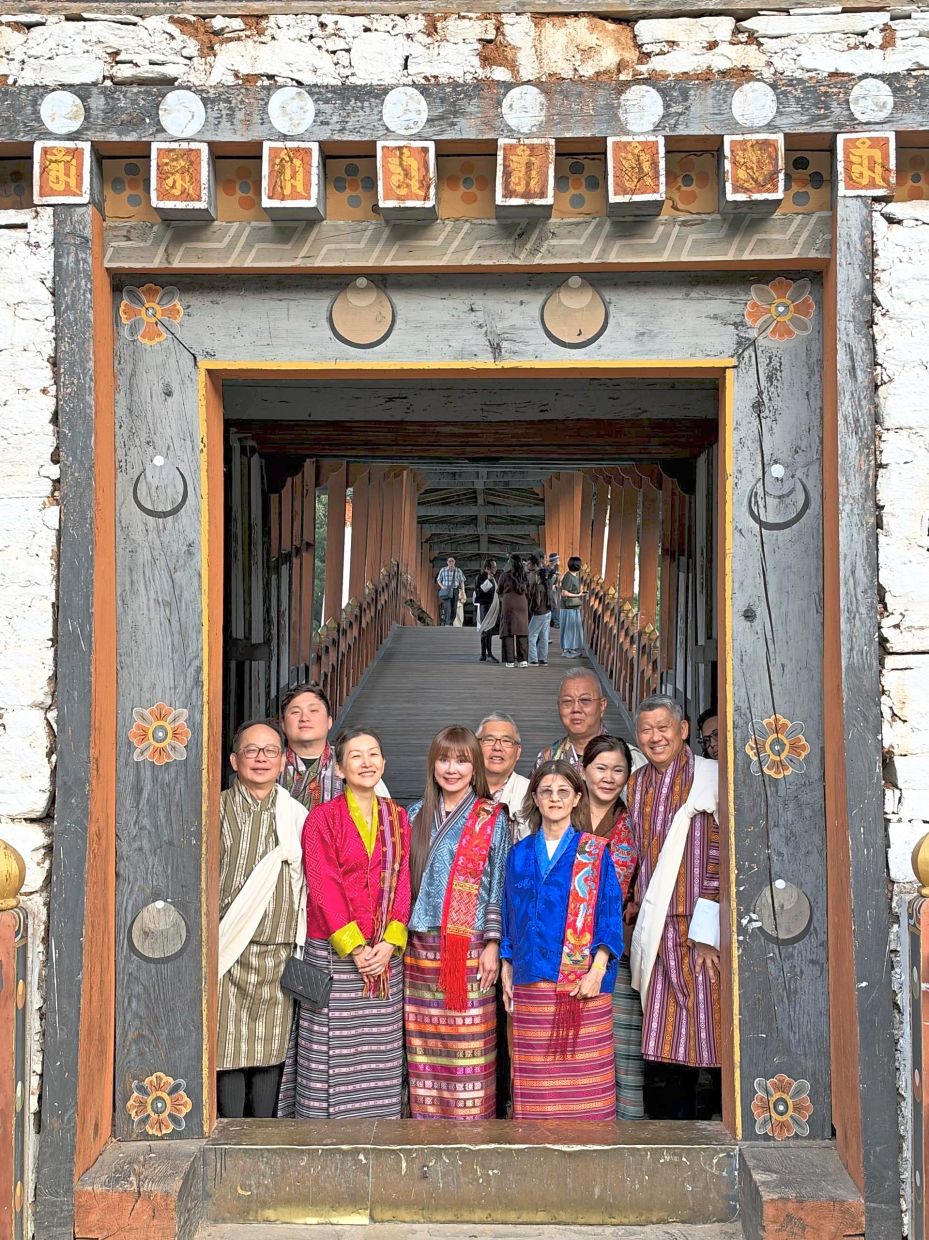
The hotel had prepared drinking water and energy snacks for us so I deliberately slowed down, shortened my strides and began enjoying the journey.
We walked through beautiful pine forests, admired moss- covered tree trunks and occasionally spotted yellow-billed blue magpies fluttering among the branches.
Suddenly, the climb was no longer just about reaching the destination. It became a journey worth savouring.
I first climbed Tiger’s Nest 15 years ago. Back then, the mountain trail was much more rugged and primitive. Hikers and horses shared the same dusty dirt paths, often leaving everyone covered in clouds of dust and animal droppings.
Today, some sections have been improved with stone steps, while horses follow separate routes some of the way. Overall, trekking conditions are noticeably better.
My good friend Ah Boon jokingly asked: “When are they going to build a cable car here? Problem solved once and for all!”
Of course, he knows perfectly well that the pleasure and benefits of trekking are part of the Bhutan experience.
So we walked and walked.
After approximately 90 minutes, we finally reached Taktsang Cafeteria, the halfway rest stop.
Then I looked up. Wow.
There it was, Tiger’s Nest monastery, clinging almost impossibly to a near-vertical cliff on the opposite mountainsid.
Whitewashed walls, golden rooftops and a series of buildings stacked against the towering rock face, with a dramatic valley plunging some 900m below.
From a distance, the entire monastery appeared to be floating among the clouds.
The religious history of Tiger’s Nest dates back to the eighth century. According to legend, Guru Rinpoche, also known as Padmasambhava, flew to this sacred site on the back of a tigress and meditated inside a cave.
In 1692, Bhutanese ruler Tenzin Rabgye initiated the construction of the monastery, which gradually developed into the remarkable complex we see today.
That makes it 334 years old.
Standing there, I was reminded of China’s Hanging Temple in Shanxi, Indonesia’s Borobudur and Cambodia’s magnificent Angkor Wat.
Different architectural styles, different religious traditions, yet all are extraordinary testimonies to the wisdom, determination and spiritual devotion of ancient civilisations.
More than three centuries ago, without modern machinery, cranes or sophisticated construction equipment, how on Earth did people transport timber, stones and other building materials up such a dangerous cliff?
After resting and taking photographs for about 30 minutes at the halfway cafeteria, we resumed our climb at 9.30am. And this, my friends, was where the real challenge began.
The mountain trail twisted and turned, climbing uphill before suddenly descending along steep stone steps.
Looking at the steps ahead, I couldn’t help thinking: “Aiyoh! Whatever we climb down now, we will have to climb all the way back up later!”
Fortunately, the scenery became increasingly spectacular. The farmlands, villages and overlapping mountain ranges of Paro Valley stretched beautifully into the distance.
Then came the sight of a magnificent waterfall, plunging some 60m down the mountainside.
Everyone became excited, thinking we had finally arrived ... but no, we hadn’t.
After crossing the little bridge near the waterfall, another steep flight of stone steps was waiting for us. By then, our legs were beginning to feel like jelly.
There was nothing left to do but grit our teeth and keep moving, one step at a time.
Finally, at 11am, we reached the entrance to the monastery.
I had always imagined Tiger’s Nest as one enormous, unified temple. But seeing it up close, I realised that it is actually a fascinating complex of prayer halls, meditation caves and monks’ quarters, built upon natural rock ledges and connected by narrow stairways and corridors.
Visitors must remove their shoes before entering, while mobile phones and photographic equipment are prohibited in the main visiting areas.
Following our guide, we quietly explored five prayer halls and a sacred cave, experiencing the profound Tibetan Buddhist traditions that have endured here for centuries.
Standing inside this sacred monastery on the edge of a cliff, something suddenly struck me.
What makes Tiger’s Nest truly extraordinary is not its seemingly impossible architecture. It is the incredible perseverance and devotion of generations of people who were willing to overcome enormous challenges in pursuit of their faith.
That, to me, is the real wonder of Tiger’s Nest.
After visiting the monastery, we began our descent at 12.15pm. Don’t imagine for once that going downhill is easier. Those steep stone steps, combined with already exhausted legs, presented yet another serious challenge for our poor knees.
But step by step, we made our way down.
Finally, at 2.30pm, we arrived safely back at the car park.
Seven hours. Eleven kilometres. Sixteen thousand steps.
Mission accomplished.
Fifteen years ago, I was overwhelmed by the Tiger’s Nest’s dramatic location and architectural magnificence.
Returning 15 years later, I came away with a deeper appreciation of the place.
Some of life’s most memorable sights cannot simply be admired with our eyes. We must walk towards them with our own two feet, earn them through sweat and experience them with determination.
At Tiger’s Nest, the climb rewards you with breathtaking scenery. The journey down teaches you something about life.
One step at a time, we measured the mountain with our own footsteps. And what a journey it was.
The views expressed here are entirely the writer’s own.
Leesan, founder of Apple Vacations and group executive chairman of KITA Tours, has travelled to seven continents and visited 168 countries/territories. He has written seven books, and shares his travel stories, experiences and insights.