
It was just a normal day’s travel in Switzerland: Up a mountain, down a mountain, across a lake and then a relaxing fireside dinner.
But it was not just any mountain, any lake – or any journey for that matter – as it involved travelling by rail beyond the snowline and then across a vast glacial lake (called see in this part of Switzerland) to Thun, a historical town located beside the lake.
With its snow-capped peaks, lush alpine meadows, crystal- clear lakes and vibrant cities, it’s easy to see why Switzerland is a popular travel destination. Somewhere on the list of “must-do” activities there is a rail journey, and near the top of that list of train journeys is one that goes to Jungfraujoch, or the Top of Europe.
This train journey begins at Interlaken (568m above sea level) and winds its way up through the Swiss Alps to Jungfraujoch, Europe’s highest railway station.
Between the Lakes
Interlaken, the town between the two lakes of Thun and Brienz, is one of Switzerland’s liveliest travel destinations.
The town began as a tourist centre and remains one of the country’s most vibrant places. Well-to-do German and English tourists identified Interlaken as a base for nature-based adventures in the mid-19th century.
Grand hotels such as the Victoria-Jungfrau Grand Hotel and the Beau-Rivage were built to accommodate affluent visitors, and they continue to offer impeccable service to contemporary travellers.
The famous peaks of the Monch, Eiger and Jungfrau rise in the south and can be admired from the grassy Hohematte in the town centre. Harder Kulm rises behind the town and is accessible via an exhilarating funicular cablecar journey.
I took the cablecar to the summit to admire the panoramic alpine scenery.
Interlaken is well set up for tourism with restaurants serving global cuisines and tour operators offering thrilling paragliding flights from surrounding peaks onto the Hohematte.
Switzerland’s biggest watch outlet is also in the middle of the town.
The ascent
There are two railway stations: Interlaken West, close to Lake Thun, and the main station of Interlaken East, which is closer to Lake Brienz and the station serving the mountain railways.
Travelling to Jungfraujoch (the saddle between the Jungfrau and Monch peaks) is the journey visitors seek, as it takes them to Jungfraujoch at an altitude of 3,454m.
The line to Jungfraujoch, conceived by Swiss industrialist Adolf Guyer-Zeller, opened in 1912. Construction began in 1896, but it was difficult and dangerous work due to rock falls and avalanches.
It’s important to do some research, since there are several ways to approach Jungfraujoch.
I caught an early morning train from Interlaken East to Grindelwald, the Eiger Express cablecar to Eigergletscher and the Jungfrau Railway to Jungfraujoch.
On the return journey, I alighted at Eigergletscher, walked downhill to Kleine Scheidegg, and then caught the train from there to Wengen, Lauterbrunnen (for a train change) to Interlaken, and then Interlaken West for my ferry across the lake to Thun.
Train enthusiasts may find it interesting that certain segments employ rack or cogwheel mechanisms, which add a central cog between the rails to improve traction. The train travels mostly inside a tunnel in its final stretch, pausing at Eismeer so passengers can enjoy the scenery before arriving at the top.
The station sits beneath a glacial saddle between two peaks. From the underground station, visitors reach the surface via an elevator that provides access to the visitors’ centre, restaurants, shops and facilities.
Visitors can admire the view from an outdoor terrace located at the Sphinx Observatory (3,571m).
A research station for astronomical studies and other scientific pursuits has operated here since 1931.
The station is a leading environmental research station for climate change and atmospheric measurements.
Facilities at the summit are extensive and include a terrace for viewing the Aletsch Glacier, Switzerland’s largest. Visitors can also walk through a cave carved through glacial ice.
Outdoor activities include tubing, skiing, snowboarding, zip-lining and glacial walks. Most visitors are happy to just take in the scenery, then return to the indoor warmth of the dining facilities or the Lindt Chocolate Heaven outlet.
The descent
On the return journey down the mountain, passengers who want a little exercise and the opportunity to photograph trains going up and down the Jungfrau line can alight at Eigergletscher and walk down to Kleine Scheidegg. I was glad that I did this, as it was a most refreshing one-hour walk that was easy, as it was downhill.
Kleine Scheidegg has accommodations, restaurants and bars, and is a popular skiing area in winter. Here, passengers change trains for either Grindelwald or Wengen/Lauterbrunnen for their homeward journey to Interlaken.
I chose the latter and travelled in the distinctive green and yellow carriages of the Wengernalp Railway to Lauterbrunnen, where I again changed trains for the final run back to Interlaken.
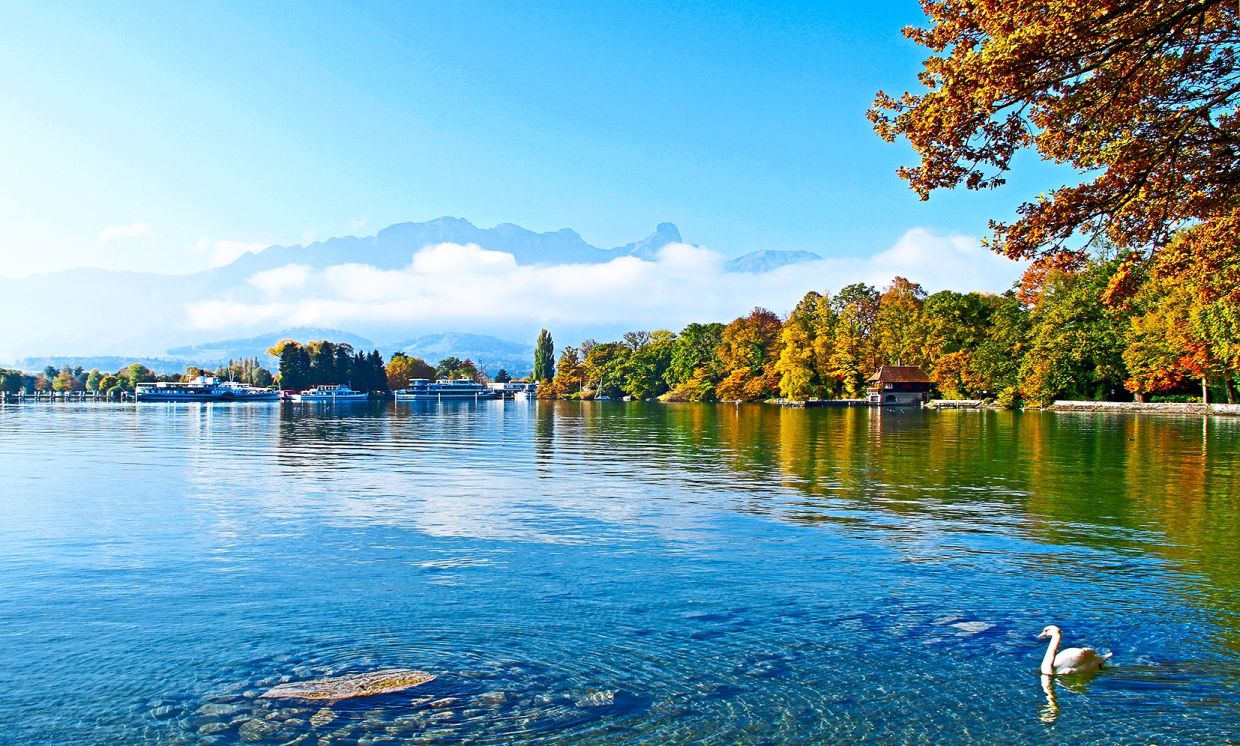
It was a long but rewarding day with the final leg on a BLS boat across Lake Thun to Thun via villages such as Spiez. Despite leaving Interlaken West at 6pm, the late autumn light was still adequate for much of the journey across the scenic and deep glacial lake.
Our vessel pulled in briefly at Spiez with its impressive castle surrounded by vineyards that, transformed from lush green to autumnal yellows, created a most impressive photo.
However, by 8pm when we berthed in Thun, it was dark, and I was eagerly looking forward to checking into the Hotel Deltapark Vitalresort on Lake Thun’s foreshore. Dinner was most enjoyable by a faux fireplace, and breakfast on the patio overlooking the lake was just as relaxing.
Thun is one of Switzerland’s lesser-known towns, but it is most enjoyable as there are fewer tourists. This medieval town is located beside the Aare River, with historic buildings around every corner.
Its Old Town is dominated by a 12th-century castle (Schloss Thun) perched on the highest land. There are also two covered wooden bridges, like the famous one in Lucerne. Thun’s Upper Lock Bridge and the Lower Lock Bridge were built in the early 18th century.
Its scale makes Thun an easy town to explore with the assistance of buses, which come with a Swiss Travel Pass. Being a bright sunny day, I walked around the lake, through Schadau Park, past Schadau Castle and admired the Stockhorn Mountain beyond the lake.
This journey of discovery was most enjoyable, as it took in the renowned train to Jungfraujoch, the majestic Lake Thun and the historic town of Thun.
Travel notes
How to get there: There are no direct flights from Malaysia, but airlines like SWISS do fly from the Kuala Lumpur International Airport to selected airports in Swizerland, with connections along the way.
Getting around: A Swiss Travel Pass provides unlimited travel on the Swiss travel network (trains, buses, and ferries) and 25% discounts for both the mountain railway to Jungfraujoch and the Eiger Express.