
A fishing boat filled with tourists and angling gear eased away from the port in Tanmen Township, Qionghai, south China’s Hainan Province, setting off on a leisurely sea-angling trip.
Standing by the rail with his wife and son, a tourist surnamed Cheng from Yunnan Province took in the coastal scenery.
“It’s my first time fishing at sea, and I’m looking forward to seeing what we’ll catch,” he said.
The sea angling trip was part of an activity launched in Tanmen during China’s recent National Day holiday, inviting visitors to spend a day as a fisherman in Tanmen. Tourists boarded boats and cast their lines under the guidance of local fishermen.
Many said the experience had given them a real taste of life at sea.
At nightfall, as the boats returned to shore, the seafood street along Fugang Road in Tanmen came alive, with seafood dining offering another way for visitors to experience local fishing culture.
After dinner, some tourists settled in for the night at one of more than a dozen traditional fishermen’s homestays in nearby Paigang Village.
From sea-angling trips to seafood dinners and fishermen’s homestays, Tanmen is seeking to connect different parts of the visitor experience and encourage tourists to spend more time and money in the town.
During China’s National Day holiday in early October, Tanmen received about 89,600 tourist visits and generated approximately CNY3.08mil (RM1.87mil) in tourism revenue, according to local statistics.
Behind these experiences lies a broader effort to diversify the economy of a town long shaped by fishing. Tanmen, notably, has preserved much of its traditional fishing village landscape, while generations of seafaring experience, port infrastructure and maritime heritage have laid the foundation for the development of recreational fisheries.
In recent years, Tanmen has explored new business models combining leisure activities, fishermen’s homestays, seafood sales and educational tours.
Yang Liguo, from Beijing, is one of those working in Tanmen’s recreational fishing sector.
“My work gave me a deep affection for the sea. On a random sea-angling trip in Hainan, I began thinking about having my own recreational fishing boat,” Yang said.
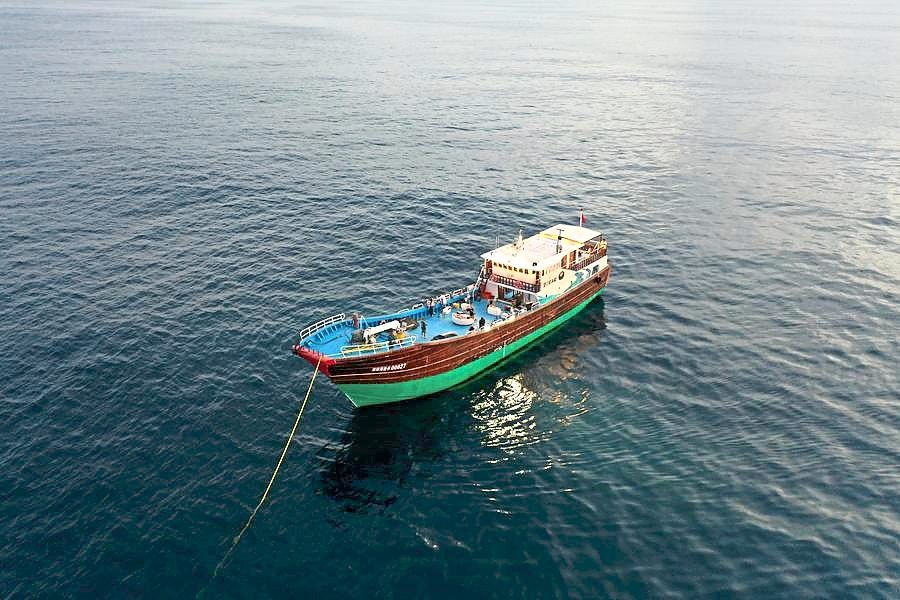
In 2025, Yang invested more than CNY3mil (RM1.82mil) to convert a 205-tonne wooden fishing boat into a recreational sea-angling vessel, which retains an all-wood structure. Its cabin preserves traditional maritime tools, including a compass and old fishing nets, while modern rescue equipment has been installed.
For Yang, the appeal of Tanmen extends beyond its fishing grounds. The town’s maritime culture, passed down through generations, was another major reason he chose to operate there.
“We invite veteran local captains aboard to share stories about Tanmen fishermen’s voyages, allowing visitors to experience the history of the Maritime Silk Road and the culture of Geng Lu Bu, traditional handwritten sailing-route manuals used by local fishermen,” he said.
Since the vessel began operating in May 2025, it has hosted educational tours involving over 2,500 participants, Yang noted.
According to official statistics, Qionghai’s recreational fishery output value reached CNY284mil (RM173.25mil) last year. From January through August 2026, meanwhile, Tanmen received 1.33 million tourist visits and generated tourism revenue of CNY47.8mil (RM29.16mil).
The government also plans to develop Tanmen into a recreational fishing hub, upgrade its recreational fishing pier, improve supporting facilities such as tourism service complexes, and provide more tourism products in sightseeing, cultural experiences, accommodation and science education.
Li Zhi, party chief of Tanmen Township, recently inspected the renovation of Tanmen’s central fishing port. The town has also taken the port renovation as an opportunity to develop facilities for recreational fishing.
“The first phase has been completed, and work on the second phase is underway. The port upgrade is intended to serve traditional fishing as well as the emerging recreational fishing sector,” Li said.
The upgraded port is set to include a 310m-long pier dedicated to recreational fishing, with capacity for up to 19 recreational fishing boats, as well as a beach, an observation lighthouse and a seafood market.
“Both traditional fishing and recreational fishing need to develop well. That is how local people can improve their livelihoods and fishermen can enjoy better lives,” Li said. – Xinhua