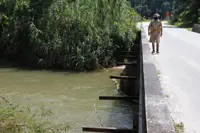
After exiting a 50m-long man-made tunnel, my eyes were immediately fixated on a beautiful lake set amid limestone karst towers. This was Tasik Cermin in Ipoh, Perak, a pristine oasis visited by many. Funnily, though, it was the surrounding geological features that really caught my attention.
Being a geology student, I couldn’t help but geek out at the natural rocky landscape.
“The karst landscape is just stunning,” I said to my friend Qistina, while pointing to the limestones surrounding the lake.
My companion, however, was unimpressed. Her lack of interest was understandable because to the untrained eye, the karst might just seem like... a pile of rocks.
A karst is a terrain with a distinctive hydrology and landform. Its unique appearance is due to having rain water trickle down the cracks of the soft rocks, which then dissolves them.
This natural phenomenon will also form bigger fractures which may then lead to the creation of caves, sinkholes and doline.
“This place is part of the Kinta Valley Geopark,” I said to Qistina when I noticed her puzzled expression throughout my mini lecture.
At this point, my friend was more interested in taking photos of the place than listening to me. But that was fine with me as the geopark really is a wonderful spot for photography, thanks to the breathtaking views.
We can see the reflection of the rocks on the surface of the water, and it is almost a perfect image. This is why it is called Tasik Cermin, which translates to mirror lake.
The photos I took, unfortunately, are now lost forever as I recently broke my phone, and realised that I had not backed up the images to another folder.
Our road trip to Perak (which took place before the pandemic) had been for leisure, but the geologist in me could not help analysing all the geological features and formations that we came across.
At one point I even crouched down to look for rock samples!
I was delighted to find a chemically weathered metamorphosed limestone. Don’t worry, I didn’t take it home with me, I only took pictures of it, although... oh well.
The Kinta Valley Geopark is truly one of the best places in Malaysia where you can learn about rock geomechanics. But if you just want to marvel at the natural wonders of the place by taking pictures and enjoying the view, that’s completely fine too.
Our next stop was the Kek Lok Tong Cave which is believed to be close to half a billion years old. It is said to date back from the Devonian to Permian ages, which is between 410 and 245 million years ago!
Located south-east of Ipoh town, the cave is famous among nature enthusiasts. Also known as the Cave of Ultimate Bliss, the place has a Buddist temple within it that’s surrounded by lakes and gardens.
I noticed that there was some sand intercalated between the limestone beds. This is an indicator of a river or drainage system running through.
“From the grain size, we can predict the local paleoclimate and understand the energy of the water that transported this sediment,” I said to Qistina.
Paleoclimate refers to a climate that was prevalent at a particular time in the geological past. Basically, if the grain size of the sand is bigger, higher energy was needed to transport the particle. And if larger-sized particles dominated the area, then we can assume that the local paleoclimate is wet, just like this cave.
Understanding the history of the cave’s formation transported me to thousands of years ago. I couldn’t help but get excited about these findings and felt like digging into the details of these carbonates. I would have loved to chisel the rocks to tease out their secrets with my specialised hammer and other tools.
However, this area is protected, so let’s preserve everything within it.
Within the spacious cavern that was illuminated by both natural and artificial lighting, we saw visible cave sediments namely stalactite (hanging concretions), stalagmites (ascending concretions), columns (joined stalactites and stalagmites), and flowstone.
They were formed from the deposition of minerals since time immemorial.
It was the first time that Qistina had stepped into a cave. She was disappointed that there were no bats to be seen.
“The features are stunning but why are there no bats?” she asked. Perhaps they have all moved out, I replied half jokingly.
When we finally stepped out from the cave and into the lake garden, we were greeted by a cold breeze.
“Not only is this place beautifully preserved, it also allows me to take a break from my hectic life,” Qistina said while quietly enjoying the views.
We explored the garden, and I saw some deformed limestones shaped like the letter “S”. As I was busily checking these out, Qistina said she now has an idea of what I actually do at geological sites but wonders why it is so important to learn how things are formed.
I told her that the past is the key to the future.
“Geology helps us to understand what we should and should not do with – or to – Mother Nature,” I explained.
The Earth is indeed full of puzzles for us to unveil and benefit from.Pin thisInterstate travel is not allowed yet so unless you live in Ipoh, this geopark is off limits to outstation visitors for now. However, you can put a pin on this place and plan for a trip for when we can travel again. For information on the Kinta Valley Geopark’s opening hours and ticket prices, check out the park’s official pages on Instagram (@geoparklembahkinta) or Facebook (@geoparkkinta). Alternatively, contact a local tour company.
Already a subscriber? Log in
Get 20% OFF The Star Digital Access
Cancel anytime. Ad-free. Unlimited access with perks.