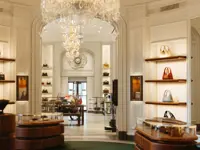
Bergdorf Goodman deals in high-end fashion items, such as US$1,500 (approximately RM6,100) Saint Laurent boots and US$2,600 (RM10,600) Bottega Veneta shoulder bags.
At its most luxuriant edges, it sells extravagant goods like a US$24,000 (RM98,000) Prada jacket made from dyed lamb shearling.
At those prices, shoppers demand a standard of service that has dwindled in recent years, even among luxury brands, as retailers took shortcuts to try to keep costs low, while buying habits changed and store visits declined.
The most glamorous department store in the US wants to return to its golden age, when shopping at its Fifth Avenue edifice combined entertainment and commerce, with highly personalised treatment that lured Hollywood stars, socialites and royalty.
Steps away from New York City’s Plaza Hotel and Central Park, the landmark building’s interior and exterior have been backdrops for feature films and television shows.
But Bergdorf Goodman, now 125 years old, is at a critical juncture.
Over the last six years, the store has survived two bankruptcies and a few different owners, with persistent questions about whether the business unit would be sold off.
In June, it emerged from bankruptcy with Saks Fifth Avenue and Neiman Marcus as part of the Exemplar Luxury Group.
Read more: Why what we wear is changing, and fashion brands are racing to keep up
The cornerstone of the retailer’s future is its top sales associates – employees who attend to customers in personal shopping suites and behind the glass countertops in the showrooms.
“There’s this notion that we are custodians of something magical,” Geoffroy Van Raemdonck, the new CEO of Exemplar, said in an interview.
“Every single employee in the back of house, in the front of house, in the executive office – we handle this with white gloves.”
Sales associates at the store have had extensive training on how to build long-term relationships with customers and how to engage with them on the sales floor.
They can direct shoppers to a wide range of personalised services: handbag restoration, private purchases, personal stylist consultations, custom tailoring and special events.
But despite its lavish offerings, Bergdorf Goodman has struggled to attract shoppers over the past year as Saks Global went bankrupt.
Many vendors didn’t get paid and stopped shipping their goods to the store.
Sales associates complained that they had few new bags, necklaces and dresses to show their clients, according to a person familiar with the matter.
Bergdorf Goodman’s opulent roots run deep. In 1901, Edwin Goodman became a partner in a tailoring shop near Union Square owned by Herman Bergdorf and soon bought him out.
Goodman moved the business in 1928 to its current location, on Fifth Avenue at 58th Street, the former site of Cornelius Vanderbilt II’s enormous French Renaissance-style chateau.
The Goodman family sold the retail business in the 1970s, but kept ownership of the building and has leased the space to the department store ever since.
Bergdorf Goodman’s various owners never opened more stores across the US in search of growth, as did some other New York department stores, such as Saks, Barneys New York and Bloomingdale’s, with one exception: a short-lived foray into White Plains, New York.
Only in 1990 did it open a single new location (sort of) that stuck – a men’s store right across the street on Fifth Avenue.
Half of Bergdorf Goodman’s sales come from customers who spend more than US$10,000 (RM40,800) at the store each year, and many spend more than 10 times that.
The retailer’s 40 highest-volume sales associates account for about US$200mil (RM816mil) of its annual sales.
That means each of them sells, on average, around US$5mil (RM20mil) in luxury goods per year.
Sales through associates and personal shoppers are up 5% this year. Van Raemdonck wants to push that figure higher. Exemplar declined to share total sales figures for the store.
“It has become a lost art,” Jessica Ramirez, a co-founder of the Consumer Collective, a retail advisory firm, said of high-end client service across the industry.
“Particularly in luxury, where I don’t think it should have ever been forgotten.”
For a time, that singularity insulated Bergdorf from the decline of shopping malls, which left national department store chains bereft of customers. But after it was acquired by groups that owned other department stores, Bergdorf Goodman became vulnerable to the same challenges.
By 2020, Bergdorf Goodman’s owner at the time, Neiman Marcus Group, filed for bankruptcy protection as it squirmed under a mountain of debt.
Then the business was bought by Saks Global, which filed for bankruptcy in January, just 13 months later.
Signs of the old glamour remained, even during bankruptcy proceedings.
The store held several private events each month for elite customers to view and buy exclusive merchandise in New York or remotely. Trunk shows at its high jewellery showrooms often result in US$300,000 (RM1.2mil) to US$500,000 (RM2mil) in sales.
Read more: From archives to runways, fashion doubles down on the power of brand heritage
In May, the store invited about 60 customers to an event that featured one-of-a-kind handbags that wouldn’t normally be available. It generated US$1mil (RM4.1mil) in sales.
Also that month, panoramic displays of a moving subway train appeared behind mannequins clad in Chanel garments in the storefront windows, and pedestrians stopped to gawk and take photos.
Chanel had given the store a one-week head start on the release of its annual Metiers D’Art collection.
But by then, Bergdorf Goodman, which had remained profitable, had already fallen behind on the annual fashion calendar, Van Raemdonck said.
The retailer’s relationships with fashion labels had deteriorated because of missed payments by its previous owner.
Saks Global owed Chanel US$136mil (RM555mil) when it filed for bankruptcy, according to court filings. The French fashion house’s return to the windows signalled that it still got along with its longtime partner.
Van Raemdonck said that “the largest brands have committed capital to pay for expressing their brand and transforming the experience” in the store.
There is also the lingering matter of whether or not Exemplar could eventually sell its prized asset.
Bergdorf’s has had many suitors over the years, including Bernard Arnault, CEO of LVMH, the world’s largest luxury goods company.
Last year, Saks Global held talks to sell a 49% stake in the business for about US$1bil (RM4.1bil), and bidders included sovereign wealth funds from the Middle East.
Van Raemdonck said that he considered Bergdorf Goodman a “valuable element” of Exemplar’s portfolio but that management would keep monitoring its options.
“We’ll continually look at what makes sense,” he said. “But there’s no immediate intent.” – ©2026 The New York Times Company
This article originally appeared in The New York Times.