Of the many legacies of the 2016 US presidential election, one of the less politically charged may be the enshrinement of the pantsuit as a uniform for powerful women.
Former US secretary of state Hillary Clinton, the first woman to secure the nomination of a major political party, identified herself in her Instagram bio at the time as a “pantsuit aficionado”.
Her signature look inspired the creation of a Facebook group called Pantsuit Nation, where her supporters posted images of themselves suited up in solidarity.
After Clinton’s loss, the pantsuit reemerged as a hot pink symbol of ambition in the 2020 election cycle, but women on both sides of the aisle – including Republican senators Susan Collins and Lisa Murkowski – have embraced it as political armor for years.
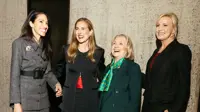
Wednesday (Oct 7) evening, Clinton, joined by a cavalry of more than 100 other pantsuited women, gathered at Marcel, a French restaurant on the Upper East Side of Manhattan, to toast the two-piece outfit.
Specifically, they were there to celebrate the 10th anniversary of Argent, a brand specialising in women’s workwear, which has dressed Clinton as well as former US vice president Kamala Harris, US congresswoman Alexandria Ocasio-Cortez, Meghan, Duchess of Sussex, and other highly scrutinised public figures.
Read more: Can fashion do the heavy lifting in politics? The symbolism stitched into a tote
The evening started with a cocktail hour in a room above the restaurant that was quickly filled with a sea of pantsuits in every colour: navy and electric blues, wine and tomato reds.
Clinton navigated the crowd, shaking hands and taking selfies, in an emerald-coloured Argent pantsuit with a green and yellow neck scarf.
It is the same suit from the cover of her most recent book, she said.
Argent was founded by Sali Christeson to solve a conundrum she faced herself: finding outfits that were both stylish and suitable for work.
It is her life’s mission, she said, to try to help eliminate workplace discrimination that can stem from a woman’s appearance.
Clinton, she added, is a prime example of someone whose appearance has often been used to discredit her and has since managed to “leverage dress as a tool and a resource”.
“We hear from women every single day on how they nailed their presentation, nailed an interview, nailed whatever work endeavour they set out to achieve because of the outfit,” Christeson said.
After Clinton was whisked away, the other guests walked downstairs for a three-course dinner that included roasted beets, steamed Dover sole, steak, and strawberries and cream.
The salad-bowl-size servings of French fries, though, were the biggest hit.
At one table, former Saturday Night Live cast member Chloe Fineman chatted with Katie Couric.
“I’ve been a pantsuit girl since the day I could walk,” Fineman said. “My dream wedding dress is just, like, me in a hot little pantsuit.”
For journalist and podcast host Molly Jong-Fast, a pantsuit denotes a “certain amount of seriousness and put-togetherness”.
It’s also helpful for television appearances, she added, because there’s “a place to put the microphone, which is not nothing”.
Therapist Esther Perel floated around the room. When actress Retta, best known as Donna Meagle on Parks And Recreation, was told she would need to leave her glass of champagne upstairs before heading down to dinner, she gulped down what remained in her flute.
Elsewhere, when Ricki Lake found out that three other women seated at her table shared her birthday – Sept 21 – they all started singing Earth, Wind & Fire’s September together.
Read more: How Italy’s leader Giorgia Meloni uses fashion to project softer authority
Before pantsuits gained some cultural cachet, professional women – especially those who worked in politics – were expected to dress in a much more feminised manner.
It was only in 1993 that women began to wear pants on the US senate floor, breaking with a convention that they wear skirts and dresses.
Huma Abedin, a longtime Clinton aide who also attended the event, recalled that when she started working in the White House, in 1996, “what was normal was to wear skirts".
She added: "And if you wore skirts, to wear pantyhose. And if your shoes had open toes, it was tradition to be sent home.”
For Clinton to do away with those conventions and wear pantsuits on the campaign trail “represented a shift in possibility for women’s empowerment”, Abedin said.
It became, in many ways, “an identity”. – ©2026 The New York Times Company
This article originally appeared in The New York Times.