
For Swiss luxury watch brand Richard Mille, every challenge is a golden opportunity to demonstrate its prowess in watchmaking.
The new RM 30-01 Automatic with declutchable rotor is a bold testimony to the brand’s pursuit of innovation and mechanical mastery.
Much like its predecessor, the RM 30-01 showcases Richard Mille’s technical expertise by introducing an innovative mechanism designed for optimal energy management and precision.
Drawing from over two decades of finely honed technical mastery, it embodies a timeless yet contemporary style that transcends fashion and fleeting trends.
Built around the complex yet user-friendly RMAR2 calibre, the watch combines the functionality of an oversized date with a ground-breaking, patented feature: a declutchable variable-geometry rotor.
This timepiece illustrates the brand’s future-facing philosophy, ensuring the watch operates at peak chronometric performance while simplifying the winding process for the owner.
Its reworked skeletonised design features exclusive geometry that creates a graphic balance on several levels, inviting the movement’s bridges to take part in a remarkable scenography imbued with perspective and depth.
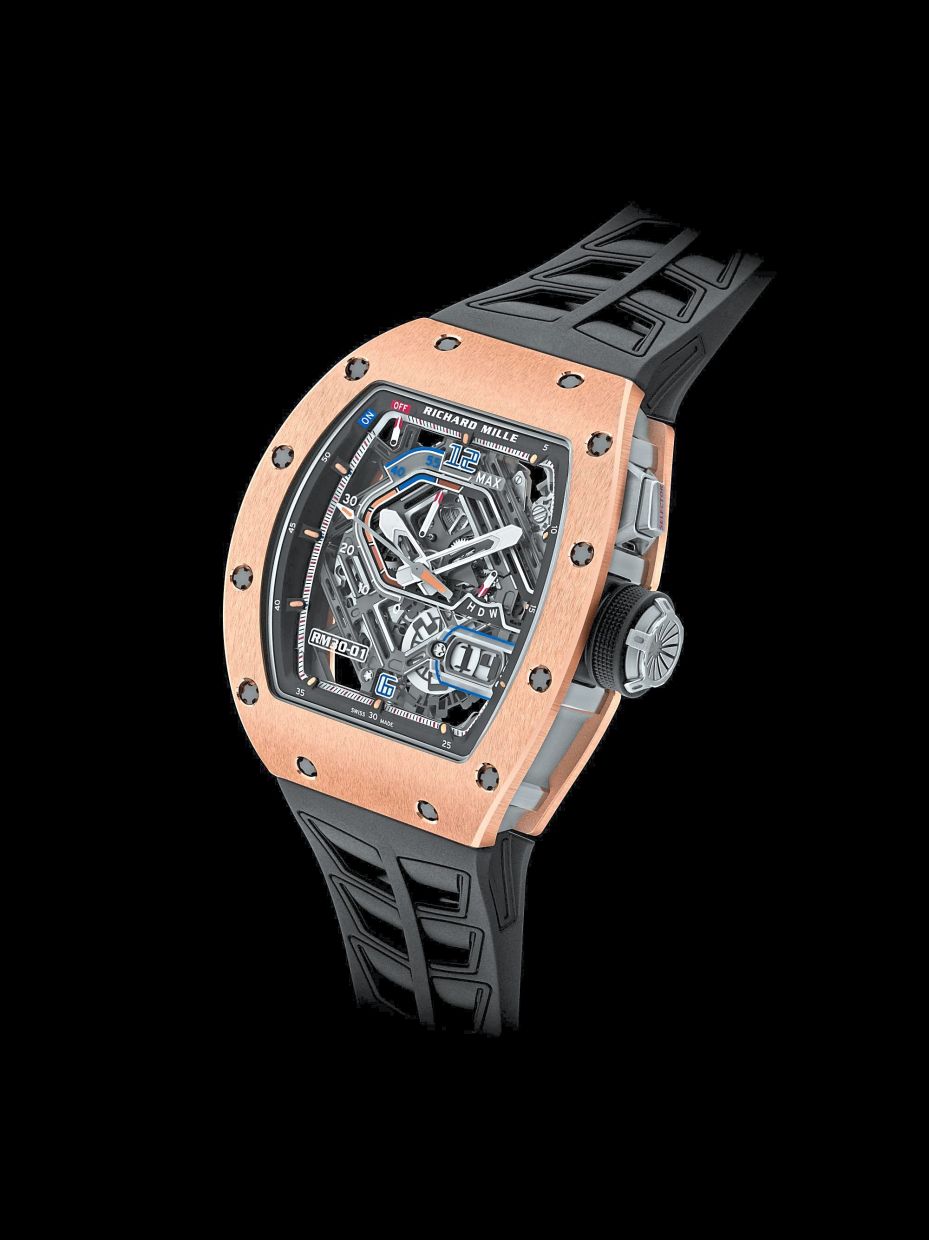
The RMAR2 calibre orchestrates the most essential time information: hours, minutes, seconds and oversized date.
It houses the mechanism’s core technical achievement: a rotor that automatically declutches once the power reserve reaches 55 hours.
This action disconnects the rotor from the winding mechanism, preventing over-winding and ensuring the movement operates when the barrel torque is at its most constant and efficient ratio.
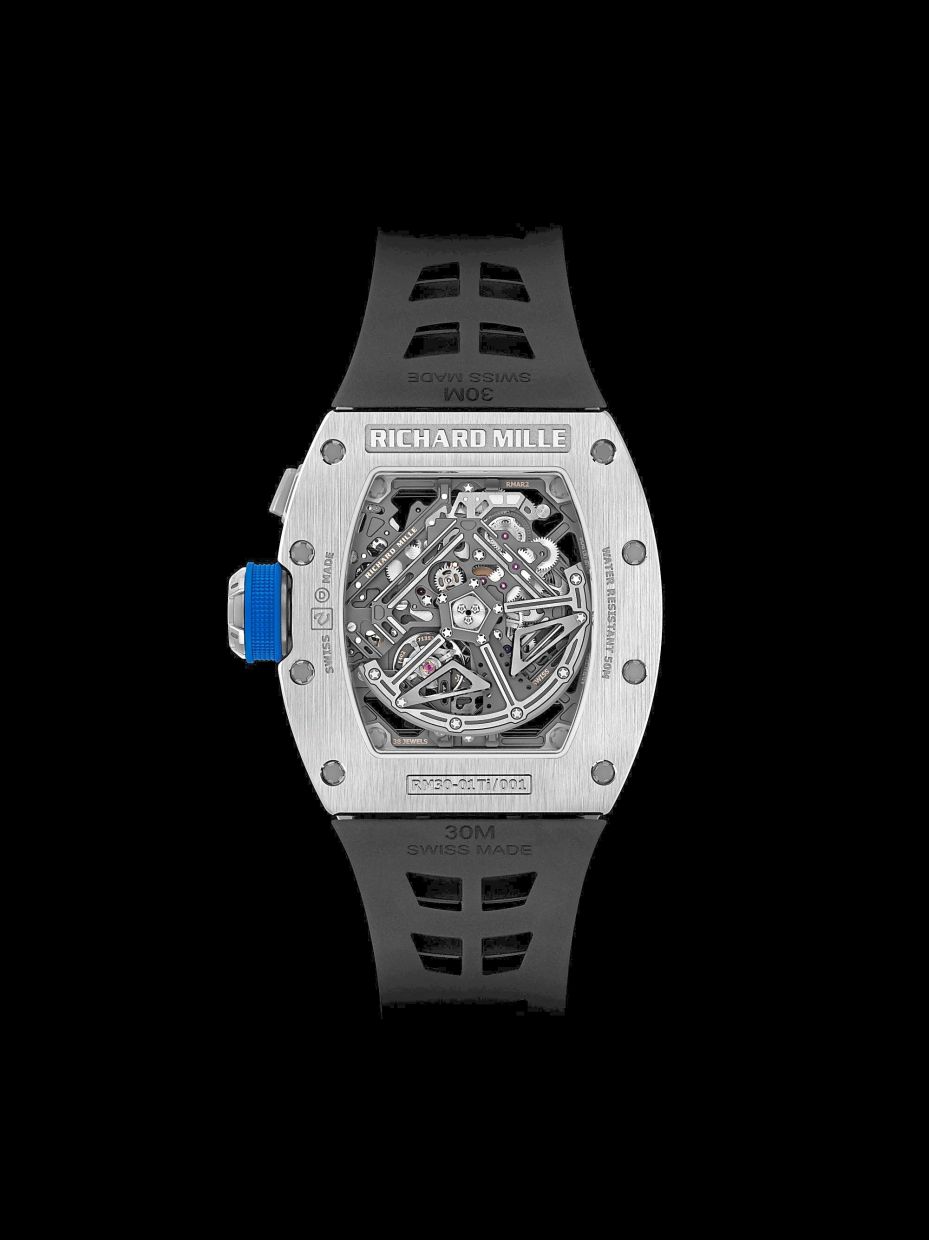
The rotor automatically re-engages when the power reserve drops below the 40-hour threshold, to rewind the barrel spring.
This crucial phase can be observed on the clutch engagement indicator at 11 o’clock, giving the wearer complete visibility into the system’s operation and demonstrating a new level of sophisticated control over the watch’s energy flow.
Beyond the declutchable rotor, the RM 30-01 is engineered for peak performance.

Its baseplate and bridges are crafted from Grade 5 titanium, creating perspective and depth through a reinterpreted skeleton design that uses a diamond-based geometry for dynamic graphic balance.
The watch also features a user-centric function selector, controlled by a pusher at 2 o’clock, which allows the owner to effortlessly switch between winding (W), date correction (D) and hand-setting (H) modes.
This technical tour de force − a harmonious balance of sophisticated mechanics and ergonomic design − firmly establishes the RM 30-01 as the benchmark for high-performance horology.

The tonneau shape evokes a sophisticated past.
Richard Mille has successfully modernised this, rooting it firmly in the 21st century.
The RM 30-01 stays true to Richard Mille’s key values: ergonomics, pure lines and exceptional finishes, marking the latest advancement in the evolution of the RM 030 wristwatch.
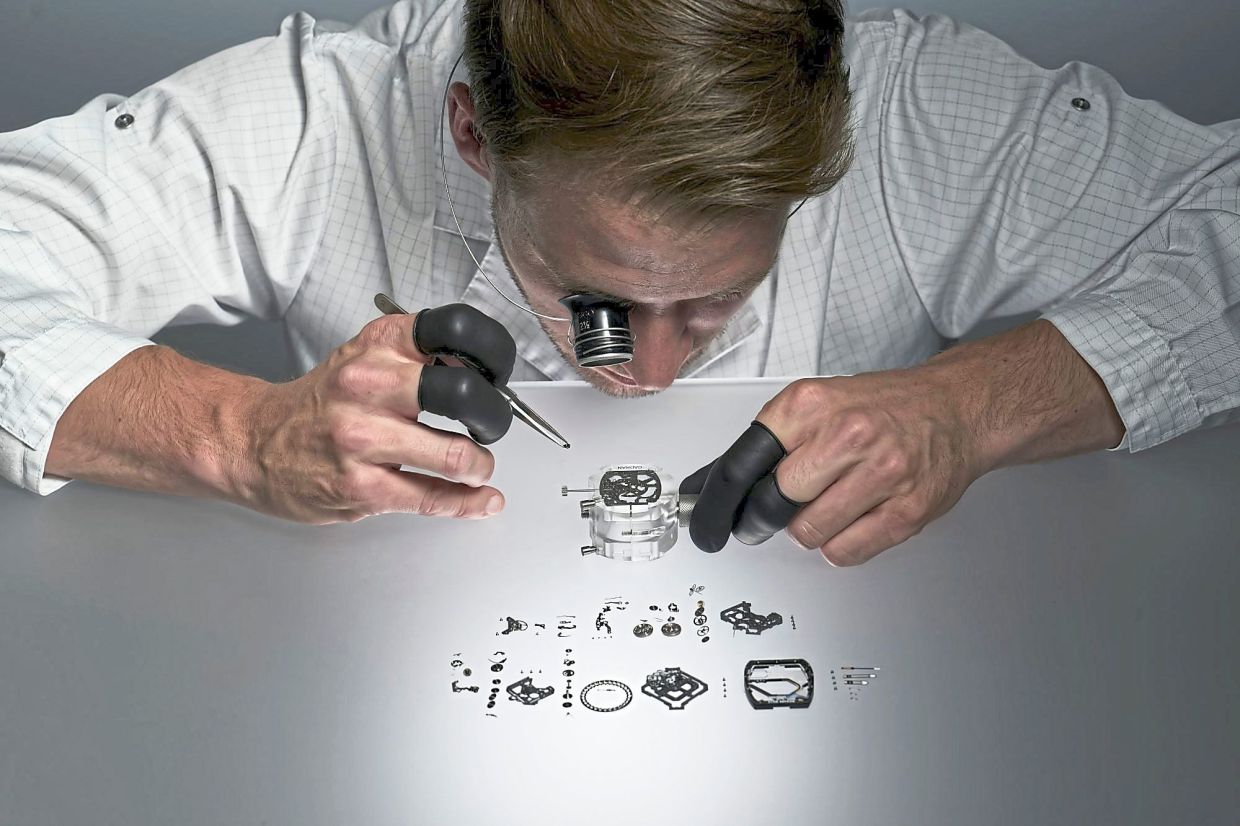
Technical director of watch exteriors Julien Boillat says, “The RM 030 was launched in 2011.
“Given all these accumulated years of experience with the techniques, technologies and expertise we possess internally, we can optimise every aspect of finishing, from the thickness of the edges to the fixing of the strap.”
This is also the opinion of movements technical director Salvador Arbona, who has worked in the same technical department as Boillat for almost 15 years.
“Precisely, we have perfected the RM 030,” says Arbona.
“However, redesigning an earlier model adds an extra layer of difficulty compared to working on an original project.
“We approached this project by asking ourselves: What’s good about it? What could be improved?
“Above all, we had to make sure we didn’t forget anything!
“The slightest adaptation can disrupt an entire timepiece.
“Here, we added a function selector and changed the displays,” he elaborates.
There are many more tests these days before a watch is approved.
This ranges from a 10-year ageing simulation to multiple shock tests – such as the “Nadal” shock test, a demanding test performed internally on the brand’s sports watches – to say nothing of tests for water resistance and the effects of magnetism.
“The whole process represents a year’s work,” says Arbona.
“It is vital that the soundness of the technical proposals made throughout the process, and the different positions of the casing-up and flange screws, are confirmed.
“It’s undoubtedly a lot of work, but it’s the price we pay for the peace of mind and quality required by the brand.
“When a watch leaves our workshops, we know that it can face even the most demanding everyday conditions,” he says.
Boillat says: “Every detail is important, even the surfaces of the components we don’t see.”
“The watch as a whole must be irreproachable,” Arbona rejoins.
“It’s not enough to simply complicate things: there has to be coherence and a certain restraint.
“Working on the RM 30-01 to provide it with an original, uncluttered design was a tricky task.
“It took us right back to the beginning of the Richard Mille story,” he adds.
The RM 30-01 has all the distinguishing characteristics of a Richard Mille watch: ergonomics, an ultra-skeletonised design and a weight that has been reduced as far as possible.
These features are found on the RM 30-01 timepiece, with its dimensions of 42mm x 49.94mm x 17.59mm, and a weight of 96g, including the strap on the titanium version.
Arbona says that with the RM 30-01, everything has been done to simplify its everyday use.
“It is easy to adjust and read off the temporal information it provides, and data related to the calibre’s energy management is smooth too,” he highlights.