Can fashion clean up its woeful environmental record? The industry is trying


By AGENCY
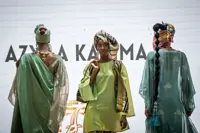
The growing demands for change have generated ingenious responses for fashion to become sustainable. Photo: AFP

From making algae-sequin dresses, dyeing clothes with bacteria to planting trackable pigments in cotton, an emerging tide of technological innovations offers the fashion industry a chance to clean up its woeful environmental record.

Change is urgently needed, since the industry consumes 93 billion cubic metres of water per year, dumps 500,000 tonnes of plastic microfibres into the ocean, and accounts for 10 percent of global carbon emissions, according to the Ellen MacArthur Foundation.

The growing demands for change have generated ingenious responses, such as New York designer Charlotte McCurdy's seaweed raincoat.

Read more: Sportswear gets an ethical revamp, with wood fibre used to fashion shorts

The shimmering algae-plastic she concocted in a lab made for a striking (and carbon-free) garment, even more so when she teamed up with fashion designer Phillip Lim to make a sequin dress.

They are unlikely to show up in department stores. She sees them more as a way to demonstrate that decarbonised clothes are possible.

"I'm not trying to monetise it. I just want to plant a seed," she explained.

"Material development is so slow and it's so hard to compete with cellphone apps for funding. Frankly, I take climate change seriously and I don't have time," said McCurdy, whose focus now is on forming an innovation and outreach hub.

Bacterial colours

Others, like Dutch designers Laura Luchtman and Ilfa Siebenhaar of Living Colour, are finding ways to reduce the toxic chemicals and intensive water consumption of dyeing clothes.

They found an unlikely ally in bacteria. Certain micro-organisms release natural pigments as they multiply, and by deploying them on fabric, they dye clothes in striking colours and patterns.

The research is published freely online and the pair have no interest in mass-production. Luchtman, who previously worked in fast-fashion, saw "up close the negative impact of that industry in terms of exploiting people and ecological problems" and is determined to stay small-scale.

Others, however, hope such ideas can infiltrate big business. Californian start-up Bolt Threads recently teamed with Adidas, Lululemon, Kering and Stella McCartney to build production facilities for Mylo, a leather made from mushroom roots.

McCartney displayed her first Mylo collection in March, and Adidas has promised a Mylo sneaker by the end of the year.

Business imperative

Some experts are sceptical that such initiatives can lead to large-scale transformation.

"Maybe some of these things will get a foothold in the industry, but the bar is very high for new approaches," warns Mark Sumner, a sustainability expert at the University Of Leeds School Of Design.

"It's an incredibly diverse industry with thousands of factories and operators all doing different things. It's not like the car industry where you only have to convince six or seven major companies to try something new."

Sumner sees the biggest impact coming from improving rather than replacing the existing systems and says pressure from consumers and NGOs means this is already happening.

"Among responsible brands and retailers, this has genuinely moved away from being a fad. They are now considering sustainability as a business imperative," he said.

Not that there are any right or wrong answers. The sustainability movement's strength comes from many actors pulling in the same direction.

"Many different strategies need to run together," said Celine Semaan, founder of the Slow Factory Foundation which supports multiple social and environmental justice initiatives around fashion, including McCurdy's algae-sequin dress.

"Technology won't resolve the issues on its own. It needs policy, culture, ethics," Semaan said.

Cotton tracing

One area many see as a priority, however, is transparency, and here technology has a clear role to play.

Such is the complexity of supply chains that "many companies have no idea where their garments are made, where fabrics come from, who provides their raw materials," said Delphine Williot, policy coordinator for Fashion Revolution, a campaign group.

Recent uproar over reports that cotton from China's Xinjiang region was picked by forced labour was compounded by the difficulty of knowing where this cotton ended up.

Beijing denies the allegations. Fibretrace, which won a sustainability award from Drapers magazine this year, offers a possible solution. It implants an indestructible bioluminescent pigment into threads. Any resulting garment can then be scanned like a barcode to find its origins.

Read more: Hemp is becoming the fashionable alternative to conventional fabrics

"You can't find the environmental impact of anything unless you know where it was made," Andrew Olah, Fibretrace's sales director, said.

Combined with data sites like SourceMap and Open Apparel Registry that give companies unprecedented clarity on their supply chains, it has become increasingly hard to plead ignorance.

"When you don't share your supply chain, you either do it because you're hiding something or you're stupid," said Olah. "There's a lot of work to do," he added. "But I'm very optimistic." – AFP Relaxnews

Get 20% OFF The Star Digital Access

Monthly Plan

RM 13.90/month

RM 11.12/month

Billed as RM 11.12 for the 1st month, RM 13.90 thereafter.

Best Value

Annual Plan

RM 12.33/month

RM 9.87/month

Billed as RM 118.40 for the 1st year, RM 148 thereafter.

Follow us on our official WhatsApp channel for breaking news alerts and key updates!
fashion , trends , green fashion , sustainability

Next In Style

Framing fashion: Bibo Aswan, the photographer shaping Malaysia's visual style
Has Taylor Swift’s wedding just outshone the Met Gala in fashion stakes?
Fashion awaits Taylor Swift's bridal look, but here's what the guests wore
The American dream, dressed: A look into 250 years of fashion and aspiration
Why letting go of a wedding dress can be among fashion’s hardest choices
Fashion sees clearly as glasses emerge as the chic accessory of the moment
The bikini at 80: Fashion is still pushing the limits of this swimwear classic
Two shirts, one outfit: Is this fashion’s smartest layering trick yet?
A shirtmaker so extraordinary that a luxury fashion house is buying the brand
Holidaying somewhere hot and humid? Stylists share their fashion essentials

Others Also Read