
A model walks in a blowout fashion show in Santo Domingo, where Oscar De La Renta was born, marking the brand’s 60th birthday. Photo: Instagram/Oscar De La Renta
Ten years ago, Oscar De La Renta, the go-to designer for women seeking fabulous party dresses, was starting to think about throwing a major party of his own: the 50th anniversary of his fashion house. Before the planning could really start, however, De La Renta died.
So it was only fitting that on Dec 17, his dreams were finally realised with a blowout fashion show and celebration in Santo Domingo, the capital of the Dominican Republic, where De La Renta was born, in honour of the brand’s 60th birthday.
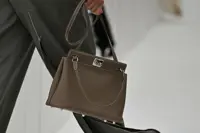
Even by the standards of today’s traveling show circus, in which fashion brands often seem to one-up one another for most exotic locale, this one was striking because it was also personal.
“So much of what informed his fashion life started right there,” said Alex Bolen, the CEO of the house and De La Renta’s stepson-in-law.
More than 500 important clients, retailers, locals, family and friends, including Nicky Hilton Rothschild, Karolina Kurkova and Rebecca Ma (the influencer who posts under the name Becca Bloom and wore Oscar De La Renta for her wedding) all turned out, dressed to sparkle.
They were beaded, befeathered and beflowered, gleaming in silver and gold.
The national government opened up a historic monument – the Fortaleza Ozama, the oldest fort in the Americas, built in 1503 – for the evening, and the Reverendo Padre Gerardo Remirez, the head of administration for the archdiocese of Santo Domingo, allowed the company to close off his road so the guests in their finery could promenade down it to the show.
Read more: Remembering Marina Yee, Antwerp Six designer who helped reshape Belgian fashion
A short film commemorated De La Renta’s life, from his childhood to his time in Paris and the start of his company, as well as the dresses he made for Sarah Jessica Parker, Taylor Swift and Oprah, not to mention almost every first lady since Jackie Kennedy.
The Dominican national symphony played his favourite song, My Way, and then, to the stately strains of Bolero, the show began: a parade of 60 mostly party dresses with hems high, low and everything in between, inspired by the story of the Dominican Republic.
There were day dresses etched with watercolours of the landscape and bubble dresses splashed with hibiscus prints (the hibiscus being the unofficial national flower).
Halter dresses trembling with silk fringe and T-shirt dresses made from a mosaic of gold leather squares and strapless dresses made from hundreds of embroidered flowers that had been cut out and hand-stitched back together. Crocheted slip dresses speckled with pearls and palm-print ball gowns.
All of them were worn with flat sandals, the better to kick up your heels. Every model was Dominican, and many of their parents were in the audience.
Later the crowd sipped champagne in tents designed to resemble De La Renta’s five homes in the Dominican Republic, complete with plush white couches and low wood coffee tables, and otherwise celebrated the allure of a really great dress.
Then the Buena Vista Orchestra took to the stage and all those dresses started to merengue.
“Oscar used to be asked the question, ‘What is your brand about?’” Alex said.
“And he said very simple things like, ‘It’s about a pretty dress or a great memory.’ He never took this stuff very seriously. We are trying to do things to help people to live their lives with a sense of joy and fun and happiness,” he continued.
"I guess that sounds a little frivolous, and perhaps it is a little frivolous, but we are proud of the fact that we’ve kept doing that. Unlike many brands, we have really tried hard not to change.”
The collection was particularly emotional because it was a homecoming of sorts.
“I’ve been crying so much,” said Eliza Reed Bolen, De La Renta’s stepdaughter and an executive vice president at the company. It was also the final show of Fernando Garcia and Laura Kim as creative directors.
The designers, who were trained by De La Renta and had taken over not long after his death with the mandate of preserving the spirit of the founder, were leaving to concentrate on their own label, Monse.
The collection was, Garcia said, their goodbye letter to the house that gave them their careers (Garcia is also from the Dominican Republic, and six of his family members were at the show).
Read more: The man reshaping South Africa's luxury fashion through identity and heritage
And it was a love letter to De La Renta’s signature silhouettes – the bell, the Watteau back, the caftan – and his guiding principle: that clothes should be a tool for, as the film put it, “a life well lived”.
Few US brands have survived 60 years, and even fewer have survived the death of the founders and managed to maintain their positions in the industry, rather than be frittered away in licensing deals, like Bill Blass and Geoffrey Beene.
New designers will be named next year, Alex said. As with Garcia and Kim, they are likely to come from within the house, to preserve continuity.
Just before the show, a pop-up shop was set up in the house De La Renta owned in the colonial city, complete with an internal courtyard with a plunge pool, where, according to the manager, guests had bought pearl-festooned cocktail frocks and long, chiffon gowns with trailing scarves.
The morning after the show, a re-see was held in a nearby hotel, where attendees could check out the runway looks, the better to start compiling their wish lists.
One woman in a floral Oscar De La Renta sundress was busy photographing almost every look on the rails.
“All I see is dresses,” she said, sighing. – ©2025 The New York Times Company
This article originally appeared in The New York Times.