WHILE rescue crews spent nearly two days searching for a five-year-old girl swept out in a rip current off Treasure Island, Laguna Beach Fire Capt Pat Cary spent dozens of hours with the grieving family, acting as their liaison, caring for them and keeping them updated.
A safety officer with 15 years at the department, Cary has had plenty of experience with traumatic events and was well-prepared to relay facts to the media, but said he hasn’t had much experience providing support to grieving families.
“It’s tough; we grieve as well, and we always wish we could’ve done more,” said Cary, the father of two young children. “During those days it was difficult to look out at the ocean because you knew there was a five-year-old out there somewhere.”
As Cary and the other involved first responders – firefighters, lifeguards, park rangers, police, paramedics and dispatchers – went through a debrief period, talking over the details of the call, they were helped by trained peer-support co-workers and a clinician, who encouraged them to share their frustrations, anxieties and feelings.
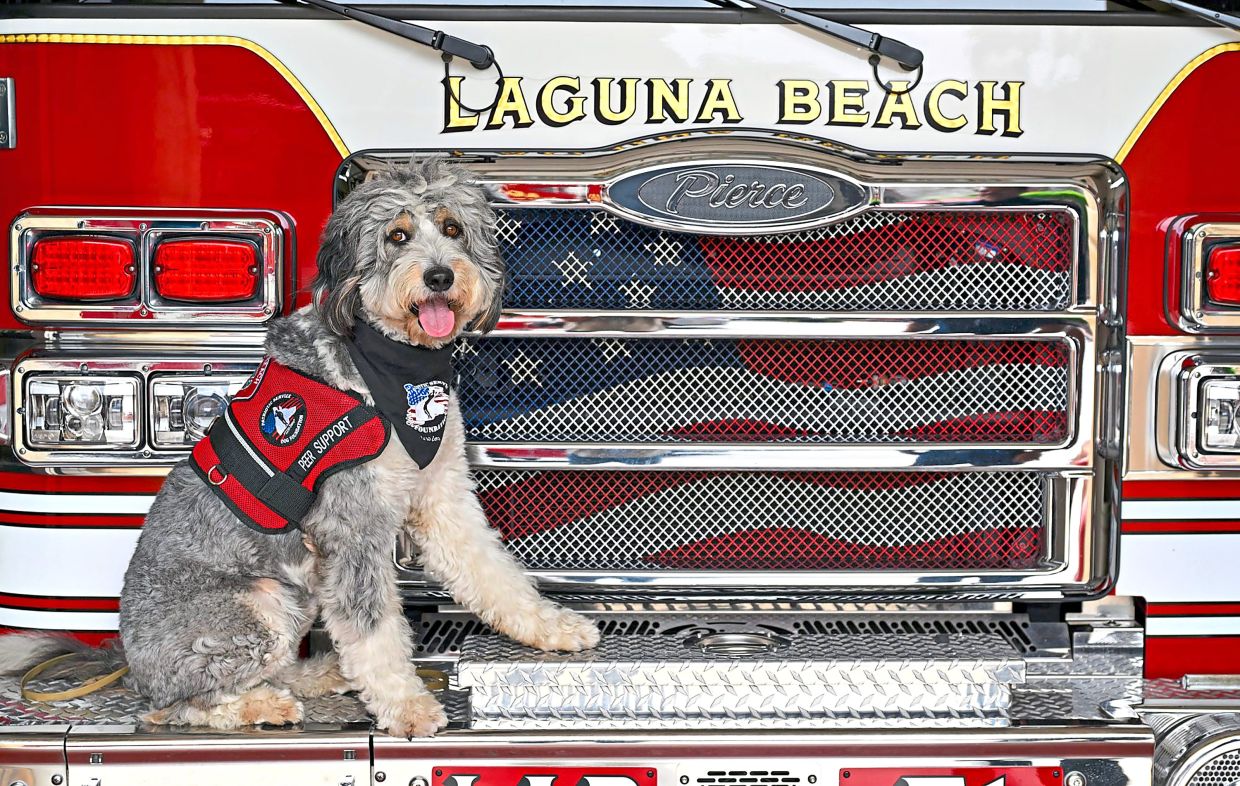
This time, though, there was a new presence, a fluffy Aussiedoodle named Oro.
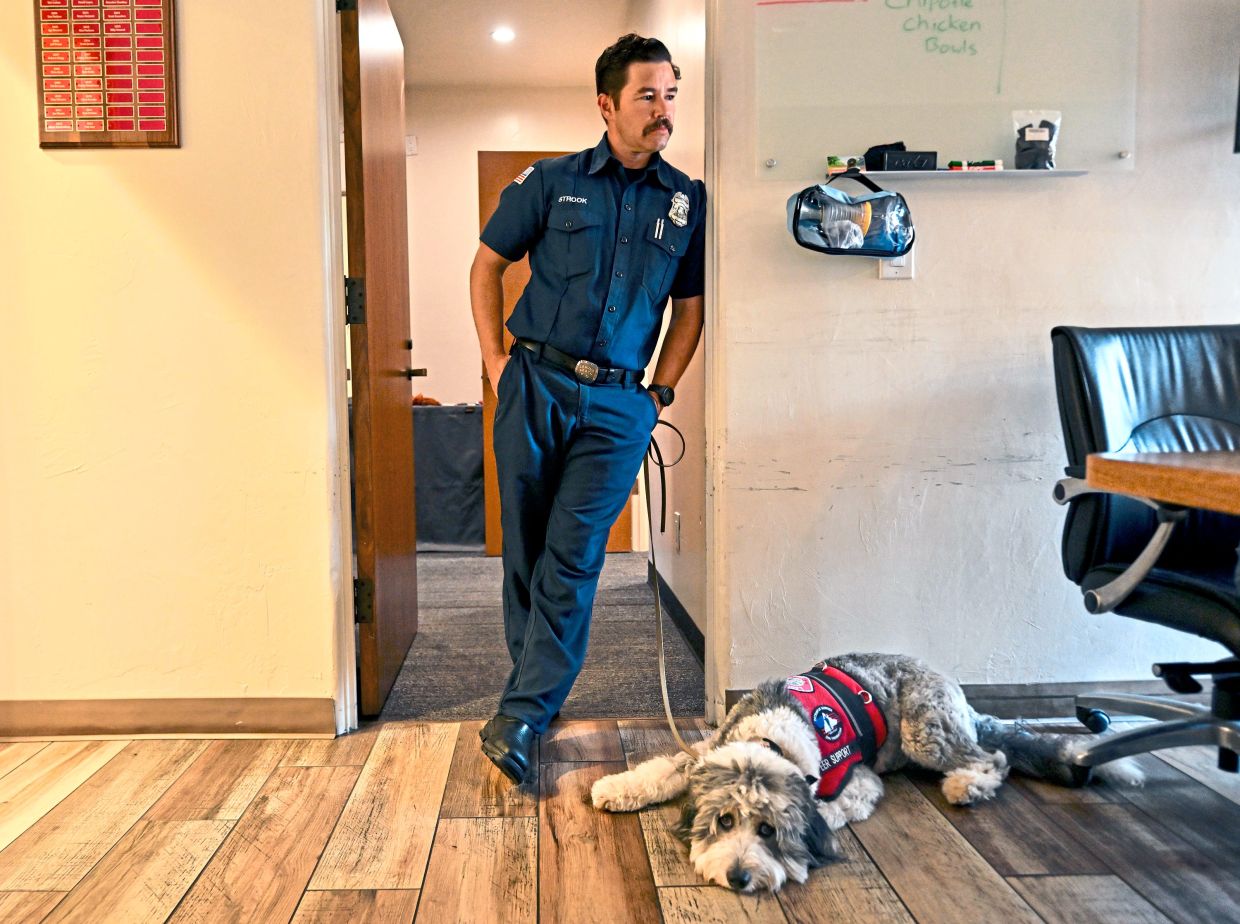
The young dog, dressed in his peer-support vest and handled by firefighter/paramedic Logan Strook, went up to those gathered, brushing against some or sitting next to others. Sometimes he took a position lying at the centre of the room.
His presence, Cary said, brought down the tension, making it easier for the first responders to open up. Part of Oro’s training is to identify high-cortisol levels, an indicator of stress, and then key in on those individuals.
Laguna Beach Fire is one of a few departments in Orange County to bring a Critical Incident Stress K-9 (CISK) aboard.
Dealing with accumulated trauma
The Huntington Beach Fire Department was the county’s first fire service nearly five years ago, when it added Kingman, a chocolate lab/Siberian husky-mix, to its roster.
Kingman is handled by Fire Engineer Kane Johnson, who now helps with regional training for other fire service trauma dogs. He does this at a 2.02ha ranch in Murrieta, operated by the Patriotic Service Dog Foundation, which Tom Tackett, a longtime protection and obedience dog trainer, founded in 2012 to train support dogs for military members and veterans.
Tackett saw a need for the CISK dogs after learning about mental health issues among firefighters who have a career dealing with often unimaginable traumas, he said.
“With the accumulated trauma they see, it wears on them,” he said. “Every day they’re dealing with something that’s really tough to deal with.”
The dogs – 70% are rescues – are trained for a year before being paired with their handlers. From there, the two operate together for about half a year before going on duty.
The stressors faced by firefighters and paramedics over their career can have a cumulative impact on their mental health, researchers from the Psychiatric Association said. The average American experiences three traumatic events over a lifetime, the researchers published in the Diagnostic And Statistical Manual Of Mental Disorders.
Recent data from the International Association of Firefighters said 28% of firefighters are at risk for suicide or suicidal thoughts.
Interaction without judgment
Since having Kingman at Huntington Beach Fire, Johnson, who’s been in the service for 21 years, said he has seen firsthand the effect Kingman has as the “ultimate icebreaker.”
“We tend to be more closed off, less vulnerable and open to talking about things that bring up emotion,” Johnson said of firefighters. Even if people find him approachable, “I’m still not going to be as effective as if I’m holding the leash and have a dog.
“It changes the dynamic and brings a feeling and comfort I can’t bring,” he said. “The dog is not judgmental, and he wants to come up and interact, which brings comfort and helps you down-regulate.”
Johnson said he’s watched as Kingman began creating a safe space for people.
“As people are emoting and processing, I’ll see there’s a comfort there,” Johnson said. “If he’s laid down in the middle of the room, they’ll look at him. And while they’re trying to process, they won’t look at the wall, the ceiling or other people; they’ll look at Kingman because he’s a safe place. He won’t know your secrets or cause you to feel shame, guilt or weakness.”
Johnson said since Kingman has been at the department, he’s seen a marked change among its members.
“I have a lot of stories where it’s undeniable how important it is to have Kingman in there and not just peer supporters or a clinician,” he added.
Having a dog like Kingman or Oro or even embracing the need for peer support is not yet the norm for the fire service, Johnson said, hoping that soon changes.
“There’s still not a ton of buy-in,” he said. “It’s really hard to see that, and the more we can get the word out, the better.”
Tackett said he is presently training hand-selected firefighters and their dogs from 11 different agencies throughout California and from out of state.
“They’re all doing extremely well,” he said.
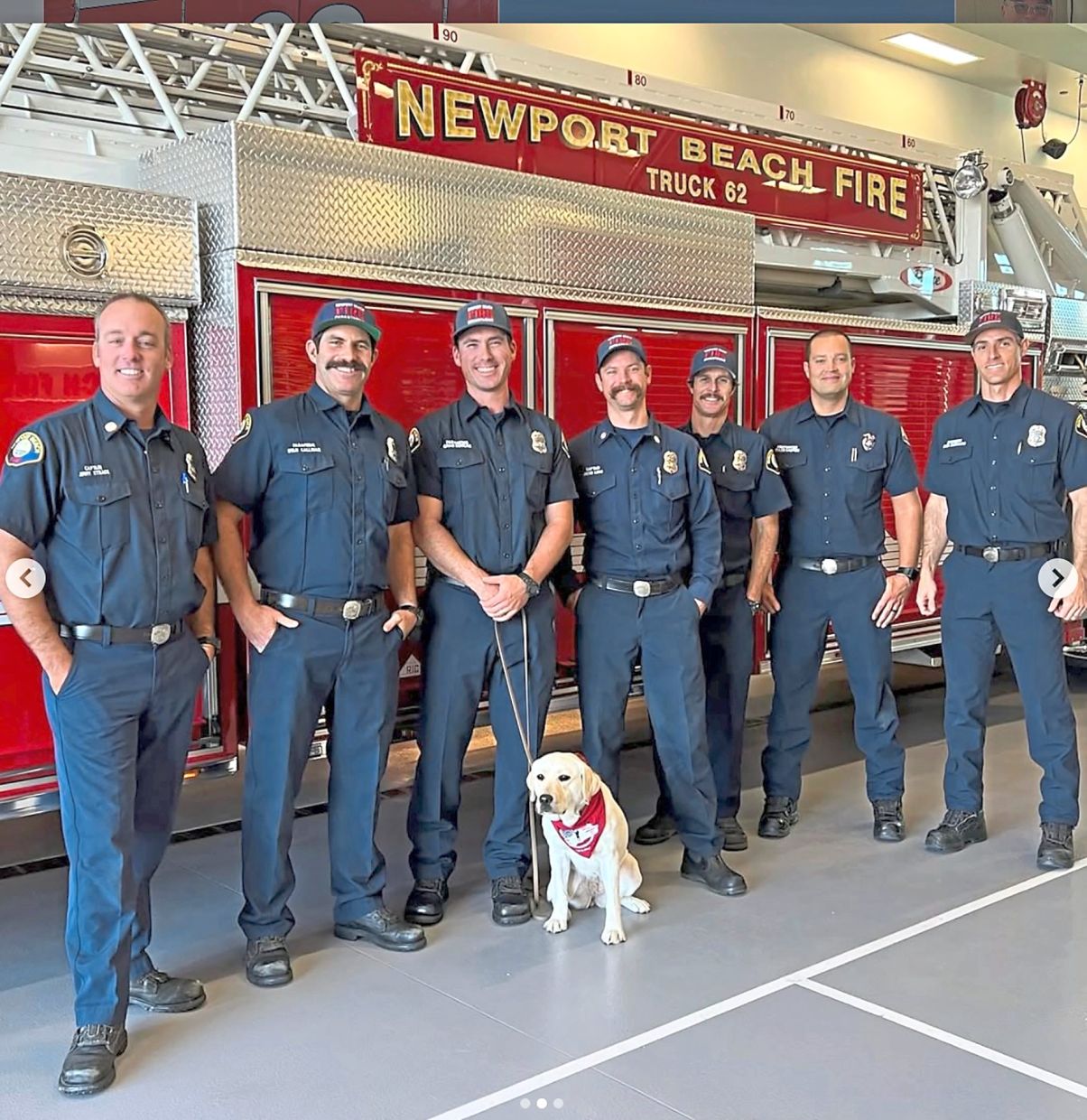
Supporting mental health
Richard Alamo, a captain at the Sacramento Fire Department and head the CISK programme in California said: “Our hope is to use the (state) platform to get nationally incorporated teams,” adding that since the programme began in 2022, peer support teams have reached out to 150,000 first responders.
All of the handlers are already certified as peer support through the International Critical Incident Stress Foundation. Among them is Laguna Beach’s Strook, who was selected through a competitive internal process to become Oro’s handler. The duo is finalising the last part of their required certifications at Tackett’s place.
Strook, who has been at the department for four years, said supporting firefighter mental health is extremely important because of how much first responders are exposed to trauma throughout their careers.
“Our careers are anywhere from 15 to 30 years, and that starts to add up,” he said, adding that he became part of peer support because he values the importance of mental health in the service. “Even though many places have peer support and mental outreach and training, it’s still stigmatised. There are generational gaps and differences, as well as just departmental cultures from one to another. We’re still battling those things of just pushing it down and saying you’re OK till you’re not.”
While Cary and other firefighters benefited from Oro participating in the debrief following the recent drowning of the young girl in Laguna Beach, so did the city’s lifeguards, said Marine Safety Chief Kai Bond.
“It’s great to have an asset that our lifeguards can lean on during incredibly difficult and stressful times,” he said. “He always makes the situations better by his sheer presence, even in the darkest moments. To have that type of power is special.”
To Cary, the dog also signifies a higher level of awareness and care for first responders.
“Yeah, it’s great he runs up to you and wants to give you kisses and wags his tail,” Cary said, “but at the end of the day what he represents with his harness on is that he’s a peer support dog and all of our members realise, we’re going to have bad days and see bad things and it’s OK to reach out and ask for help.” – The Orange County Register/Tribune News Service