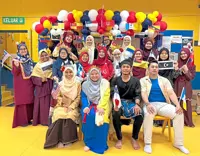
Every year in August and September, the spirit of national pride can be felt across Malaysia.
The Jalur Gemilang is proudly displayed at homes, schools, businesses and on vehicles as a symbol of national pride.
In schools and kindergartens, National Day and Malaysia Day are often celebrated through patriotic songs, parades, competitions and themed outfits.
Beyond being an annual celebration, these activities provide an opportunity to nurture a sense of love and pride for the country from a young age.
However, the Jalur Gemilang is more than just a national flag. Behind it lies a country rich in history, culture and identity.
Each state has its own unique traditions, flora, fauna, traditional clothing and heritage. This diversity is what makes Malaysia special and deserves to be introduced to children from an early age.
With this in mind, our preschool introduced “Discover Malaysia” as the main theme for its 2026 National Day and Malaysia Day celebrations. The idea was to give children an opportunity to discover Malaysia through the unique identities of its states.
While the sub-theme “My Country” is already part of the curriculum for six-year-old children here, a programme like “Discover Malaysia” allows the children to take what they learn in the classroom and experience it in a more meaningful and practical way.
As part of the celebration, each class was assigned a state to discover. The children were introduced to its flag colours, traditional clothing, flora, fauna and other unique features.
Instead of learning about Malaysia only through books and classroom activities, they could see and experience its diversity for themselves.
The approach also gave teachers an opportunity to make learning more creative and meaningful.
Rather than simply presenting facts about a state, teachers helped children connect what they learned with their own experiences.
When the colours, clothing, animals and cultural elements could be seen around them, the lessons became easier to understand and remember.
Parents also became part of the learning experience. They were informed about the state assigned to their child’s class and encouraged to prepare a suitable outfit.
Some used the state’s flag colours, traditional clothing, animal symbols or other elements that reflected its identity.
The preparation was simple, but it created opportunities for conversations at home.
Parents could ask questions such as, “Which state does this flag belong to?” or “What is the state animal?” Simple conversations like these can become meaningful learning experiences beyond the classroom.
The diversity of the states could then be seen through the children’s outfits. For example, the class representing Perak featured its white, yellow and black colours, while Kelantan was represented through its red and white colours, and the kijang, or barking deer.
Sabah highlighted the orangutan, while Sarawak featured the hornbill. Penang showcased the pinang palm, while Melaka incorporated elements reflecting its rich history.
Although each class represented a different state, they shared one message: this is the colourful Malaysia we share.
Through the experience, children did more than learn the names of different states.
They began to understand that every state has its own identity and uniqueness. They learned about flag colours, traditional clothing, flora, fauna and aspects of the history of the state they represented.
More importantly, they began to see that differences in culture, nature and traditions are part of Malaysia’s richness. What they usually encounter through books and classroom activities could now be seen in a more real and meaningful context.
The programme also introduced children to the idea of diversity. They could see that every state has its own colours, culture and identity, yet all are part of the same country.
At a young age, experiences like this can help children understand that differences are not something to avoid, but something to discover, appreciate and celebrate together.
Ultimately, a Merdeka celebration does not have to be limited to flying the national flag, singing patriotic songs or wearing national-themed outfits.
For children, it can also be an opportunity to discover the country through experiences that are close to their everyday lives.
For adults, Malaysia’s diversity may already be familiar. But for a child, a simple experience of discovering a state’s flag, animal, culture or traditional clothing can be the first step towards knowing, appreciating and loving the country.
If we want the next generation to love Malaysia, should we not first give them the opportunity to discover what makes Malaysia unique?