This Malaysian social enterprise builds communities through upcycling projects


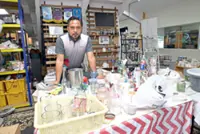
‘Small actions can create a big impact when communities work together,’ says Mohd Faisal. Photos: The Star/Art Chen

So you’ve dropped an empty glass bottle into a recycling bin and walked away feeling like you’ve done your part for the environment.

But have you ever wondered what happens next?

Discarded bottles are processed through a crushing machine (foreground) before being made into decorative items.
While many people assume every bottle is recycled into a new one, the reality is far more complex.

Glass recycling facilities are limited in Malaysia, and transporting used bottles to the few facilities for processing is often costly, making glass a challenging material to recycle.

But instead of seeing discarded bottles as waste, social enterprise Impactlution in Petaling Jaya, Selangor, sees them as an opportunity.

Its community-based upcycling programme, GlazCraft, turns used glass bottles into glass sand, which is then made into concrete products such as planter pots, trays, coasters and holders.

The initiative also creates op­­por­­tunities for women from un­­derserved communities to earn an income while contributing to environmental conservation.

“The project aims to look into the issue of glass recycling and upcycled products from glass waste, while helping underprivileged communities generate income. We hope communities can eventually become independent entrepreneurs,” says co-founder Mohd Faisal Abdur Rani.

Impactlution works with two women’s groups in Selangor – Muslimah Lotus Craft (MLC) in Taman Puchong Prima, Pu­­chong and Persatuan Warisan Kraf Wanita in Kampung Dato Harun, Petaling Jaya.

Since earlier this month, a third community in Iskandar Puteri, Johor, has begun operating its glass recycling programme too.

Cute fox figurines made from crushed glass and cement.

MLC was selected because of its commitment to learning new skills and building a sustainable source of income. They joined Mohd Faisal in 2023.

“When we started the initiative, the women from MLC showed interest and dedication. We have limited funding, so we need to work with communities that are committed before we invest our time and resources in training them,” said Mohd Faisal, who received a RM30,000 seed grant from All-Party Parliamentary Group Malaysia on Sustainable Development Goals (APPGM-SDG) to work with MLC.

The women underwent six months of intensive training before continuing with regular mentoring and monitoring over the following year as they refined their skills and developed products for sale.

Crushed and repurposed

According to Mohd Faisal, empowering communities requires more than just introducing a new craft.

“It takes time to build confidence, improve product quality and help communities understand how to operate as a social enterprise.”

The glass used in the prog­­ramme is collected from the PJ Eco Recycling Plaza at Sungai Way Free Trade Industrial Zone, PJ.

Give your used bottles a second life by sending them for recycling.

However, not every bottle can be immediately recycled. Each one must first be washed thoroughly and have its label removed before it can be processed.

“The cleaning process is tedious. Not everyone wants to remove labels and prepare the bottles properly, but that’s necessary if we want to create quality products.” Mohd Faisals says.

After cleaning, the bottles are fed into a glass crushing machine, which crushes the bottles into different grades.

The finest particles, measuring less than 2mm, become glass sand. Pieces measuring up to 10mm are separated as glass cullets. Larger fragments are fed back into the machine until they reach the required size.

Crushed glass is sorted into different particle sizes, with each grade suited for creating different decorative concrete products.
Over the past three years, approximately 15 tonnes of glass have been processed through the programme at the centre.

The crushed glass then begins its transformation into artisan products.

Glass sand is mixed with either grey or white cement before being poured into specially designed moulds.

The mixture is left to cure for about 24 hours before each piece undergoes quality inspection, finishing work and sealing to improve durability.

The result is a range of handcrafted decorative products that give discarded bottles a new life.

Although the process may appear straightforward, developing it took years of experimentation, Mohd Faisal says.

“The idea for GlazCraft first emerged in 2020. We spent six months researching different techniques through online resources, experimenting with prototypes before producing our first successful products in 2021. We continued refining the process for another year before introducing the techniques to community groups in 2022.”

The programme also addresses a broader challenge facing glass recycling in Malaysia.

Unlike paper, plastic and aluminium, glass has little commercial value.

By processing glass locally and converting it into higher- value products, communities can retain more of that value instead of treating glass as low-worth waste.

Decorative owl figurines are made from recycled glass.

Changing perception

Mohd Faisal says his biggest hurdle is changing public perception about upcycled products.

Many consumers still assume products made from recycled materials should be cheap since they originate from waste.

“People think handmade recycled products should be cheap. They compare them with mass-produced products and sometimes prefer to buy something ‘new’.

“But they’re not paying for the discarded material. They’re paying for the craftsmanship, skills and environmental impact.”

Mohd Faisal is doing his part for a greener community. Photo: Mohd Faisal Abdur Rani

For Impactlution, GlazCraft represents only one part of a much larger mission to promote environmental stewardship through practical education.

The social enterprise works with schools, communities and corporate organisations on programmes centred around circular economy principles and sustainable waste management.

In 2019, Mohd Faisal won the Star Golden Hearts Award (SGHA), an annual community award organised by The Star and Star Media Group to recognise Malaysians who make a positive difference through selfless service.

Before venturing into sustainability, Mohd Faisal worked as a business development manager for a hydrogen technology company in Singapore.

He was diagnosed with brain cancer in 2008 and a decade later, with stomach cancer.

These health events prompted him to reassess his priorities and pursue work that has lasting social and environmental impact.

“My cancer’s return strengthened my resolve. I realised I wanted to create meaningful change through this work.”

Mohd Faisal teaching student volunteers Dhiya Camalia Mahyuddin (left) and Renee Tay (right) how to ecobricks. Photo: Filepic

Among Impactlution’s flagship initiatives is EcoBricks, which teaches participants how to pack clean, dry plastic waste tightly into plastic bottles that can later be used to build benches, garden structures and modular furniture.

Mohd Faisal hopes his work will inspire long-term behavioural change.

His aim is to increase the use of recycled materials, including crushed glass, in community infrastructure and public spaces while building long-term partnerships with organisations seeking meaningful environmental, social and governance (ESG) initiatives.

“We want to show that waste isn’t the end of a product’s life,” says Mohd Faisal, who works with five communities across Malaysia on recycling different materials including plastic, textile and cooking oil.

“With the right knowledge and community, unwanted items can become something valuable again while creating new income streams for people.”


Follow us on our official WhatsApp channel for breaking news alerts and key updates!

Next In Living

Take advantage of okra’s slime to make pillowy scallion pancakes
How these Malaysian crafters turn crushed glass bottles into craft
What would happen if the moon suddenly disappeared?
Building nests is hard – That’s why some birds steal
One pot dishes that are easy to make after work – and tasty, too
The assisted spelling technique: An autism breakthrough, or an illusion?
The Toy Box: Building sets for kids, and a milestone trading card sale
Do you really need to wear sunglasses every time you go outside?
Oystercatchers, known for sharp bills and beady eyes, are making a comeback
A family in India's Nagaland finds alternate ways to cook food

Others Also Read