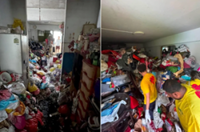
Imagine towering stacks of boxes and heaps of random items competing for space, leaving only a narrow path to walk through the place called home.
The solution may seem obvious: just clean up the mess.
But what many may perceive as a lack of discipline, psychologists say, reflects a complex and often misunderstood mental health condition.
Hoarding refers to a situation where one has an overwhelming need to keep a large number of items and a persistent difficulty to part with them.
It is officially recognised as a disorder in the current edition of the Diagnostic And Statistical Manual Of Mental Disorders (DSM-5) – a guide used by mental health professionals to diagnose mental health conditions.
According to the International OCD Foundation, roughly 2% to 6% of the global population suffers from this.
Soul Mechanics Therapy clinical psychologist Kelly Chan notes that hoarding disorder usually occurs beneath other mental health struggles.
“In my clinical practice, clients rarely come in saying they have this disorder. More often, they seek help for depression, anxiety or overwhelming stress. It’s only when we explore their experiences further that they reveal hoarding behaviours as a coping mechanism.”
However, Chan says that awareness is relatively low in Malaysia.
Sunway University psychology lecturer Dr Hiran Shanake Perera agrees that popular culture has increased exposure to this issue, although research remains limited.
“We still don’t have enough information about it. There are a lot of grey areas, which is why misconceptions continue to exist,” he says.
One of the biggest misconceptions is confusing hoarding with being untidy.
“It’s different from being messy. A messy person can eventually clean up and will feel relieved afterwards. Someone with hoarding disorder experiences significant distress when asked to discard their possessions.”
Hoarding is not collecting, Perera adds, as collectors would intentionally acquire items, organise and even display them proudly.
“With hoarding, the items accumulate to the point where living spaces become compromised and everyday functioning is affected.”
Hard to let go
These explanations resonate with Farah (not her real name), whose mother’s career back then allowed her to spend on a lot of things.
Over the years, those purchases – perfumes, appliances, bedsheets, wooden cabinets, boxes of miscellany – piled up in heaps until they spilled onto the porch.
“There were only small pathways left for us to walk. Almost every room was filled with things, and they’ve now become totally unusable because even the wooden cabinets are rotting,” Farah recalls.

Whenever Farah suggested throwing something away, “she would get angry, saying she bought everything with her own hard-earned money and that the items would be useful one day.”
The disconnect between how others perceive the belongings and how the person views them is a central aspect of hoarding, says Perera.
“For the person going through this condition, the items may hold value even if they appear worthless to everyone else. They may believe they’ll need them one day or they may have an emotional attachment to them,” he explains.
As the space dwindled, life grew harder for Farah. “It affected me physically and emotionally. I got sick quite often and dealt with infections several times,” she says, finding the clutter mentally taxing.
“Every morning when I woke up, I would feel so drained because everywhere I looked, there were just piles of things. It felt suffocating,” she says.
Still, Farah understands what her mother feels, a distinction Chan hopes more people will learn. “Negative labels like lazy, messy or unhygienic will only make it harder for these people to seek help.”
Many of her clients are already painfully aware that their homes have become unmanageable.
“They don’t want to continue living this way and they have tried to stop. The problem is that people often cannot understand their perspective, so these labels become a source of shame,” Chan says.
That shame becomes a barrier, reducing their motivation to seek treatment as they no longer see it as something they deserve help for.
A sense of control
Losing both parents as a teenager left Meera, who requested anonymity, carrying grief that lingered into her adulthood.
Moving back into her family home after her studies, she found everything exactly where it had always been.
“My relatives decided to keep the house as it is so I can return to it when I’m ready. When I moved back in, it never really occurred to me to throw anything away,” she explains.
“I was very attached to the items. If I got rid of all the things, it felt like I was doing something bad – like I didn’t care for their memories anymore.”
Meera’s late mother had accumulated many items over the years too.
Often at work, Meera confined herself to a few rooms, until she began adding to the clutter.
“The moment I started earning a stable income, I began buying things that I didn’t really need. I went through emotional ups and downs which was why I resorted to shopping. Most of them would just pile up in one corner of my room, including the boxes and packages the items came in.”
The house came to reflect two attachments: her parents’ possessions, and items she’d bought to fill her own emotional needs.
“It came to a point where I felt sad looking at my own state of living every time I came home from work. But instead of cleaning it, I just got more demotivated. It turned into a cycle.”
Perera and Chan observe this cycle all the time, linking hoarding behaviours to deeper emotional difficulties.
“For some, the possessions create a sense of safety. For others, they may represent things they have lost or experiences they aren’t ready to let go,” says Perera.
“The items themselves are not always what they’re attached to. It’s what those items represent emotionally.”
Chan adds: “When people experience emotions like being depressed, anxious or traumatised, they often feel like they’ve lost control over their lives. Keeping certain possessions can create that sense of safety and emotional security.”
Gentle communication
Family members sometimes try to clear the clutter in secret while the person is away, believing it will solve the problem. However, experts warn it’s more complicated than that.
“When loved ones throw things away without permission, the house may look cleaner temporarily. But over time, it can actually reinforce the behaviour,” says Chan, adding that it can damage trust and leave the individual feeling less in control.
“When the relationship becomes more strained, they may feel even more lonely, anxious or depressed. Those emotions can drive them to accumulate even more items because it helps them regain a sense of control.”

Regardless of how good the intentions of family members are, clearing a hoarder’s clutter in secret can be harmful.
Instead of starting with the clutter, Perera and Chan encourage families to start with communication.
“Try to understand why they’re holding on to those things. For example, if it’s because they’re worried about running out of something, reassure them that they’ll be able to replace it if needed.
“Once you understand the reason, you can respond to the emotion instead of just the behaviour,” Chan explains.
For Farah, that lesson took years to sink in while running her own food business.
There were times when she pleaded with her mother to discard the items, only to be met with refusal.
All this time, she carefully prepared every order in an area of the house kept clean.
One day, a customer collecting an order left a negative review. It was more about the condition of the house rather than the food.
“That was the final straw for me. I talked to my mother about it and cried as I explained how it was affecting my livelihood as well.”
Her mother began acknowledging the impact and agreed to let go of items slowly. Earlier this year, Farah began clearing and deep-cleaned the house.
Even now, her mother sometimes asks about an item already discarded.
“Her memory is getting weaker now, so I’ll explain gently that it no longer served any purpose and that we threw it away,” she says.
“I still feel guilty sometimes because I know those things meant something to her. But I also had to prioritise our health and safety in the house.”
Less judgment, more empathy
Meera’s recovery began with her aunt, who could no longer ignore how hard the house was to live in.
Around the same time, friends introduced her to the idea that it might be more than just “being unable to clean up”.
“I didn’t know anything about hoarding back then. But after reading about it, I realised I might have been dealing with it too. That was a wake-up call for me.”
Over a week, her aunt and relatives helped sort through the house, keeping only sentimental items and discarding the rest.
“It’s such a big difference now. I’ve lived in this house almost my whole life, but I’ve never seen it look like this before,” she remarks.
Though she’s in a much healthier place today, Meera admits the urge to hold onto things still resurfaces.
“I still catch myself thinking, ‘Maybe I’ll need this one day’,” she says, smiling and shaking her head.
“But I’m more aware of it now. I stop and ask myself whether I’m keeping it because I truly need it, or because I associate something emotional with it and am afraid to let it go.”
Perera says small steps are better than drastic interventions. “Start with one small area first, one thing at a time. It’s important to keep communicating with the individual, explaining how you’re prioritising their safety.”
If it persists, a common approach is cognitive behavioural therapy (CBT) to build healthier thinking patterns and coping strategies.
Farah and Meera hope their life stories can encourage others to empathise with those living with this disorder. “This is something difficult to understand until you’ve had experience living with a loved one who has this condition,” Farah says.
“I hope the larger society will have more compassion and take a moment to step back and remind themselves that there might be more to hoarding than meets the eye.”