Old terrace houses in established neighbourhoods are always sought after, not just for their locations, but also their transformation potential.
In the case of a conventional terrace house in a Kuala Lumpur neighbourhood, the owners sought the services of architect Fabian Tan to remodel their double-storey house to make it more liveable.
Typical intermediate link houses are usually dark in the centre, if no skylight or air-well is built in.

The house is owned by a young couple that was about to start a family when Tan was commissioned for the job. The brief from the clients was to create a space of calm and a simple lifestyle.
To achieve this, the architect went about creating the illusion of having more space, while letting in more air and light.
For this project that he nicknamed Ottiqa House, Tan embraced the concept of “extensions”, though this is not necessarily as straightforward as adding more gross floor area.
By relooking at the very definition of extension, he came up with an overall scheme of extending architecture through the creation of volume, voids and openings.
Tasteful additions
The formerly unassuming house frontage took on a bold T-shape form that incorporates the car porch roof and entrance foyer, while still leaving enough space for two cars to be parked.
Upon entering from a side entrance door, visitors as well as residents will navigate through a central cloister that takes them through the garden courtyard before they enter the living hall.
ALSO READ: Malaysian terrace houses transformed into homes that embrace nature
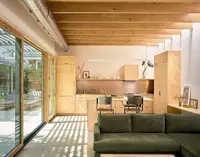
Featuring split levels, the living room is elevated above the kitchen and dining areas.
Playing on “extension”, Tan introduced a series of structures that has lines leading both horizontally and vertically, directing the eyes towards the sky, especially when one stands to admire the tree in the courtyard.
Trees are also introduced elsewhere in the house, with the perforation of the greenery through the house not only softening the space, but also heightening the heavy contrast of lines within.
The wall at the front of the house was completed removed, replaced with sliding glass doors that let light in while providing a generous view of the courtyard.
However, security is completely assured even when the sliding glass doors are fully opened, as there is an unobtrusive grille fixed at the perimeter of the courtyard garden.
ALSO READ: Malaysian couple creates serene, plant-filled home to deal with pandemic anxiety
With security and good cross ventilation assured, the ground floor has been transformed into open living spaces that make the house so much more liveable.
A central void area was also created to connect all the floors through natural light and ventilation, with this advantage extending to the bedrooms on the first floor.
No room was added nor removed, and the major work for the first floor involved relocating the bathroom. The original staircase, made of a steel frame that supported planks, was replaced by a sturdy concrete-based stairway accentuated with timber steps.
The higher areas of the house received a very tasteful addition in the form of a newly-built loft that now serves as a study.
The new loft study sits on a former water tank slab, and is accessed through a small spiral staircase. From here, another flight of stairs leads to the open roof deck, which is the most interesting aspect of the house, contributing to a final built-up area of 2,200sq ft (204sq m).
ALSO READ: 5 ways to create your own cosy nooks at home
With an accessible roof, the occupants and guests can enjoy a commanding view of the city skyline as they chill or relax on the flat concrete platform that doubles up as a seating or lounging area.
Complete with a small pool, the space makes for a perfect, private staycation. The addition to the rooftop is cleverly done, as the “extension” is not apparent from the ground level as the original contours of the roof are maintained.
“The transformed home reflects how it may not be necessary to change or alter an idea for concepts to be fresh and new. Perhaps its boundaries just need to be ‘extended’, ” said Tan of the home that took more than a year to renovate.
Already a subscriber? Log in
Get 20% OFF The Star Digital Access
Cancel anytime. Ad-free. Unlimited access with perks.